HCMC strives to save its heritage from urbanization impact

Ho Chi Minh City (known as Saigon until 1976, after Vietnam’s reunification) has long had a reputation for being cosmopolitan.
hcmc strives to save its heritage from urbanization impact hinh 0
Notre Dame Cathedral in Ho Chi Minh City. (Photo: internet)

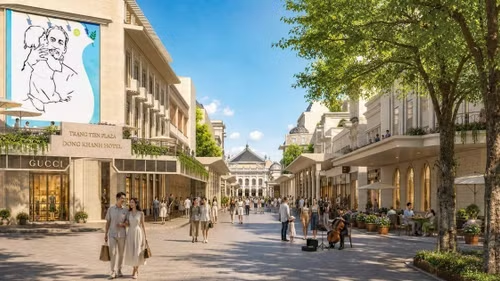
This week’s Culture shines a spotlight on how the city is struggling to protect its 300-year architectural heritage in the face of strong economic development and rapid urban renewal.

Ho Chi Minh City has 172 historical relics but only 40 of them are promoted as tourist attractions. The 10 must-see landmarks in the city include Notre Dame Cathedral, the Central Post Office, Ben Thanh market, and the municipal People’s Committee offices.

A story in late 2018 on preserving Thuong Tho Palace rang the alarm on the urgency of developing a heritage master plan as part of Ho Chi Minh City’s urban development strategy to ensure conservation of its architectural heritage. Built in the 1860s to serve as Cochinchina's Home Office, the Thuong Tho Palace at 59-61 Ly Tu Trong Street, District 1 is today the headquarters of the Ho Chi Minh City’s Department of Information and Communications and Department of Industry and Trade.

HCM City has 3,000 historical houses and villas that should be preserved, but are likely to be demolished. 1,300 of those houses were built before 1975 and many of them are privately owned, leading to difficulties in preservation. Archaeologist Nguyen Thi Hau, secretary general of the HCM City History Science Association, said the city needs a master plan to balance urbanization and preservation of the city’s remaining heritage. 

“The government, property developers, researchers, and the community all have a role in preserving the city’s architectural heritage. The municipal authorities need to complete urban planning, strengthen existing regulations, and create new laws on preserving heritages,” said Hau. 

Tran Van Khai of HCM City University of Architecture says most people are unaware of the economic value of architectural heritage, which is the key to the current problem. 

"The government can do a lot for this effort by adjusting land use planning, investment in infrastructure at the grassroots level, and tax policies. Government policies should support people who own heritages by finding ways for them to earn good money from their heritages," said Khai.

Cao Thanh Nghiep, a member of the Ho Chi Minh City Architecture Association, said architectural heritage must be credited for its potential economic value. In many countries, historic buildings are preserved for aesthetic reasons as well as for the huge economic benefits they offer.

"Once preservation work is done properly in the central areas, urban planning of nearby districts will also be well taken care of. The city should make a list of buildings in dire need of preservation without waiting for them to be listed as national heritages," said Nghiep. 

Truong Kim Quan, Director of Ho Chi Minh City’s Monuments Conservation Center, said "Buildings surrounding architectural heritages should play a supporting economic role as they will benefit a lot from the heritages."

Poor preservation of historic heritages could reduce the number of cultural tourists who otherwise would stay longer, take part in more cultural activities, and spend more money. Experts say that many people are not aware that when they destroy heritage buildings they are in fact losing a potential economic value.

VOV

Other News

Vietnam secure berth at FIFA U17 World Cup 2026 for first time

Vietnam secure berth at FIFA U17 World Cup 2026 for first time

Vietnam national U17 football team secured a place at the FIFA U17 World Cup 2026 for the first time after defeating United Arab Emirates national U17 football team 3-2 on in the final Group C match of the AFC U17 Asian Cup 2026 in Saudi Arabia on early May 14 (Vietnam time).

Vietnam’s most beautiful railway station twins with French counterpart

Vietnam’s most beautiful railway station twins with French counterpart

A twinning agreement between Da Lat Railway Station in Vietnam and Trouville-Deauville Railway Station in France was signed at the French Embassy in Vietnam on May 7, creating new opportunities for cooperation in station management and operations, as well as cultural and tourism promotion between the two sides.

Hanoi gains two more craft villages in World Crafts Cities network

Hanoi gains two more craft villages in World Crafts Cities network

The recognition of Chuyen My and Son Dong craft villages as members of the World Crafts Cities network represents international acknowledgement of the cultural value, artisanal techniques, creativity and sustainable vitality of Vietnam’s traditional craft villages, he said.

Thang Long - Hanoi Festival 2026 to return in September

Thang Long - Hanoi Festival 2026 to return in September

Co-hosted by the municipal People’s Committee, the Department of Culture and Sports, and domestic and foreign agencies, the whole spectacle is meant to honour the city’s millennia-old heritage while reafffirming its strategy of establishing culture as a development engine.

Spreading Vietnamese cultural identity in digital space

Spreading Vietnamese cultural identity in digital space

In the context of deep international integration, cultural identity serves as both a “shield” against assimilation and a defining marker of a nation’s image. Protecting and promoting uniquely Vietnamese cultural values has therefore become a pressing task, particularly in an increasingly complex digital environment.

ITE HCMC 2026 to promote Vietnam’s tourism on global map

ITE HCMC 2026 to promote Vietnam’s tourism on global map

With its large scale, the ITE HCMC 2026 aims to promote tourism cooperation between Vietnam and priority markets such as Northeast Asia, Western Europe, North America, Southeast Asia, and Oceania while also boosting visitor arrivals from the Indian market

Vietnamese puppetry seeks renewal amid preservation challenges

Vietnamese puppetry seeks renewal amid preservation challenges

Although widely regarded as a cultural “speciality” attracting tourists, Vietnamese puppetry is facing multiple challenges in preservation and development, requiring renewed efforts to both safeguard its identity and adapt to contemporary cultural currents.

Project on digital transformation in cultural sector approved

Project on digital transformation in cultural sector approved

By 2030, the project targets the establishment of shared digital platforms across 100% of cultural sectors. All digitised cultural heritage will be standardised under the national data framework and shared in accordance with regulations, while 80% of public digital heritage assets are expected to receive digital identifiers to clarify ownership and management, encouraging organisations and individuals to do the same and support market development.

Vietnam eyes becoming region’s leading tourism destination

Vietnam eyes becoming region’s leading tourism destination

Vietnam has in recent years undergone a notable transformation in its tourism development strategy, placing a strong emphasis on nature-based and eco-tourism. This shift is not merely aligned with global trends, but represents a necessary step towards safeguarding valuable natural resources, while appealing to a growing segment of environmentally conscious travellers.