 |
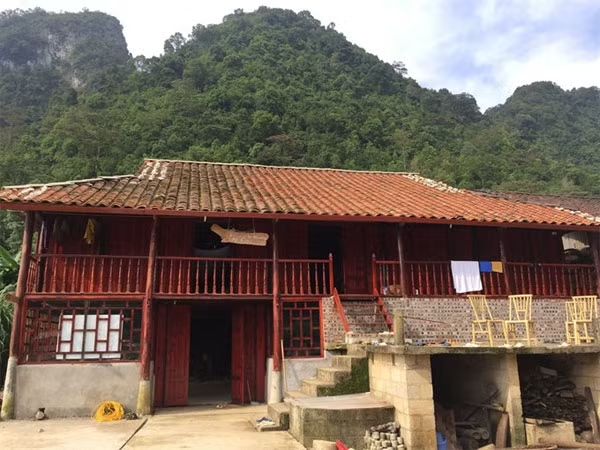
| Homestay of Hoang Ngoc Kim in Phia Thap Village, Cao Bang Province |
Nung people live in stilt houses right next to their fields with domestic cattle being raised in the shade under the house.
Hoang Ngoc Kim’s home stands out. Outside the newly-repaired house constructed from brightly-polished wood hangs a small sign reading “Welcome to Homestay Mr Kim”.
The traditional structure of Kim’s stilt house is still preserved. The house’s first floor, which used to be a cattle holding area, has been extended to make a cozy living room with wooden tables and chairs.
The well-organised second floor is where tourists can sleep, providing more than 20 mattresses and eco-friendly decoration. Each mattress is well prepared with a pillow, a mosquito net, a lamp and an electricity socket.
Kim is the only one in the village with a homestay facility. Community-based tourism (CBT) projects aided by the Centre for Rural Economy Development (CRED) have been implemented in the northern mountain provinces of Ha Giang and Cao Bang, where ethnic minorities face many disadvantages. The model aims to create sustainable income sources and employment opportunities for ethnic minority communities, improve their sanitation and natural environment, and preserve traditional cultural identities.
Everyone gets involved
Kim was excited to talk about his first trip to the tourist mecca of Sa Pa in Lao Cai Province and Hoa Binh Province last year to learn about the homestay model.
“After the trip, I came back home and started to repair my house last November. Two months ago, we welcomed the first tourists. The most important thing is this is a community-based tourism project so every member of our community can get involved,” he said.
The CBT project not only brings jobs to homestay owners like Kim, but also offers other services for tourists. The more services, the more jobs it provides.
Just finishing a nearly 10km trek as a local tour guide, 20-year-old Thanh Mao was more than happy to receive positive feedback from his tourists. This was his first time as a guide after a training course for the Phia Thap villagers.
Several months ago, the project chose six residents to participate in the training and Mao was lucky to be one of them. The young boy used to stay home to help his parents with farming. Now his daily job is to guide tourists on local trekking routes, with which he is familiar.
“My limit is now English so I will try to learn English to be able to help foreign tourists more,” he said.
Besides homestay and tour guide service, residents have set up a fleet of xe om (motorbike taxi) and group of porters to help trekkers.
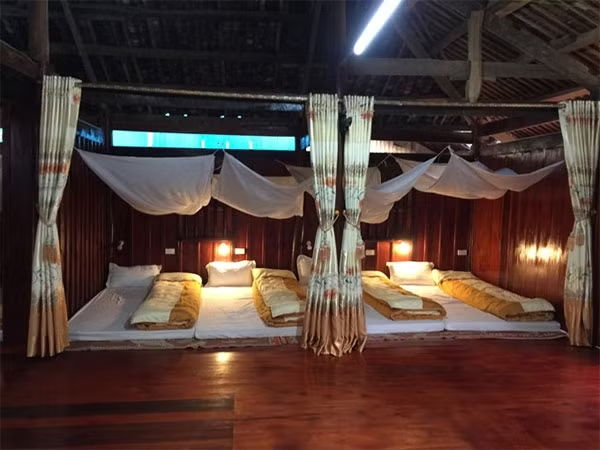 |
| Well-organised beds on the homestay’s second floor. — Photos: Khanh Duong/VNS |
Community empowerment
Phia Thap Village is located on the trekking route offered by the Cao Bang local authority.
Cao Dai Hung, the project manager, says tourists on the trek can rest at traditional craft villages on the way, such as the Pac Rang blacksmith village, Lung Rì tile-making village, or relax at the homestay in Phia Thap Village, which is well known for its incense making tradition. They can observe how the locals make various items and even learn how to make crafts.
“We want to maximise social opportunities for local people. We target to provide them with direct earning opportunities from homestays and tour guiding, and indirect income from planting and breeding to supply food for tourists. "When tourists come to visit the villages, they also buy products. It is indirect profit,” he added.
The CBT also sets up local funds managed by the community, which decides its capital rate, following a management guidebook, contributing to community empowerment and involvement.
"We provided VND400 million (US$17,400) to the fund. Kim’s family was the first one to borrow from the fund. In five years, after his family pays off the loans, this money will be rotated for lending to other families to build homestays. That is all about the project’s sustainability," he said.
Moving the cattle
Besides income benefits, environmental protection and cultural preservation are also a focus of the projects.
“As a homestay owner, I am always aware of protecting the environment. To protect the village’s environment, we asked for sponsorship of the local authority to provide wastebaskets for each house,” Kim said.
Hung says one of the biggest difficulties encountered by such projects is to build local residents’ capacity to operate, manage and develop a tourism model in a sustainable way. "It took us two to three months to change their awareness about moving domestic cattle out of their houses. Raising cattle under the stilt houses and always keeping animals is an ingrained habit of ethnic communities because buffalos, pigs, cows are the most precious treasures of farmers. We have to persuade them to understand why they have to change, and what benefits they will enjoy,” he said.
So far ten households in Phia Thap Village moved their buffalo cages far from their living area. This year, the authority targets to move another ten.
Potential wonderland
Cao Bang Province, located nearly 300km to the northeast of the capital city, is home to well-known destinations such as the Ban Gioc Waterfall, listed among the world’s top 10 significant waterfalls, the Pac Bo Historical Site and the Non Nuoc Cao Bang Geopark. Cao Bang has been chosen as one of five adventure tourism spots in Southeast Asia.
Given the potential, tourism has been identified as one of six key areas for socio-economic development.
Truong The Vinh, deputy director of the provincial Department of Culture, Sports and Tourism, told Viet Nam News that the province will review and list intangible cultural heritages of ethnic groups this year, and has promoted the implementation of cultural development and preservation programme.
In the small wooden house lit by warm oven fire, Kim, his wife, his son and daughter-in-law are still hastily preparing dinner to welcome a new batch of tourists that evening. Each of them wishes their lives and their neighbours’ livelihoods would be better.
“Turning the age of 60, my wife and me are no longer able to do hard work on the farm. I hope to receive more tourists regularly and pass on my homestay experience to other villagers,” Kim said.