Hue celebrates UNESCO recognition

The People’s Committee of the central province of Thua Thien-Hue organised a ceremony on June 17 evening at Ngọ Mon Square in Hue city to celebrate the UNESCO recognition of the Complex of Hue Monuments and nha nhac (royal court music).

Hue celebrates UNESCO recognition -0
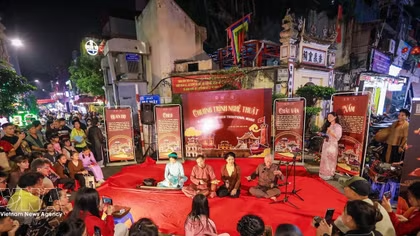
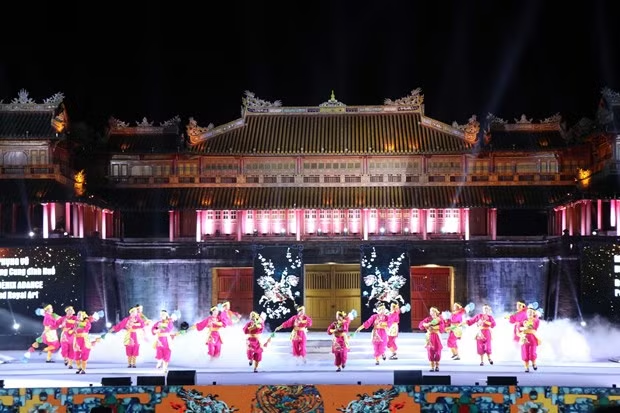
An art performance at the event. (Photo: VNA)

The People’s Committee of the central province of Thua Thien-Hue organised a ceremony on June 17 evening at Ngọ Mon Square in Hue city to celebrate the UNESCO recognition of the Complex of Hue Monuments and nha nhac (royal court music).

The Complex of Hue Monuments was recognised as a World Cultural Heritage on December 11, 1993, and the royal court music won the recognition on November 7, 2003.

Prominent among the guests were Politburo member, President of the Ho Chi Minh National Academy of Politics and Chairman of the Central Theory Council Nguyen Xuan Thang, Deputy Prime Minister Tran Luu Quang, and representatives of UNESCO and other international organisations in Vietnam.

In his remarks, Thang noted that the recognition has paved way for Vietnamese cultural heritages to gradually integrate into the region and the world.

The Hue culture is special, he said, stressing that Thua Thien-Hue is the only province in Vietnam and Southeast Asia to be home to five UNESCO-recognised cultural heritages. They are the Complex of Hue Monuments (1993-tangible heritage), nha nhac (2003-intangible heritage), woodblocks of Nguyen Dynasty (2009-documentary heritage), documents of Nguyen Dynasty (2014-documentary heritage), and royal literature on Hue Royal Architecture (2016-documentary heritage).
Such cultural heritages have served as a great impulse for the local socio-economic development, as well as a special cultural diplomatic channel, helping promote the friendship and mutual understanding between Vietnam and international friends, Thang said.

The official asked Thua Thien-Hue to continue raising public awareness of the role and position of culture, and preserving and upholding heritage values in the ancient capital city of Hue.

Hue has been hailed by UNESCO as the leading Vietnamese locality in terms of heritage preservation, which turned it into a model centre for technological heritage transfer in the Asia-Pacific region, according to the municipal Department of Culture and Sports.

Over the past few years, around 170 works of different sizes have been restored – most notably Ngo Mon, Thai Hoa Palace, Hien Lam Cac and Duyet Thi Duong as well as the royal tombs of Kings Gia Long, Dong Khanh, Thieu Tri, and Tu Duc, among others.

The complex was recognised as World Heritage by UNESCO in 1993. It is the 410th heritage inscribed onto UNESCO's list and the first world cultural heritage in Vietnam.

Nha nhac refers to a broad range of musical and dance styles performed at the Vietnamese royal court from the fifteenth to the mid-twentieth century. It was generally featured at the opening and closing of ceremonies associated with anniversaries, religious holidays, coronations, funerals and official receptions.

Among the numerous musical genres that developed in Vietnam, only nha nhac can claim a nationwide scope and strong links with the traditions of other East Asian countries, according to UNESCO.

“Vietnam royal court music has the meaning of ‘refined music’. Among various kinds of music developed in Vietnam, only nha nhac is considered the national music”, according to the UNESCO Council’s evaluation.
VNA

Other News

Ta Xua named Asia's leading emerging tourism destination 2026

Ta Xua named Asia's leading emerging tourism destination 2026

In recent years, Ta Xua, dubbed "the paradise of clouds", has emerged as one of the mountainous destinations attracting strong interest from young travellers, particularly for its spectacular sea of clouds stretching across the mountains in the northwestern region.

Digital transformation key to preserving, promoting ethnic cultural values

Digital transformation key to preserving, promoting ethnic cultural values

Training local young people in filming, audio recording, digital storytelling, data preservation and responsible use of AI can help build a new generation of cultural custodians. This, in turn, can help transform cultural heritage into a resource for economic development while contributing to the country’s broader development.

Indigenous culture becomes tourism asset in northern highlands

Indigenous culture becomes tourism asset in northern highlands

With growing recognition of indigenous knowledge, customs and cultural values as unique assets, ethnic communities in the northern mountainous region are shifting from simply providing tourism services to becoming creators and owners of tourism products, confidently telling their own cultural stories

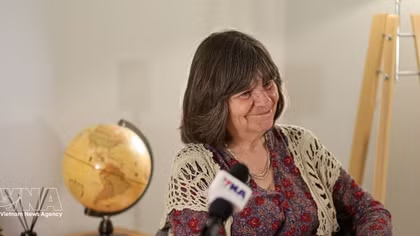
UNESCO ready to work with Vietnam to implement International Decade of Culture for Sustainable Development initiative: Representative

UNESCO ready to work with Vietnam to implement International Decade of Culture for Sustainable Development initiative: Representative

Jonathan Wallace Baker, UNESCO Representative to Vietnam, noted that the official proclamation of the 2027–2036 period as the "International Decade of Culture for Sustainable Development" comes at a particularly important moment. As the international community works to accelerate progress towards the 2030 Agenda while beginning to consider what comes after 2030, the Decade provides a ten-year framework to strengthen the place of culture in development.

Traditional culture finds new life in contemporary Vietnam

Traditional culture finds new life in contemporary Vietnam

Under Resolution 80-NQ/TW, dated January 7, 2026, November 24 was designated Vietnam Culture Day, to be observed annually. The occasion aims to give the public opportunities to participate in, create and enjoy cultural activities, helping spread positive values and foster pride in Vietnamese culture.

Vietnam prioritises MICE tourism as strategic product

Vietnam prioritises MICE tourism as strategic product

For the MICE tourism sector in both Ho Chi Minh City and Vietnam, growth can no longer be driven merely by increasing the number of events; instead, the focus must shift to enhancing the value of each event and the competitiveness of each destination.

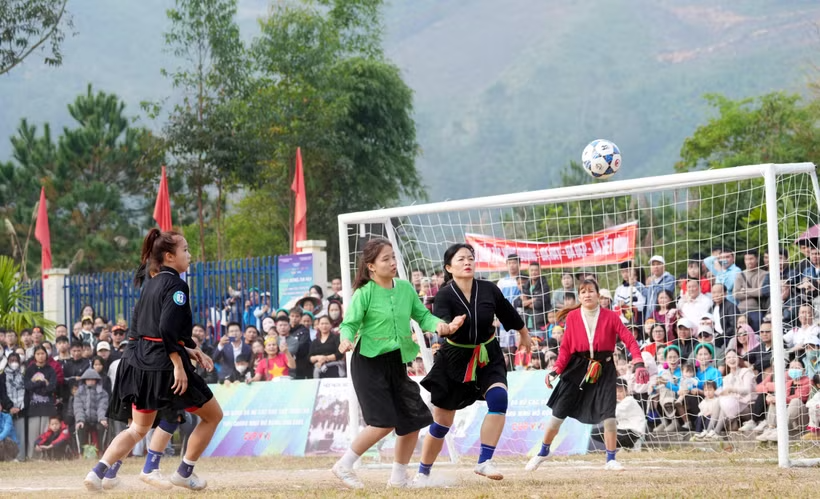
Potential of ethnic minority women's football

Potential of ethnic minority women's football

Women’s football movements in local communities have been quietly growing, but they’ve now built up enough momentum to inspire organisers to launch the first Vietnam Ethnic Minority Women’s Football – VTV Cup in 2026.

Phong Nha - Ke Bang named among Vietnam's 11 most beautiful destinations

Phong Nha - Ke Bang named among Vietnam's 11 most beautiful destinations

According to the magazine, boat trips into Phong Nha Cave and strolls through Paradise Cave (both family-friendly) offer a tantalising glimpse of their astonishing scale, but the real adventure lies deeper within the park, where cavers wade through underground rivers and weave among stalagmites.

Tourism seeks new growth momentum under Resolution 26

Tourism seeks new growth momentum under Resolution 26

Tourism effectiveness should be measured not only by visitor numbers and revenue, but also by spending, length of stay, repeat visits, job quality, visitor satisfaction and environmental carrying capacity, said experts.

Vietnam welcomes nearly 2 million international visitors in August, up 19.7% from July and 18.4% year-on-year. (Illustrative photo: VNA)

Vietnam tourism maintains strong growth, expands international markets

The National Statistics Office under the Ministry of Finance reported that Vietnam welcomed nearly 2 million international visitors in August, up 19.7% from July and 18.4% year-on-year. The figure represented 63.6% of the tourism sector’s full-year target of 25 million arrivals.

First ladies of Vietnam, Myanmar visit Van Phuc silk village

First ladies of Vietnam, Myanmar visit Van Phuc silk village

Ngo Phuong Ly, the spouse of General Secretary of the Communist Party of Vietnam Central Committee and President To Lam, said the two countries share similarities in silk weaving and can enrich their cultural heritage through exchanges and experience sharing.