Huoi Man – A “sky-high” hamlet where wood and stone architecture reigns

Nestled in the remote border area of Nghe An province, Huoi Man hamlet is often affectionately referred to by local residents and visitors as the “hamlet at the top of the sky.”

Nestled in the remote border area of Nghe An province, Huoi Man hamlet is often affectionately referred to by local residents and visitors as the “hamlet at the top of the sky.”

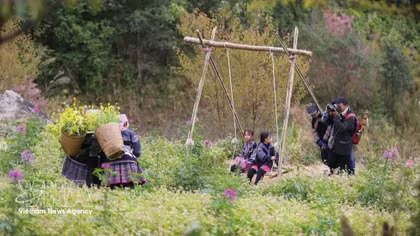
Perched at nearly 1,700 metres above sea level, it is one of 21 hamlets in Nhon Mai commune, home to 21 households with 128 residents of the Mong ethnic minority group that have preserved their way of life for nearly eight decades.
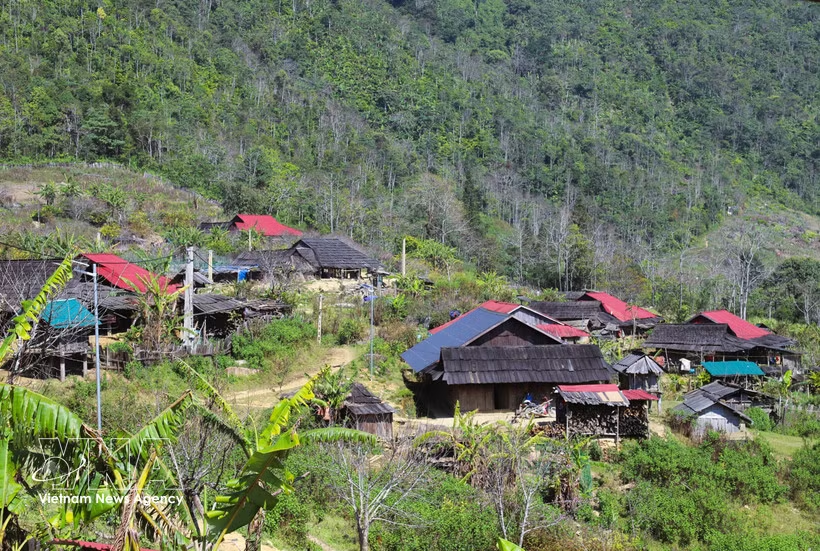
Huoi Man – A “sky-high” hamlet where wood and stone architecture reigns -0
Perched at nearly 1,700 metres above sea level, Huoi Man is home to 21 households with 128 residents of the Mong ethnic minority group. Photo: VNA

Huoi Man stands out not only for its dramatic mountain scenery but also as a “living museum” of indigenous culture. Traditional customs, daily practices, and a resilient work ethic remain deeply rooted in the community’s lifestyle.

Reaching the hamlet is no easy feat. The journey winds along steep mountain roads, with sheer cliffs on one side and deep valleys on the other. Upon arrival, visitors encounter a strikingly different cultural landscape. There are no modern concrete houses in Huoi Man. Instead, wood and stone dominate every aspect of life. Timber sourced from the forest appears in homes and daily tools, while stone pathways extend into courtyards and kitchens.

The most distinctive feature of the hamlet is its unique “turtle-shell” architecture. Homes are built low and wide, with sturdy wooden walls and roofs crafted from samu (Cunninghamia lanceolata) and pomu (Fokienia hodginsii) timber. Carefully cut and hand-laid, the wooden planks form curved roofs resembling giant turtle shells. Over time, moss blends with the dark wood, giving the houses an ancient, tranquil character. From a distance, the hamlet appears as a cluster of dusky domes emerging from lush green mountains.

According to the head of the hamlet, Gia Ba Lay, the architectural style reflects both aesthetic value and human adaptation to harsh highland conditions. The wooden roofs help keep homes warm in winter and cool in summer, while resisting moisture, frost, and strong winds.

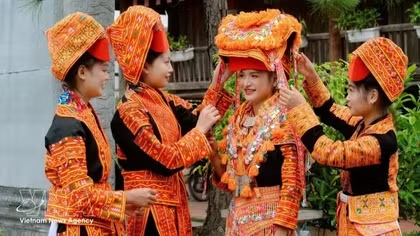
Beyond its architecture, Huoi Man preserves a rich repository of intangible cultural heritage. From intricately embroidered traditional costumes and the sound of the ‘khen’ (panpipe) in festivals, to blacksmithing, terrace farming, and food preservation practices, every aspect of life reflects ingenuity and cultural identity. Unique features such as elevated granaries and small hillside fish ponds further illustrate how the community harmonises with nature.

Despite gradual modernisation, including access to electricity and improved infrastructure, Huoi Man continues to safeguard its cultural essence. The hamlet offers a rare sense of tranquility, inviting visitors to experience the rhythm of mountain life and the enduring spirit of the Mong people in the border mountainous area.

VNA

Other News

Vietnam secure berth at FIFA U17 World Cup 2026 for first time

Vietnam secure berth at FIFA U17 World Cup 2026 for first time

Vietnam national U17 football team secured a place at the FIFA U17 World Cup 2026 for the first time after defeating United Arab Emirates national U17 football team 3-2 on in the final Group C match of the AFC U17 Asian Cup 2026 in Saudi Arabia on early May 14 (Vietnam time).

Vietnam’s most beautiful railway station twins with French counterpart

Vietnam’s most beautiful railway station twins with French counterpart

A twinning agreement between Da Lat Railway Station in Vietnam and Trouville-Deauville Railway Station in France was signed at the French Embassy in Vietnam on May 7, creating new opportunities for cooperation in station management and operations, as well as cultural and tourism promotion between the two sides.

Hanoi gains two more craft villages in World Crafts Cities network

Hanoi gains two more craft villages in World Crafts Cities network

The recognition of Chuyen My and Son Dong craft villages as members of the World Crafts Cities network represents international acknowledgement of the cultural value, artisanal techniques, creativity and sustainable vitality of Vietnam’s traditional craft villages, he said.

Thang Long - Hanoi Festival 2026 to return in September

Thang Long - Hanoi Festival 2026 to return in September

Co-hosted by the municipal People’s Committee, the Department of Culture and Sports, and domestic and foreign agencies, the whole spectacle is meant to honour the city’s millennia-old heritage while reafffirming its strategy of establishing culture as a development engine.

Spreading Vietnamese cultural identity in digital space

Spreading Vietnamese cultural identity in digital space

In the context of deep international integration, cultural identity serves as both a “shield” against assimilation and a defining marker of a nation’s image. Protecting and promoting uniquely Vietnamese cultural values has therefore become a pressing task, particularly in an increasingly complex digital environment.

ITE HCMC 2026 to promote Vietnam’s tourism on global map

ITE HCMC 2026 to promote Vietnam’s tourism on global map

With its large scale, the ITE HCMC 2026 aims to promote tourism cooperation between Vietnam and priority markets such as Northeast Asia, Western Europe, North America, Southeast Asia, and Oceania while also boosting visitor arrivals from the Indian market

Vietnamese puppetry seeks renewal amid preservation challenges

Vietnamese puppetry seeks renewal amid preservation challenges

Although widely regarded as a cultural “speciality” attracting tourists, Vietnamese puppetry is facing multiple challenges in preservation and development, requiring renewed efforts to both safeguard its identity and adapt to contemporary cultural currents.

Project on digital transformation in cultural sector approved

Project on digital transformation in cultural sector approved

By 2030, the project targets the establishment of shared digital platforms across 100% of cultural sectors. All digitised cultural heritage will be standardised under the national data framework and shared in accordance with regulations, while 80% of public digital heritage assets are expected to receive digital identifiers to clarify ownership and management, encouraging organisations and individuals to do the same and support market development.

Vietnam eyes becoming region’s leading tourism destination

Vietnam eyes becoming region’s leading tourism destination

Vietnam has in recent years undergone a notable transformation in its tourism development strategy, placing a strong emphasis on nature-based and eco-tourism. This shift is not merely aligned with global trends, but represents a necessary step towards safeguarding valuable natural resources, while appealing to a growing segment of environmentally conscious travellers.