Illegal fishing continues unbated in Quang Ninh

Despite local authorities of northern coastal province of Quang Ninh ordering tougher management and punishment of destructive fishing practices, use of illegal fishing equipment is still common, Nong Thon Ngay Nay (Countryside Today) newspaper reported.
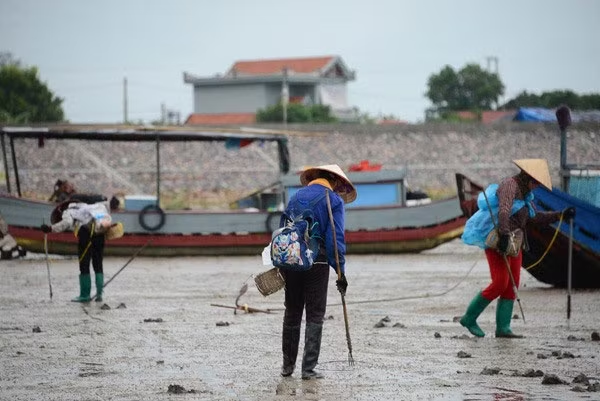
Fishermen use electric generators to catch clams. - Photo danviet.vn

In the first week of August, after inspecting fishing at Bai Tu Long Bay and Ha Long Bay, Nguyen Van Doc, Secretary of the Quang Ninh provincial Party Committee ordered local agencies to step up inspections and impose strict penalties on fishing vessels which use destructive fishing equipment.

He also ordered the ban on fishing in the core zone of Ha Long Bay and called for a plan to ban fishing in the buffer zone.

Quang Ninh Province has instructed local agencies to communicate the policy to the public and help fishermen find other jobs.

“We’ll launch a province-wide campaign. Communications should be expanded. We’ll also rein in the over-harvesting of marine resources,” said Dang Huy Hau, Vice Chairman of the provincial People’s Committee.

However, destructive fishing practices continue, even in daylight in some localities such as Hai Ha District and Mong Cai City.

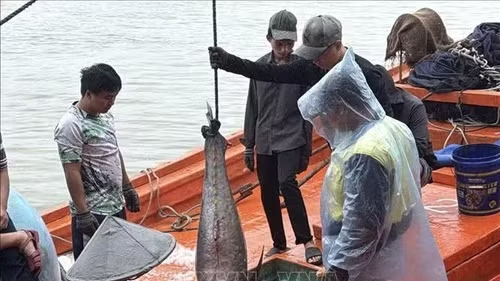
According to the paper, at 9pm on August 9, on low-capacity fishing boats which docked Cai Chien Port in Hai Ha District, fishermen were using banned fishing equipment such as eight-sign cages, tasers and electric generators. Fishermen did not even attempt to hide these illegal devices.

When asked whether this equipment was seized before, a fisherman said ‘Sometimes they have campaigns but cannot ban. If we do not use this, we will starve to death.”

Along beaches of Quang Minh, Quang Phong, Quang Thanh, Tien Toi communes, some vessels use electric generators, with local authorities nowhere in sight.

Yet Nguyen Manh Cuong, chairman of Hai Ha District’s People’s Committee confirmed to reporters that the district’s authorities are still ordering inspections and punishments.

On the beach along Hai Dong District, Mong Cai City, groups of fishermen use electric generators to catch clams. When the clams are stunned by the electric current, fishermen scoop them up. This fishing practice has been used in the commune for years, however, until now, no one has been punished.

Again, Nguyen Van Chieu, secretary of the commune’s Party Committee and chairman of communal People’s Committee confirmed that they established a team to penalise violations in fishing. After inspection campaigns, the biggest last May, he claimed there were no more violations in the commune.

VNS

Other News

Hanoi ready to implement Capital Law 2026, unlocking new development momentum

Hanoi ready to implement Capital Law 2026, unlocking new development momentum

The effectiveness of the Capital Law 2026 will be measured not by the number of legal documents issued but by tangible improvements in governance and public administration, better services for people and businesses, faster administrative procedures, stronger investment attraction and higher economic growth.

Vietnamese students earn honours at ROBOG Asia Cup 2026

Vietnamese students earn honours at ROBOG Asia Cup 2026

Three teams from Chu Van An Secondary School in Vietnam’s Thai Nguyen province have earned First Prize honours and advanced to the quarterfinals at the ROBOG Asia Cup 2026, a regional robotics and artificial intelligence (AI) competition for students held in Hong Kong, China.

Hanoi sets out new investment blueprint with century-long development vision

Hanoi sets out new investment blueprint with century-long development vision

As of early June, Hanoi had attracted 74.6 billion USD in foreign direct investment (FDI) through more than 9,250 valid projects. FDI inflows in the first six months were projected at 3.2 billion USD, surpassing the annual target by 116%, while nearly 16,000 new businesses were established in the first five months, up 34.4% year-on-year.

Vietnam promotes legal cooperation and rule of law at global forum

Vietnam promotes legal cooperation and rule of law at global forum

Vietnam’s development and international integration have gone hand in hand with the improvement of its legal system, the incorporation of international commitments into domestic legislation, and legal reforms aimed at fostering development, openness and global integration. The country regards international law as an essential instrument for building fair, mutually beneficial relations among nations.

Hanoi to hold investment promotion event on June 29

Hanoi to hold investment promotion event on June 29

At the event, Hanoi authorities plan to grant investment policy decisions and investment registration certificates to 20 exemplary projects in the fields of transportation infrastructure, industrial parks, urban development, social housing, environment, science and technology, and foreign investment attraction.

Hanoi's Red River urban area development draws widespread attention

Hanoi's Red River urban area development draws widespread attention

Located south of the Red River and extending from the historic inner city to newly developing areas in the south and the west, the central urban area along Red River’s right bank covers approximately 45,317 hectares and is projected to accommodate around 6.365 million residents by 2045 and 6.455 million by 2065.

Hanoi's Red River urban area development draws widespread attention

Hanoi's Red River urban area development draws widespread attention

Located south of the Red River and extending from the historic inner city to newly developing areas in the south and the west, the central urban area along Red River’s right bank covers approximately 45,317 hectares and is projected to accommodate around 6.365 million residents by 2045 and 6.455 million by 2065.

Regional cooperation strengthened to combat cross-border drug crime

Regional cooperation strengthened to combat cross-border drug crime

Vietnam, China, Laos and Myanmar face common challenges as drug syndicates increasingly exploit the Mekong River, cross-border transport networks, e-commerce platforms, international logistics services, cyberspace and cryptocurrencies to organise drug transactions and smuggling operations.