In developing Hanoi, old battles new

The 1,000-year-old capital city of Hanoi has rapidly grown into one of the busiest and most crowded cities in the country and even in the region. 
Illustrative image
Illustrative image 

Over the past 10 years, high buildings, shopping centres, entertainment complexes, high-class apartments etc. have been built, which has completely changed the landscape of the city. Economic changes and continuous introduction of foreign culture over the past decades has brought about indispensable changes in the culture of the indigenous people as well.

Recalling not too long ago, around the mid-2000s, Hanoi used to be a quiet place, with shady trees and cold street corners in the winter. 

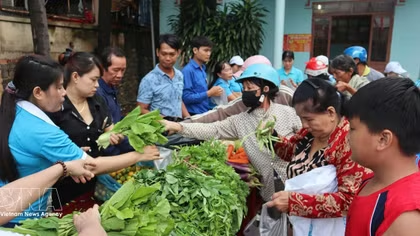
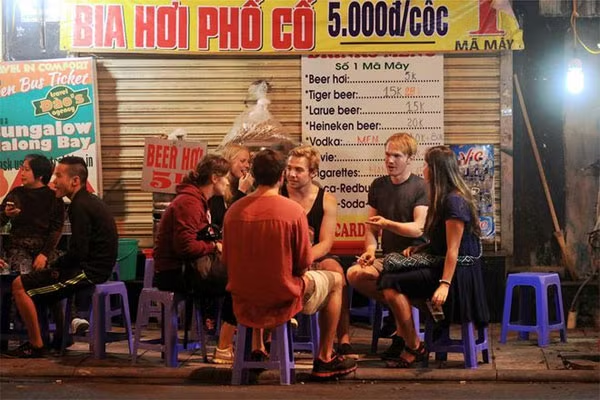
One of the prominent sights was the presence of street vendors on the large sidewalks of the streets, selling the most common and popular food, such as pho bo, bun thang, banh cuon. There were flower vendors too with a shoulder pole. Suburban farmers modestly and quietly pedalled their bikes with the three words: “Banh da ke”. The small sidewalk cafes or tea shops were filled with clients who liked playing chess. That is the old way of life in Hanoi, also called the “sidewalk culture”.

“The sidewalks of Hanoi have almost everything a Hanoian needs: food, drinks, relaxing space. Eating a bowl of noodle soup, sipping a cup of hot tea, sucking a Vina cigarette and watching people walking down the familiar street is something that most people living in the city will never forget,” says 58-year-old Phan Chi Kien.

And it’s not only the people who enjoy the sidewalk culture. Artists consider Hanoi’s street vendors or sidewalks an endless source of inspiration. Like Kien, they work on the sidewalks and shop for things they need from street vendors as Hanoians would do. As artists, they compose to praise their homeland with the culture of street vendors.

Even people from other parts of Vietnam and foreigners are fascinated with this unique feature.

In October last year, photographer Loes Heerink, who clicked the pictures titled “Ha Noi — Vendors from Above”, was nominated for the Bui Xuan Phai Award, the 10th For the Love of Ha Noi Award. Heerink says the first thing to mention about the city is the great food. She advises people to try eating food at markets and from street vendors and even buying fruit there.

Street vendors: an obstacle to growth?

Despite the immense love of people, the fate of Hanoi’s street vendors is being challenged today by the expansion of urban space.

“The city government and many others have talked about the irrationality of street vendors. They say that street vendors occupy the sidewalks, making it dangerous for the pedestrians as they have to walk on the roads. And if there were no pedestrians, it would be a traffic disaster as all the people would use their personal vehicles,” Kien says.

“People buying food from street vendors are also at risk of food poisoning as they do not know about the origin of the food. The city also looks messy when the sidewalks are full of shops in front of modern buildings,” Nguyen Thu Uyen, 35, says.

People are divided in their opinion of street vendors. Those who love them continue to stand up for them in support. But the situation in Hanoi is changing with time. With construction becoming increasingly urgent, the space for transportation has become more painful.

Street vendors need special attention. They sell food for a living and also because they do not want to remain idle. If this group is expelled from the sidewalks or banned on the roads, it is likely that Hanoi will face social instability.

The debate is likely to continue as Hanoi, too, continues to develop. In such a scenario, tall buildings will co-exist with small food stalls with a few tables and chairs and old men sitting together and smoking or drinking tea.

Martin Rama, new Project Director at the Centre for Sustainable Urban Development (Viet Nam Academy of Social Sciences), said: “There is no doubt that development requires highways and shopping centres, but it would be nice if the Hanoians did not have to get them in exchange for trees, public spaces and special social activities that make their city a charming place in a strange way...” 
VietNamNet Bridge/VNS

Other News

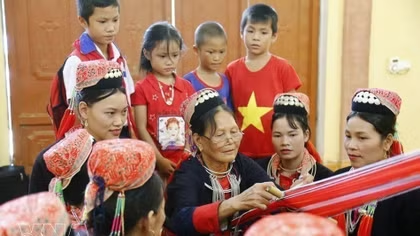
Vietnam steps up implementation of ethnic affairs strategy through 2030

Vietnam steps up implementation of ethnic affairs strategy through 2030

To accelerate the implementation of the the Ethnic Affairs Strategy by 2030, with a vision toward 2045, the Prime Minister requested ministries, agencies and local authorities to continue thoroughly carrying out the Party and State’s policies on ethnic affairs, enhancing the effectiveness of State management and strengthening oversight of policy implementation.

Security preparations reviewed for APEC 2027 in Phu Quoc

Security preparations reviewed for APEC 2027 in Phu Quoc

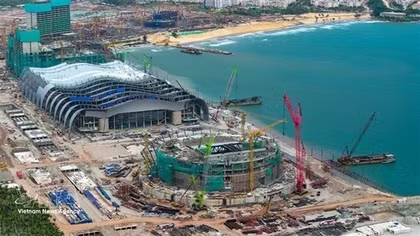
The team examined the APEC 2027 Convention Centre, where main conference activities are scheduled; Sun Serenia Hospital, designated to provide healthcare and emergency medical services for delegates; provincial road DT.975, which connects Phu Quoc International Airport to the convention centre; and the area surrounding Phu Quoc International Airport.

Hanoi accelerates seven Red River bridge projects, many exceed 70% completion

Hanoi accelerates seven Red River bridge projects, many exceed 70% completion

According to the municipal Transport Construction Investment Project Management Board, the city is simultaneously implementing seven projects, namely Tu Lien, Ngoc Hoi, Tran Hung Dao, Thuong Cat, Van Phuc, Hong Ha and Me So bridges. Construction is being carried out on multiple fronts, focusing on bored piles, pile caps, piers and superstructure works.

Dien Bien battlefield legacy powers tourism revival

Dien Bien battlefield legacy powers tourism revival

Seventy-two years after the Dien Bien Phu Victory, its legacy still reverberates. The unity, self-reliance, and resilience forged in that historic triumph remain a powerful internal engine, now propelling Dien Bien toward fast and sustainable development.

Hanoi accelerates shift to green buses, targets 100% by 2030

Hanoi accelerates shift to green buses, targets 100% by 2030

In the 2027–2030 period, the city will accelerate the transition towards the complete phase-out of fossil fuel-powered buses. The share of electric and green energy-fueled buses is projected to reach 79–89% by 2029 and 100% by 2030.

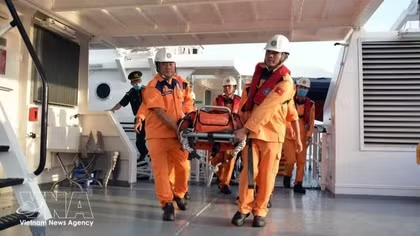
36 fishermen safely rescued after boat breaks down near Truong Sa

36 fishermen safely rescued after boat breaks down near Truong Sa

At 8:00 the same day, KN475 began towing the disabled fishing boat toward Da Tay A island. The towing operation was carried out safely, and by 18:30 both the vessel and its crew had arrived at the island without incident, where repairs and additional support procedures were arranged.

Vietnamese language contest in Laos strengthens youth ties, bilateral friendship

Vietnamese language contest in Laos strengthens youth ties, bilateral friendship

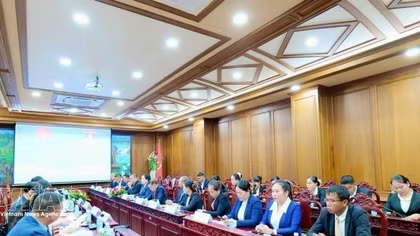
Held in response to the launch of the Vietnamese Language Day among overseas Vietnamese communities, the event aimed to enhance the quality of Vietnamese language teaching and learning in Laos while contributing to the great friendship, special solidarity, comprehensive cooperation and strategic cohesion between the two countries.

Vietnamese language contest in Laos strengthens youth ties, bilateral friendship

Vietnamese language contest in Laos strengthens youth ties, bilateral friendship

Held in response to the launch of the Vietnamese Language Day among overseas Vietnamese communities, the event aimed to enhance the quality of Vietnamese language teaching and learning in Laos while contributing to the great friendship, special solidarity, comprehensive cooperation and strategic cohesion between the two countries.

Hanoi launches 10 electric bus routes from April 1

Hanoi launches 10 electric bus routes from April 1

By the end of April, the number of buses using electricity and other green energy sources in the city is expected to reach 822, including 683 electric buses and 139 compressed natural gas (CNG) buses, representing 42.1% of the total number of vehicles.