- Kien Giang: more islanders connected to national power grid
- Pictures of “Phu Quoc – Kien Giang Green Tourism” campaign on display
- Nghinh Ong Festival – Unique cultural identity in Kien Giang
- Tourism - important pillar in Vietnam’s economy: EIU
It is no exaggeration to say that Kien Giang is a natural ‘masterpiece’. The locality is home to plains, hills, forests, rivers, seas and islands, providing itself with a significant advantage for tourism development, even when compared to other areas in the Mekong Delta region.
This is a solid basis, amongst favourable conditions, for Kien Giang province to make its otherwise lacking industry begin to thrive.
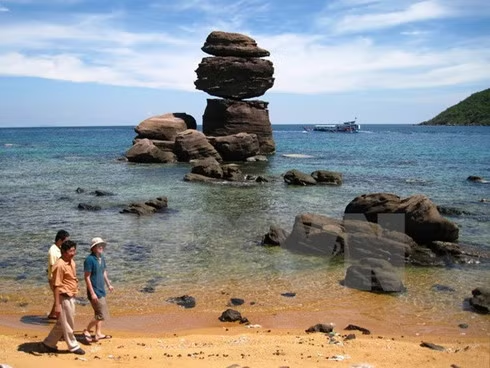 |
| Kien Giang is in hope of satisfying travellers’ demands for discovery, relaxation and sightseeing. |
As part of Kien Giang province, Phu Quoc island district is experiencing increased interest, as investors push to make it a high-end tourist destination. The district boasts Ngoc Island which features unique terrain, including a mountain range that is inhabited by many vibrant species of plants and animals.
Its beautiful beaches and its system of 26 islets create a picture of breathtaking beauty.
The province’s Ha Tien - Kien Luong region, with scenic spots such as Mui Nai, Hon Trem, Hang Pagoda, Binh San Mountain, and the mountains To Chau, Da Dung and Thach Dong, will make a lasting impression on visitors. Its islands are associated with fairy tales, many of which contribute to local beliefs.
In coming to the Rach Gia - Kien Hai region, visitors cannot help but be surprised by the impressive sea encroachment work that has been completed to expand the town of Rach Gia.
In addition, this coastal town is home to the sites of many valuable cultural and historical relics, along with unique architectural works by the three main ethnic groups: the Kinh, the Hoa and the Khmer.
During folk festivals, the locality’s well-known destinations, such as Nguyen Trung Truc Temple, Tam Bao Pagoda, Phat Quang Pagoda, Quan De pagoda and Khmer Pagoda, attract millions of tourists every year.
The Nam Du archipelago and Hon Tre Island (in the Kien Hai island district) are among travellers’ top choices for exploration, with their pristine natural landscapes and healthy environment.
U Minh Thuong National Park is part of the Kien Giang Biosphere Reserve, where visitors are provided with the opportunity to discover globally rare ecosystems, such as submerged tropical forests and peat swamps, which still thrive in Vietnam.
The park is home to a diverse range of flora and fauna, with around 254 species of vascular plants, 32 species of mammals, 188 species of birds and 64 species of fish. Many of these species are listed in both Vietnam's and the world’s Red Book of endangered species.
In order to make full use of the natural potential and inherent strengths in the four key tourist zones, Kien Giang province has mobilized all resources to invest in developing infrastructure that will serve tourism development.
Major infrastructural works have already been put into use, including the upgraded Rach Gia Airport, the Phu Quoc International Airport, in addition to a number of sea ports such as Rach Gia, Bai Vong and Duong Dong, along with transport and power systems on the island of Phu Quoc.
The province will invest further in the construction of infrastructure at many tourist attractions, as well as upgrading historical, cultural and scenic sites to serve tourists. These sites include Phu Quoc Prison, U Minh Thuong historical site, Binh San mountain, and Phat Quang pagoda.
Kien Giang province has attracted more and more investment in tourist industries, even at a time when the island district of Phu Quoc has seen rapid development of tourist infrastructure and facilities.
Tran Chi Dung, Director of the Kien Giang Tourism Department, said the province has so far attracted more than 270 projects which are being implemented in all four tourist zones, with a total registered capital of approximately 232 trillion VND.
"Kien Giang province is focused on using tourism to develop a spearhead for its economic sector, which has experienced fast and sustainable growth. It is expected to become an attractive destination and tourist center, not only within the Mekong delta region and the country, but also across Asia and even the world,” said the director.
He added that the province has set a target of welcoming 6.8 million tourists by 2020, including 450,000 foreign visitor arrivals. This represents a projected average annual growth of 9.5 percent.