Kon Tum wooden church - A hundred years of salvation

Around 1840, as the Nguyen Kings banned Christianity in Vietnam, the Western missionaries moved to the faraway highlands in Kon Tum Province on the Mid-Vietnam plateau. 

From Hue Capital through lowland provinces to Kon Tum, they took the 120km long, so-called ‘salt, ceramics and gongs’ trading route. 

The stretch of road from Quang Ngai to Kon Tum at the time was very desolate, bumpy and perilous. 

To evangelize the rustic highland tribes of Kon Tum, the first thing the missionaries did was build a primitive church from trees and leaves. 

Without knowledge of local languages and customs, they had a lot of troubles. However, with perseverance and patience, the Western missionaries have managed to introduce Christianity to the ethnic minorities here.

In 1913, as more people began turned Christian, Brother Joseph Décrouille, head of Kon Tum parish, decided to build a more robust church. He mobilized the parishioners and their elephants to gather necessary hardwood from the forest.

Having amassed a large amount of wood, he invited famous carpenters from the lowlands to work with local masters. In 1918, the 500-seat wooden church was completed.

Since then, the wooden church had survived two long bloody wars and the harsh Kon Tum weather. 

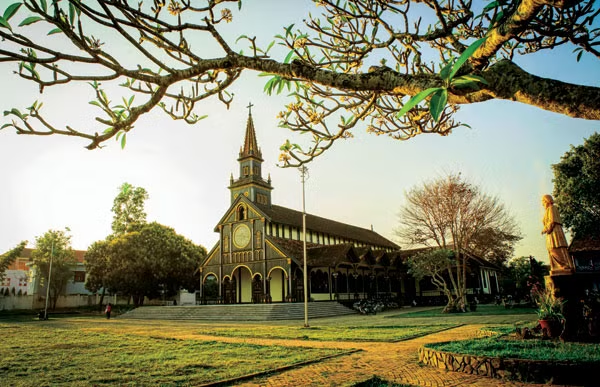
In 1995, the wooden church was expanded to double the old capacity. The old and new parts matched well, and the whole structure looks like a huge cross.
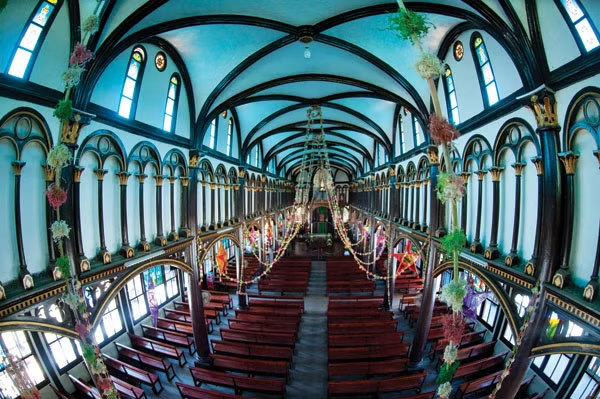
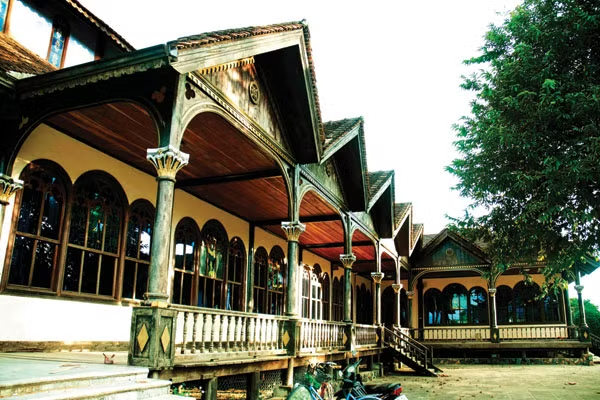
Today, Kon Tum wooden church stands on Nguyen Hue Street of Kon Tum city. Apart from the main building, it has also a 25m tall Cross Tower, a reception house, a showroom exhibiting ethnic and religious products, a typical local tribal communal house, an orphanage, a brocade weaving and sewing shop, and a carpentry workshop. 

In the church’s garden, there is a statue of Virgin Maria holding newborn Jesus, made of a single log in the rustic style of Tay Nguyen ethnic tribes. 

Culturologists say that Kon Tum wooden church was designed and built in Roman style combined with elements of Tay Nguyen stilted house architecture. 

The exterior and interior decoration is also a mixture of Western and local ethnic cultures.

The Website of Vietnam Tourism Authority asserts, ‘The Kon Tum wooden church is a masterpiece of architecture, where Romantic style mixes in harmony with Ba Na stilted house model.’
During Christmas, the minority parish artisans use timber, brocades and tree bark to decorate the wooden church in typical Tay Nguyen colours and motifs. In the outdoor space they plant many festive trees – a spiritual symbol of Tay Nguyen peoples’ life.

On High Masses, multitudes of people of Ba Na, Xe Dang, Gia Rai, Ro Mam, B’rau and tribes from deep mountains come to receive God’s grace and blessing. They fill up the church’s 7000m2 premises.

Not far away from the wooden church is the Kon Tum seminary constructed during 1935-1938 by the first bishop of Kon Tum episcopate. 

Built from precious wood and stones, the seminary has the same style as the church but is much bigger. 

The upper floor of the seminary has a showroom exhibiting the missionary history of Kon Tum since the mid-19th century, personal items and handwritten documents of priests and missionaries, and images and texts related to the establishment and development of Kon Tum episcopate. 

Meticulously carved in wood, items showcased at the seminary are very valuable. 

This can be considered as a small museum of life utensils, farming tools and cultural artefacts of the ethnic minorities living in this province.

VN Heritage

Other News

Vietnam secure berth at FIFA U17 World Cup 2026 for first time

Vietnam secure berth at FIFA U17 World Cup 2026 for first time

Vietnam national U17 football team secured a place at the FIFA U17 World Cup 2026 for the first time after defeating United Arab Emirates national U17 football team 3-2 on in the final Group C match of the AFC U17 Asian Cup 2026 in Saudi Arabia on early May 14 (Vietnam time).

Vietnam’s most beautiful railway station twins with French counterpart

Vietnam’s most beautiful railway station twins with French counterpart

A twinning agreement between Da Lat Railway Station in Vietnam and Trouville-Deauville Railway Station in France was signed at the French Embassy in Vietnam on May 7, creating new opportunities for cooperation in station management and operations, as well as cultural and tourism promotion between the two sides.

Hanoi gains two more craft villages in World Crafts Cities network

Hanoi gains two more craft villages in World Crafts Cities network

The recognition of Chuyen My and Son Dong craft villages as members of the World Crafts Cities network represents international acknowledgement of the cultural value, artisanal techniques, creativity and sustainable vitality of Vietnam’s traditional craft villages, he said.

Thang Long - Hanoi Festival 2026 to return in September

Thang Long - Hanoi Festival 2026 to return in September

Co-hosted by the municipal People’s Committee, the Department of Culture and Sports, and domestic and foreign agencies, the whole spectacle is meant to honour the city’s millennia-old heritage while reafffirming its strategy of establishing culture as a development engine.

Spreading Vietnamese cultural identity in digital space

Spreading Vietnamese cultural identity in digital space

In the context of deep international integration, cultural identity serves as both a “shield” against assimilation and a defining marker of a nation’s image. Protecting and promoting uniquely Vietnamese cultural values has therefore become a pressing task, particularly in an increasingly complex digital environment.

ITE HCMC 2026 to promote Vietnam’s tourism on global map

ITE HCMC 2026 to promote Vietnam’s tourism on global map

With its large scale, the ITE HCMC 2026 aims to promote tourism cooperation between Vietnam and priority markets such as Northeast Asia, Western Europe, North America, Southeast Asia, and Oceania while also boosting visitor arrivals from the Indian market

Vietnamese puppetry seeks renewal amid preservation challenges

Vietnamese puppetry seeks renewal amid preservation challenges

Although widely regarded as a cultural “speciality” attracting tourists, Vietnamese puppetry is facing multiple challenges in preservation and development, requiring renewed efforts to both safeguard its identity and adapt to contemporary cultural currents.

Project on digital transformation in cultural sector approved

Project on digital transformation in cultural sector approved

By 2030, the project targets the establishment of shared digital platforms across 100% of cultural sectors. All digitised cultural heritage will be standardised under the national data framework and shared in accordance with regulations, while 80% of public digital heritage assets are expected to receive digital identifiers to clarify ownership and management, encouraging organisations and individuals to do the same and support market development.

Vietnam eyes becoming region’s leading tourism destination

Vietnam eyes becoming region’s leading tourism destination

Vietnam has in recent years undergone a notable transformation in its tourism development strategy, placing a strong emphasis on nature-based and eco-tourism. This shift is not merely aligned with global trends, but represents a necessary step towards safeguarding valuable natural resources, while appealing to a growing segment of environmentally conscious travellers.