Lawmakers debate real estate, budget, nuclear project changes

The draft revised real estate law is intended to turn Party and State guidelines into statute, codify tested resolutions that have been tested in practice, and shift power under the two-tier local administration model. It seeks to cut investment and business conditions, accelerate digital transformation, improve market transparency and predictability, strengthen market regulation, and clear practical bottlenecks to support a healthy property market.

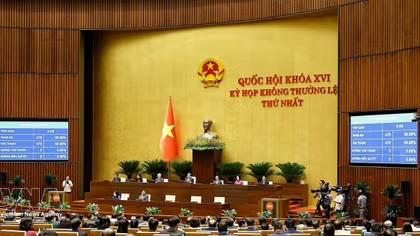
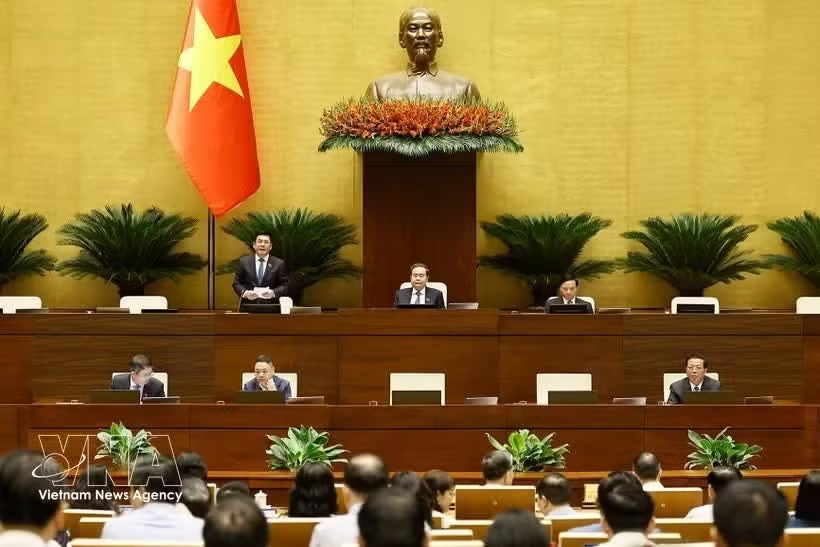
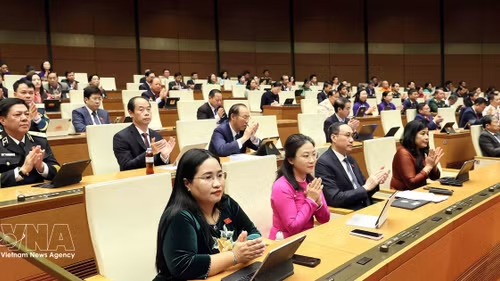
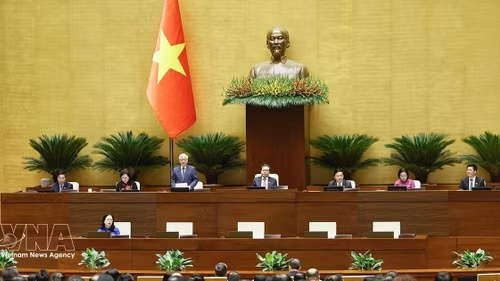
Hanoi (VNA) – The 16th National Assembly (NA) will hold a plenary debate on August 22 on proposed amendments to the Law on Real Estate Business, and mechanisms and policies for sea-encroachment urban projects under the draft Law on Urban Development, as part of its extraordinary session in Hanoi.
3.jpg
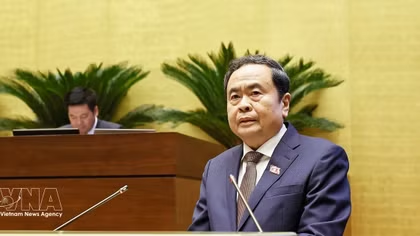
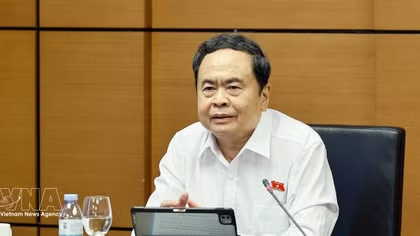
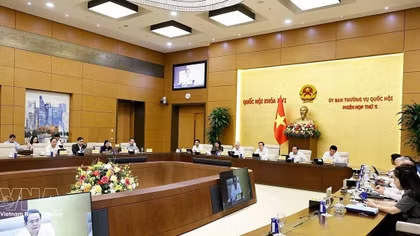
NA Vice President Nguyen Hong Dien moderates the session. (Photo: VNA)

The draft revised real estate law is intended to turn Party and State guidelines into statute, codify resolutions that have been tested in practice, and shift power under the two-tier local administration model. It seeks to cut investment and business conditions, accelerate digital transformation, improve market transparency and predictability, strengthen market regulation, and clear practical bottlenecks to support a healthy property market.

On decentralisation and delegation of authority, the draft only revises regulations on the authority to approve the transfers of all or part of a real estate project, moving that power from the Prime Minister to provincial People’s Committees.

On reducing conditions and procedures, the bill will cut or simplify nine of 31 investment and business conditions, eliminate four of 12 administrative procedures, and simplify seven others. One procedure concerning registration for access to and use of housing and real estate market data under the Ministry of Construction’s authority, will remain unchanged.

To clear obstacles and add new mechanisms, the draft stipulates that foreign entities, individuals and overseas Vietnamese may buy only houses and construction works not attached to land-use rights. It also introduces a mechanism to secure land-related financial obligations for build-operate-transfer projects through guarantees or escrow accounts.

In the afternoon, lawmakers will debate in plenary policy directions for drafting a consolidated State Budget Law, a NA resolution on personal and corporate income tax reductions, and the separation of the Ninh Thuan nuclear power project into independent projects.

According to the Government's report, the 2025 Law on the State Budget and the 2024 Law on Public Investment, as amended and supplemented in 2025, have been fundamentally revised in recent years to turn Party resolutions into law, maintain the central budget’s leading role, give localities greater autonomy, and address issues related to the two-tier local administration. The changes also aim to expand decentralisation, abolish outdated provisions and clear public investment bottlenecks.

But keeping two separate laws has created overlaps in authority, paperwork, procedures and timelines between state budget planning and public investment planning. Consolidating the laws is therefore necessary to create a unified public financial management system, cut procedures, time and compliance costs, and mobilise, manage and use budget resources effectively to support growth.

The proposed law is expected to comprise 10 chapters and 102 articles. Key revisions include integrating the five-year financial plan and state budget estimates with public investment plans./.
en.vietnamplus.vn

Other News

16th NA wraps up first extraordinary session

16th NA wraps up first extraordinary session

Lawmakers passed 15 laws and six legal resolutions and gave first-round consideration to seven other draft laws. The session was aimed at clearing bottlenecks, fine-tuning the legal and institutional framework, accelerating decentralisation and delegation of authority, cutting administrative procedures, clearing barriers, unlocking resources, creating favourable conditions for citizens and businesses, and improving the effectiveness and efficiency of state management.

Vietnam values relationship with US: Deputy Foreign Minister

Vietnam values relationship with US: Deputy Foreign Minister

Deputy Foreign Minister Dang Hoang Giang said Vietnam-US ties have maintained positive momentum following the February 2026 meeting between General Secretary of the Communist Party of Vietnam Central Committee and President To Lam and President Donald Trump, with regular exchanges and expanding cooperation across various fields.

Vietnam seeks to deepen strategic partnership with Kazakhstan

Vietnam seeks to deepen strategic partnership with Kazakhstan

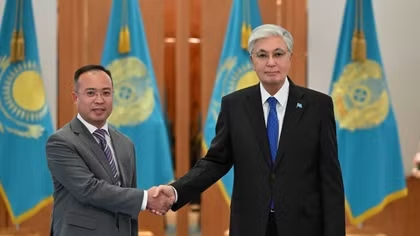
Ambassador Nguyen Thanh Le affirmed that he will work closely with Kazakhstan’s Ministry of Foreign Affairs, ministries, agencies and localities to effectively implement high-level agreements, strengthen political trust and promote cooperation in trade, investment, transport and logistics, tourism, culture, education and people-to-people exchanges.

Amendments to Land Law aim to achieve three key goals

Amendments to Land Law aim to achieve three key goals

The Government has identified three major objectives: promptly institutionalising Party policies on land, private-sector development and national digital transformation; addressing urgent practical obstacles to unlock resources and support the goal of double-digit economic growth; and building a modern, streamlined and effective land management system through stronger decentralisation and administrative reform.

Draft laws must support management reform, stronger decentralisation: PM

Draft laws must support management reform, stronger decentralisation: PM

Participants looked into 11 draft laws and one draft resolution, including laws amending and supplementing several articles of laws on non-agricultural land use tax and corporate income tax; natural resources tax; securities; accounting and independent auditing; the Labour Code; and laws on archives, gender equality, Red Cross activities and employment.

Top Vietnamese leader's New Zealand visit draws media attention

Top Vietnamese leader's New Zealand visit draws media attention

Reports, articles and assessments published on August 12-13 highlighted that Vietnam-New Zealand relations are shifting strongly from high-level political commitments to concrete cooperation programmes, with a focus on trade, investment, education, agriculture, science and technology, defence and security, and climate change response.