The thundering comandante, who built a Soviet-sponsored Communist state 90 miles (145 km) from the United States and survived a half century of U.S. attempts to topple or kill him, died on Nov. 25 at 90 years old.
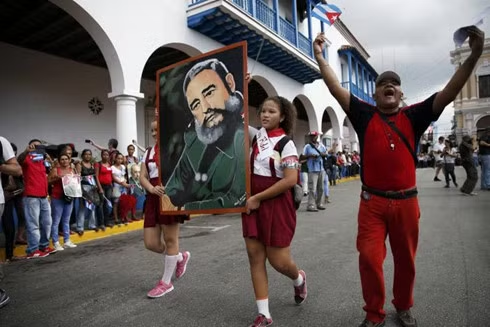 |
| Students carry a portrait of Cuba's late President Fidel Castro as the caravan carrying Castro's ashes arrives in Santiago de Cuba, Cuba, December 3, 2016. Photo: REUTERS/Carlos Garcia Rawlins |
On December 4 morning, his ashes will be interred near the remains of Cuba's independence hero Jose Marti in a cemetery in the eastern city, in what is likely to be a solemn ceremony.
Drawn in a trailer behind an olive green army jeep, Castro's ashes have made a 600-mile (1,000-km) journey in which hundreds of thousands of Cubans, many chanting "I am Fidel!," have lined up on roadsides and gathered in plazas for a final tribute.
"We have to be grateful for Fidel," said Olbert Estrada, 53, a former soldier who now manages a gas station. "We were five brothers, I was the only one who studied because I was born after the revolution."
Castro's socialist government survived the fall of the Berlin Wall, but at the cost of more than a decade of great economic hardship that was relieved by the largesse of his political disciple, the late Venezuelan President Hugo Chavez.
Over the past two decades a clutch of leftist governments rose to power in Latin America inspired by his ideas and fierce opposition to the United States. Several have now been defeated at the ballot box.
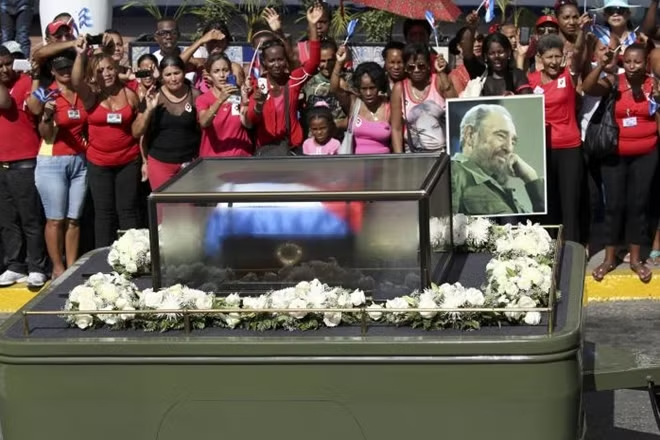 |
| Residents wave as the caravan carrying the ashes of Cuba's late President Fidel Castro arrives in Santiago de Cuba, Cuba, December 3, 2016. Photo: REUTERS/Carlos Garcia Rawlins |
High-profile friends of Castro, including Bolivian President Evo Morales and former Brazilian President Luiz Inácio Lula da Silva, arrived for an evening sendoff in the city where he launched the Cuban revolution six decades ago.
Morales embraced da Silva and fellow former Brazilian President Dilma Rouseff as they arrived at Santiago airport.
"I will miss his affection, his recommendations, his education," said Morales, who has been inspired by Castro's social ideas more than his economics.
Lula was a close ally of Cuba when he was president from 2003 to 2011, as was his successor Rousseff until she was impeached this year.
On Tuesday night, sitting presidents and prime ministers from around the world said goodbye to Castro in a four-hour ceremony in Havana attended by tens if not hundreds of thousands of Cubans.
The funeral cortege departed the capital the next day, retracing the route Castro and his bearded rebels took from Santiago to Havana in January 1959 after ousting US-backed dictator Fulgencio Batista.
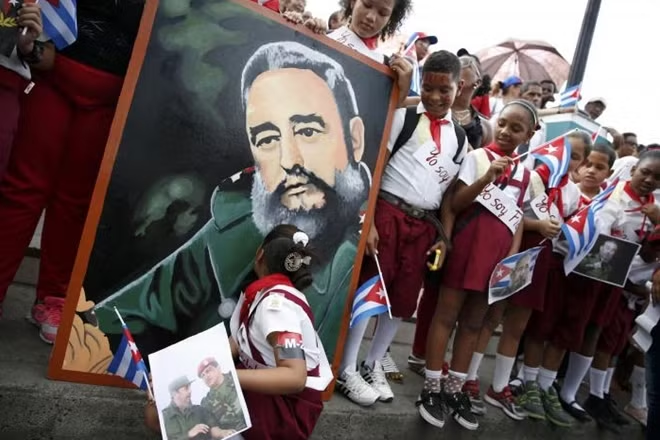 |
| A student kisses a portrait of Cuba's late President Fidel Castro as the caravan carrying Castro's ashes arrives in Santiago de Cuba, Cuba, December 3, 2016. Photo: REUTERS/Carlos Garcia Rawlins |
Castro went on to rule for 49 years until illness forced him to resign.
Crowds have greeted the caravan along the whole route, with volunteers sprucing up bridges and houses with fresh paint in Castro's honor.
Musicians have played at vigils by night, including one evening when his remains rested by the mausoleum containing the remains of his rebel friend Ernesto "Che" Guevara.
Castro's critics have kept a low profile, during the official nine-day mourning period that ends Sunday, but supporters have turned out in droves, even under a blazing tropical sun.
"A little bit of sun is not going to stop us from honoring our commander the way he deserves," said Alba Rodriguez, 29-year-old school teacher, from the city of Bayamo.
Cuba's government has not revealed the cause of Castro's death, but he had been frail ever since a severe stomach condition that nearly killed him in 2006.