Local universities to receive sponsors for startup ecosystem projects

The Vietnam-Finland Innovation Partnership Programme phase 2 (IPP2) will sponsor Vietnamese universities to develop their curriculum on innovation and startup as a part of efforts to improve the startup ecosystem in the country.

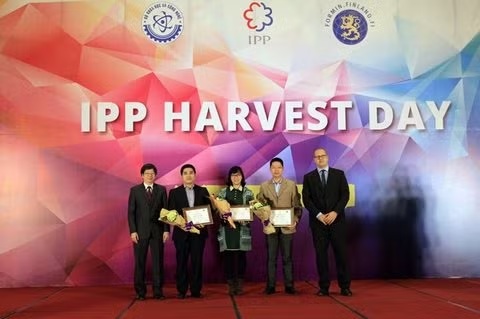
The statement was made at the IPP Harvest Day held on March 10 to summarise the progress of IPP2, which is a co-operative development programme between Vietnam and Finland’s governments.

The programme will also help local universities develop their own startup and innovation ecosystems, including projects that integrate universities and innovation-startup ecosystem development joint ventures.

The universities that are qualified for IPP2’s funding include the Foreign Trade University, Hanoi University of Science and Technology, Đà Nẵng University of Science and Technology and Hue Industrial College.

The programme in 2017-18 will also focus on transferring results, practices, experiences and models on supporting startup and innovation ecosystem to Vietnamese partners to make sure the programme will be continued in a sustainable way. This will also help transform the partnership between Vietnam and Finland from aid to trade.

At the ceremony, 35 lectures from 12 local universities and education establishments were granted certificates for completing the Training of Trainers (ToT) programme to become “source lecturers” that are expected to improve the training of innovation and startup business in their universities.

The programme has been carried out by the Finland’s Ministry for Foreign Affairs and Vietnam’s Ministry of Science and Technology in the last two years and is projected to end in 2018.

The programme director Trần Thị Thu Hương said at the ceremony: “IPP2 has taken the leading role in testing new models in training, developing and supporting innovation and startups in Vietnam in the past two years.”

“The programme is expected to develop a healthy innovative startup ecosystem in Vietnam to support local businesses to achieve strong growth so that they can contribute to the country’s sustainable development.”

IPP2 has successfully tested the model of funding model based on two stages, provided with Finland’s ‘soft support’ in terms of consultancy and training, Hương said.

IPP2 has sponsored 32 projects on innovative startup business and startup ecosystem development, and some of them have been accepted to proceed to the second stage of advance sponsorship, she said.

Those accepted projects include ones on providing automatic marketing applications for e-commerce websites, ones on big data analysis, and ones on booking and hotel management system.

A typical project funded by IPP2 was the non-thermal plasma technology, which was developed by Đỗ Hoàng Tùng and Nguyễn Thế Anh for the Vietnam Plasma Technology JSC. The project was sponsored by IPP2 in 2015 and was voted one of Vietnam’s top 10 science-technology events in early 2016.

The technology was certified by the Ministry of Health to be available for hospitals and clinics in 2016 and helped make Vietnam one of the first countries to use non-thermal plasma technology in the health service.

According to Deputy Minister of Science and Technology Trần Quốc Khánh, the Vietnamese Government has been strongly committed to enhance the system of innovative startup businesses and sees it an important solution to increase the quantity and quality of local businesses.

He said that his ministry has tried to work with other ministries to develop and synchronise the policies that are required to support startup businesses and their operations.

So far, the Government has initiated many programmes and projects to help develop and assist local startup businesses by making investment in technologies and funding for the startup community, he said.

DTiNews

Other News

Hanoi ready to implement Capital Law 2026, unlocking new development momentum

Hanoi ready to implement Capital Law 2026, unlocking new development momentum

The effectiveness of the Capital Law 2026 will be measured not by the number of legal documents issued but by tangible improvements in governance and public administration, better services for people and businesses, faster administrative procedures, stronger investment attraction and higher economic growth.

Vietnamese students earn honours at ROBOG Asia Cup 2026

Vietnamese students earn honours at ROBOG Asia Cup 2026

Three teams from Chu Van An Secondary School in Vietnam’s Thai Nguyen province have earned First Prize honours and advanced to the quarterfinals at the ROBOG Asia Cup 2026, a regional robotics and artificial intelligence (AI) competition for students held in Hong Kong, China.

Hanoi sets out new investment blueprint with century-long development vision

Hanoi sets out new investment blueprint with century-long development vision

As of early June, Hanoi had attracted 74.6 billion USD in foreign direct investment (FDI) through more than 9,250 valid projects. FDI inflows in the first six months were projected at 3.2 billion USD, surpassing the annual target by 116%, while nearly 16,000 new businesses were established in the first five months, up 34.4% year-on-year.

Vietnam promotes legal cooperation and rule of law at global forum

Vietnam promotes legal cooperation and rule of law at global forum

Vietnam’s development and international integration have gone hand in hand with the improvement of its legal system, the incorporation of international commitments into domestic legislation, and legal reforms aimed at fostering development, openness and global integration. The country regards international law as an essential instrument for building fair, mutually beneficial relations among nations.

Hanoi to hold investment promotion event on June 29

Hanoi to hold investment promotion event on June 29

At the event, Hanoi authorities plan to grant investment policy decisions and investment registration certificates to 20 exemplary projects in the fields of transportation infrastructure, industrial parks, urban development, social housing, environment, science and technology, and foreign investment attraction.

Hanoi's Red River urban area development draws widespread attention

Hanoi's Red River urban area development draws widespread attention

Located south of the Red River and extending from the historic inner city to newly developing areas in the south and the west, the central urban area along Red River’s right bank covers approximately 45,317 hectares and is projected to accommodate around 6.365 million residents by 2045 and 6.455 million by 2065.

Hanoi's Red River urban area development draws widespread attention

Hanoi's Red River urban area development draws widespread attention

Located south of the Red River and extending from the historic inner city to newly developing areas in the south and the west, the central urban area along Red River’s right bank covers approximately 45,317 hectares and is projected to accommodate around 6.365 million residents by 2045 and 6.455 million by 2065.

Regional cooperation strengthened to combat cross-border drug crime

Regional cooperation strengthened to combat cross-border drug crime

Vietnam, China, Laos and Myanmar face common challenges as drug syndicates increasingly exploit the Mekong River, cross-border transport networks, e-commerce platforms, international logistics services, cyberspace and cryptocurrencies to organise drug transactions and smuggling operations.