Lunar New Year – biggest traditional holiday in Vietnam

The traditional Lunar New Year (Tet) is the biggest and oldest festival in Vietnam, bringing its people together to celebrate the sacred and meaningful annual event.

Tet is an occasion when members of a family, no matter where they are and what they do to earn a living, get together and pray in front of the ancestral altar. Their return to home in celebration of Tet is regarded as a journey back to their birthplace.

For most Vietnamese, Tet actually begins with the “Ong Cong - Ong Tao” (Land Genie and Kitchen Gods) ceremony on the 23rd of the last month of the lunar year, which fell on January 23 this year.

The Kitchen Gods are believed to comprise of two male and one female spirit, who bless the household and keep up the kitchen fire, making every member of the family happy and prosperous.

According to legend, the Land Genie and the Kitchen Gods will ride carps to Heaven on the 23rd to deliver an annual report on the household’s activities to the God of Heaven. 

As the gods make their journey on the back of fish, it is traditional to release live carps into lakes or rivers, which is considered a kind-hearted deed to pray for good luck.

lunar new year – biggest traditional holiday in vietnam hinh 0

On that day, people also burn joss paper clothing, including hats, robes and boots, intended for use by the genies on the trip.

After the Kitchen Gods go to Heaven, families begin tidying and decorating their houses to usher in the New Year as they believe that a clean house represents a fresh start.

A year-end praying ceremony will be held in the evening of the lunar January 30. Offerings to ancestors are indispensable, especially a tray of five fruits which symbolizes hope for abundance and prosperity. 

Before and after the holiday which will usually last for seven days, the Vietnamese have different customs, depending on each locality.


Northerners will offer their ancestors a bunch of bananas, a grapefruit, oranges or tangerines, persimmons and kumquats while southerners will give a coconut, a papaya, custard apples, green mangos and a piece of twig.

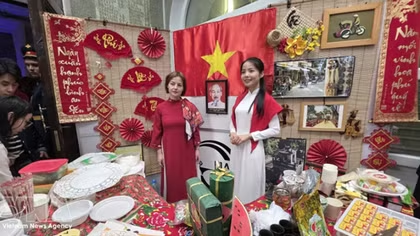
Folk paintings, calligraphy, peach blossom and kumquat trees are very popular in each family in the northern region while apricot blossom is prevalent in the south. They represent affluence, good luck and happiness.

It is also their custom to clear up all debts and conflicts to look towards a new year of full harmony.

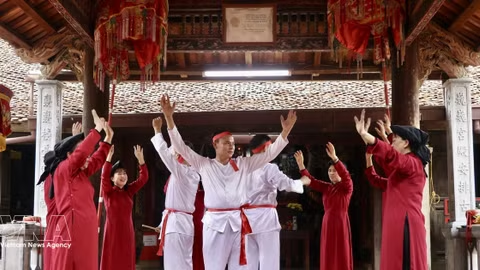
On the Eve of the New Year, each family holds a ceremony to welcome deities, ancestors to their house – a meeting between humans and heavenly spirits.

In front of the altar with spiralling incense smoke and sparkling candles, they clasp hands and pray in deep respect.

According to their belief, the God will appoint new mandarins in charge of the earth during this moment. That’s why they must prepare a tray of offerings to see off old spirits and welcome new ones, in a hope for a year of peace and well-being.
VNA

Other News

Vietnam secure berth at FIFA U17 World Cup 2026 for first time

Vietnam secure berth at FIFA U17 World Cup 2026 for first time

Vietnam national U17 football team secured a place at the FIFA U17 World Cup 2026 for the first time after defeating United Arab Emirates national U17 football team 3-2 on in the final Group C match of the AFC U17 Asian Cup 2026 in Saudi Arabia on early May 14 (Vietnam time).

Vietnam’s most beautiful railway station twins with French counterpart

Vietnam’s most beautiful railway station twins with French counterpart

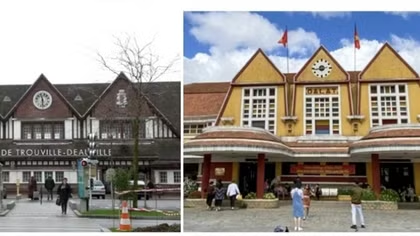
A twinning agreement between Da Lat Railway Station in Vietnam and Trouville-Deauville Railway Station in France was signed at the French Embassy in Vietnam on May 7, creating new opportunities for cooperation in station management and operations, as well as cultural and tourism promotion between the two sides.

Hanoi gains two more craft villages in World Crafts Cities network

Hanoi gains two more craft villages in World Crafts Cities network

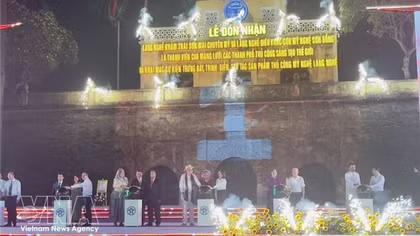
The recognition of Chuyen My and Son Dong craft villages as members of the World Crafts Cities network represents international acknowledgement of the cultural value, artisanal techniques, creativity and sustainable vitality of Vietnam’s traditional craft villages, he said.

Thang Long - Hanoi Festival 2026 to return in September

Thang Long - Hanoi Festival 2026 to return in September

Co-hosted by the municipal People’s Committee, the Department of Culture and Sports, and domestic and foreign agencies, the whole spectacle is meant to honour the city’s millennia-old heritage while reafffirming its strategy of establishing culture as a development engine.

Spreading Vietnamese cultural identity in digital space

Spreading Vietnamese cultural identity in digital space

In the context of deep international integration, cultural identity serves as both a “shield” against assimilation and a defining marker of a nation’s image. Protecting and promoting uniquely Vietnamese cultural values has therefore become a pressing task, particularly in an increasingly complex digital environment.

ITE HCMC 2026 to promote Vietnam’s tourism on global map

ITE HCMC 2026 to promote Vietnam’s tourism on global map

With its large scale, the ITE HCMC 2026 aims to promote tourism cooperation between Vietnam and priority markets such as Northeast Asia, Western Europe, North America, Southeast Asia, and Oceania while also boosting visitor arrivals from the Indian market

Vietnamese puppetry seeks renewal amid preservation challenges

Vietnamese puppetry seeks renewal amid preservation challenges

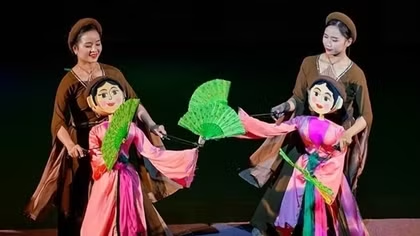
Although widely regarded as a cultural “speciality” attracting tourists, Vietnamese puppetry is facing multiple challenges in preservation and development, requiring renewed efforts to both safeguard its identity and adapt to contemporary cultural currents.

Project on digital transformation in cultural sector approved

Project on digital transformation in cultural sector approved

By 2030, the project targets the establishment of shared digital platforms across 100% of cultural sectors. All digitised cultural heritage will be standardised under the national data framework and shared in accordance with regulations, while 80% of public digital heritage assets are expected to receive digital identifiers to clarify ownership and management, encouraging organisations and individuals to do the same and support market development.

Vietnam eyes becoming region’s leading tourism destination

Vietnam eyes becoming region’s leading tourism destination

Vietnam has in recent years undergone a notable transformation in its tourism development strategy, placing a strong emphasis on nature-based and eco-tourism. This shift is not merely aligned with global trends, but represents a necessary step towards safeguarding valuable natural resources, while appealing to a growing segment of environmentally conscious travellers.