Methanol poisoning up in Hanoi

An increase in the number of serious methanol poisoning cases reported in Hanoi in the past several days has raised concerns among the city’s drinkers and health authorities.

An urgent meeting was held late on March 7 by the National Inter-sector Steering Committee of Food Hygiene and Safety to discuss measures to tackle the situation.

The Vietnam Food Administration and district authorities together inspected 225 alcohol businesses, collected 25 samples and ran tests on three after several cases of alcohol poisoning in Hanoi came to light, the city’s Health Department said.

The tests showed that the methanol content of two alcohol samples collected in the capital city are 900 to 2,000 times higher than permissible level.

The sample taken from two bottles of violet glutinous rice wine at VT Eatery in Ha Dong district’s Mo Lao ward has methanol level of 202,475 mg per litre, which is 2,000 times higher than the permissible level of 100 mg per litre.
The sample from a bottle of homemade alcohol at a house in Thanh Xuan district’s Khuong Dinh ward showed a methanol level of 89,680 mg per litre, 900 times higher than what is permitted.

Officials conducted inspections in Ba Dinh, Ha Dong, Thanh Xuan, Hoang Mai, Phu Xuyen and Thuong Tin districts.

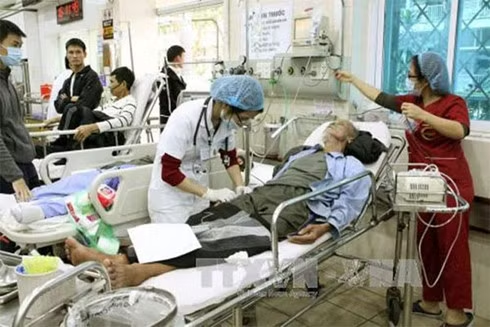
Between February 22 and March 7, Bach Mai Hospital’s Poison Control Centre has treated 11 patients from 40 to 54 years of age for alcohol poisoning, all residents of Dong Da, Thanh Xuan, Hoang Mai, Phuc Tho and Ba Dinh districts; one patient from Phuc Tho died.

All patients reported symptoms such as extreme tiredness and headache, with some slipping into coma. Their blood tests showed high blood methanol concentrations of 40 to 318 mg per decilitre.

Nguyen Hung Long, vice director of VFA, said the administration would be requesting police cooperation to investigate alcohol businesses and take steps against those found violating regulations on methanol content in alcohol.

The city’s health department said it is considering banning private eateries from selling alcohol of unclear origin. It also plans to conduct an awareness drive for alcohol business owners on the possible consequences of consuming alcohol of unclear origin.

In February, seven people died of alcohol poisoning in northern Lai Chau province’s Ta Chai village. The methanol content in the alcohol they consumed was found to be 4,750 to 5,560 times above the permissible limit.

Around 2,000 people suffered from alcohol poisoning across the country between January 28 and 30, the first three days of Tet (Lunar New Year) celebrations, the health ministry said.

VNA

Other News

Hanoi ready to implement Capital Law 2026, unlocking new development momentum

Hanoi ready to implement Capital Law 2026, unlocking new development momentum

The effectiveness of the Capital Law 2026 will be measured not by the number of legal documents issued but by tangible improvements in governance and public administration, better services for people and businesses, faster administrative procedures, stronger investment attraction and higher economic growth.

Vietnamese students earn honours at ROBOG Asia Cup 2026

Vietnamese students earn honours at ROBOG Asia Cup 2026

Three teams from Chu Van An Secondary School in Vietnam’s Thai Nguyen province have earned First Prize honours and advanced to the quarterfinals at the ROBOG Asia Cup 2026, a regional robotics and artificial intelligence (AI) competition for students held in Hong Kong, China.

Hanoi sets out new investment blueprint with century-long development vision

Hanoi sets out new investment blueprint with century-long development vision

As of early June, Hanoi had attracted 74.6 billion USD in foreign direct investment (FDI) through more than 9,250 valid projects. FDI inflows in the first six months were projected at 3.2 billion USD, surpassing the annual target by 116%, while nearly 16,000 new businesses were established in the first five months, up 34.4% year-on-year.

Vietnam promotes legal cooperation and rule of law at global forum

Vietnam promotes legal cooperation and rule of law at global forum

Vietnam’s development and international integration have gone hand in hand with the improvement of its legal system, the incorporation of international commitments into domestic legislation, and legal reforms aimed at fostering development, openness and global integration. The country regards international law as an essential instrument for building fair, mutually beneficial relations among nations.

Hanoi to hold investment promotion event on June 29

Hanoi to hold investment promotion event on June 29

At the event, Hanoi authorities plan to grant investment policy decisions and investment registration certificates to 20 exemplary projects in the fields of transportation infrastructure, industrial parks, urban development, social housing, environment, science and technology, and foreign investment attraction.

Hanoi's Red River urban area development draws widespread attention

Hanoi's Red River urban area development draws widespread attention

Located south of the Red River and extending from the historic inner city to newly developing areas in the south and the west, the central urban area along Red River’s right bank covers approximately 45,317 hectares and is projected to accommodate around 6.365 million residents by 2045 and 6.455 million by 2065.

Hanoi's Red River urban area development draws widespread attention

Hanoi's Red River urban area development draws widespread attention

Located south of the Red River and extending from the historic inner city to newly developing areas in the south and the west, the central urban area along Red River’s right bank covers approximately 45,317 hectares and is projected to accommodate around 6.365 million residents by 2045 and 6.455 million by 2065.

Regional cooperation strengthened to combat cross-border drug crime

Regional cooperation strengthened to combat cross-border drug crime

Vietnam, China, Laos and Myanmar face common challenges as drug syndicates increasingly exploit the Mekong River, cross-border transport networks, e-commerce platforms, international logistics services, cyberspace and cryptocurrencies to organise drug transactions and smuggling operations.