Nam Dinh has four more new-style rural districts

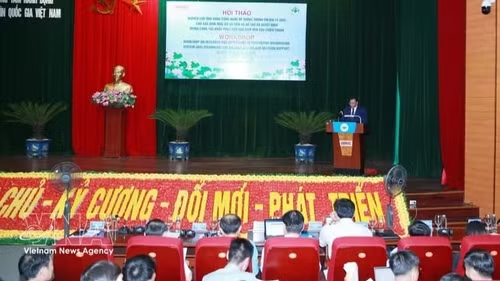
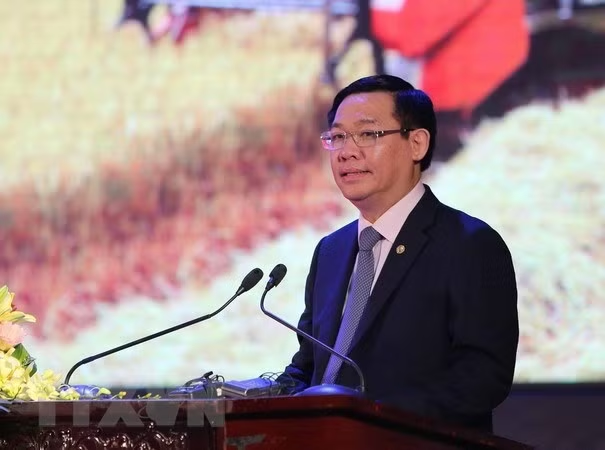
Deputy Prime Minister Vuong Dinh Hue, head of the Steering Committee for National Target Programmes, has handed over the Prime Minister’s decisions recognising four districts of the northern provinces of Nam Dinh as new-style rural areas.
Deputy Prime Minister Vuong Dinh Hue addresses the ceremony (Photo: VNA)

The recognition of the four localities – Nghia Hung, Xuan Truong, Truc Ninh and Giao Thuy – has raised total new-style districts and cities of Nam Dinh to five out of total 10. Hai Hau was the first one receiving the title in 2015.

At the same time, the province currently has 200 out of 209 communes and towns recognised as new-style rural areas.

Addressing the ceremony to hand over the certificates on April 21 in Nam Dinh city, Deputy PM Hue suggested that Nam Dinh province should focus on building socio-economic infrastructure to make it more modern and convenient.

The province should also pay more attention to boost production by strengthening the application of advanced technology in agriculture, while protecting the environment.

The locality is striving to become a new-style rural province in 2020. To this end, the province will speed up the project to restructure its agricultural sector to enhance added value and sustainable development of the sector, while building high technology agriculture models.

Along with State budget, the province will also mobilise social resources to develop its socio-economic infrastructure to improve locals’ living conditions.

In the 2011-2017 period, Nam Dinh spent nearly 16.5 trillion VND in new-style rural building programme, of which only 27.7 percent came from the State budget.

Locals donated nearly 3,000 hectares of farming land and over 200 hectares of building land for road and irrigation expansion as well as public works.

The national target programme on building new-style rural areas, initiated by the Vietnamese Government in 2010, sets 19 criteria on socio-economic development, politics, and defence, aiming to boost rural regions of Vietnam.     

The list of criteria includes the development of infrastructure, the improvement of production capacity, environmental protection, and the promotion of cultural values.      

According to the Ministry of Agriculture and Rural Development, so far, Vietnam has 2,853 recognised new-style rural communes, accounting for 31.96 percent of total communes. Of which, 295 communes fulfilled all criteria of the programme’s new standards for the 2016-2020 period.
VNA

Other News

Hanoi ready to implement Capital Law 2026, unlocking new development momentum

Hanoi ready to implement Capital Law 2026, unlocking new development momentum

The effectiveness of the Capital Law 2026 will be measured not by the number of legal documents issued but by tangible improvements in governance and public administration, better services for people and businesses, faster administrative procedures, stronger investment attraction and higher economic growth.

Vietnamese students earn honours at ROBOG Asia Cup 2026

Vietnamese students earn honours at ROBOG Asia Cup 2026

Three teams from Chu Van An Secondary School in Vietnam’s Thai Nguyen province have earned First Prize honours and advanced to the quarterfinals at the ROBOG Asia Cup 2026, a regional robotics and artificial intelligence (AI) competition for students held in Hong Kong, China.

Hanoi sets out new investment blueprint with century-long development vision

Hanoi sets out new investment blueprint with century-long development vision

As of early June, Hanoi had attracted 74.6 billion USD in foreign direct investment (FDI) through more than 9,250 valid projects. FDI inflows in the first six months were projected at 3.2 billion USD, surpassing the annual target by 116%, while nearly 16,000 new businesses were established in the first five months, up 34.4% year-on-year.

Vietnam promotes legal cooperation and rule of law at global forum

Vietnam promotes legal cooperation and rule of law at global forum

Vietnam’s development and international integration have gone hand in hand with the improvement of its legal system, the incorporation of international commitments into domestic legislation, and legal reforms aimed at fostering development, openness and global integration. The country regards international law as an essential instrument for building fair, mutually beneficial relations among nations.

Hanoi to hold investment promotion event on June 29

Hanoi to hold investment promotion event on June 29

At the event, Hanoi authorities plan to grant investment policy decisions and investment registration certificates to 20 exemplary projects in the fields of transportation infrastructure, industrial parks, urban development, social housing, environment, science and technology, and foreign investment attraction.

Hanoi's Red River urban area development draws widespread attention

Hanoi's Red River urban area development draws widespread attention

Located south of the Red River and extending from the historic inner city to newly developing areas in the south and the west, the central urban area along Red River’s right bank covers approximately 45,317 hectares and is projected to accommodate around 6.365 million residents by 2045 and 6.455 million by 2065.

Hanoi's Red River urban area development draws widespread attention

Hanoi's Red River urban area development draws widespread attention

Located south of the Red River and extending from the historic inner city to newly developing areas in the south and the west, the central urban area along Red River’s right bank covers approximately 45,317 hectares and is projected to accommodate around 6.365 million residents by 2045 and 6.455 million by 2065.

Regional cooperation strengthened to combat cross-border drug crime

Regional cooperation strengthened to combat cross-border drug crime

Vietnam, China, Laos and Myanmar face common challenges as drug syndicates increasingly exploit the Mekong River, cross-border transport networks, e-commerce platforms, international logistics services, cyberspace and cryptocurrencies to organise drug transactions and smuggling operations.