Nguyen Dynasty’s reforms expressed through chau ban

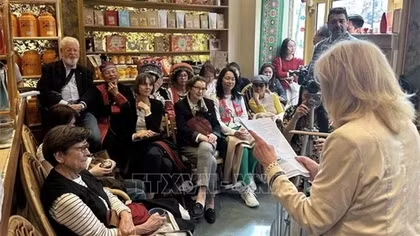
Administrative reforms are very important to the development of a nation, State managers and researchers agreed during a conference reviewing administrative reforms under the Nguyen Dynasty (1802-1945), reflected through chau ban (official administrative papers).

nguyen dynasty’s reforms expressed through chau ban hinh 0

The Ministry of Home Affairs hosted the event in Hanoi late last week with the aim of acknowledging the value of administrative reforms under the Nguyen Dynasty.

The panelists discussed what can be learnt from the Kings’ policies and how the reforms continue to influence the country today.

Deputy Minister of Home Affairs Nguyen Trong Thua said "this is the good chance for us to acknowledge the great contributions of the ancestors in establishing and developing the country".

“By the way, we also have lessons learnt from administrative reforms in history, to apply to today’s society,” he said. “The conference is also a forum to research further and exchange knowledge about the regulations and remarkable achievements of administrative reforms in the history,” said Thua.

Opening the conference, Dang Thanh Tung, head of the State Department for Records and Archives, said at least one administrative reform was organised during each dynasty.

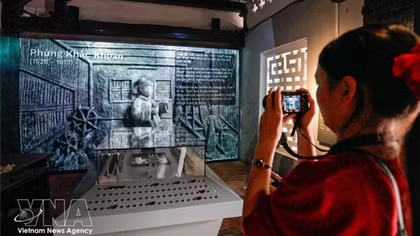
Chau ban, including laws, decrees, edicts and instructions for resolving problems in various fields such as politics, military affairs, foreign affairs, economy, society and culture, received the certificate of the Asian-Pacific Region’s Memory of the World Programme in 2014. They also recorded details of the administrative reforms of the Nguyen Kings.

When King Gia Long (1762-1820) started the Nguyen Dynasty, he made new policies such as naming the country Vietnam and introduce new seals and currency.

King Minh Mang (1791-1841) released a royal proclamation that ensured students of Quoc Tu Giam (a royal college built in 1803 in the imperial city of Hue) would receive allowances to encourage them in their study.

In addition, “thieves who confessed their guilt before being investigated would receive clemency”, wrote the king.

Phan Thanh Hai, Director of the Hue Monuments Conservation Centre, remarked that some policies of King Minh Mang still work in the modern society.

For example, he applied the law of hoi ty (a phrase that literarily means “keeping away”) in managing mandarins. Accordingly, people who share a blood line or have a close relationship won’t be appointed to the same office. In an exam, if the contestant and the mandarin working at the examination compound had a close relationship, one of them had to move to another place.

“The law is still up-to-date nowadays, it prevents corruption and collusion to unfairly benefit a single group,” said Hai.

Nguyen Thu Hoai from the National Archives Centre 1 said King Bao Dai tried to create administrative reforms though the country was colonised by the French.

He allowed to open a part of the Royal Citadel to visitors starting in 1938, to showcase a part of the chau ban for public exhibition in 1943, to name streets after Vietnamese famous people, and to allow Vietnamese workers to have a day off on May Day.
VNS/VNA

Other News

Vietnam secure berth at FIFA U17 World Cup 2026 for first time

Vietnam secure berth at FIFA U17 World Cup 2026 for first time

Vietnam national U17 football team secured a place at the FIFA U17 World Cup 2026 for the first time after defeating United Arab Emirates national U17 football team 3-2 on in the final Group C match of the AFC U17 Asian Cup 2026 in Saudi Arabia on early May 14 (Vietnam time).

Vietnam’s most beautiful railway station twins with French counterpart

Vietnam’s most beautiful railway station twins with French counterpart

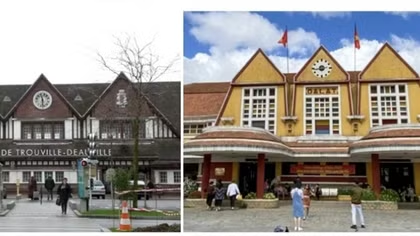
A twinning agreement between Da Lat Railway Station in Vietnam and Trouville-Deauville Railway Station in France was signed at the French Embassy in Vietnam on May 7, creating new opportunities for cooperation in station management and operations, as well as cultural and tourism promotion between the two sides.

Hanoi gains two more craft villages in World Crafts Cities network

Hanoi gains two more craft villages in World Crafts Cities network

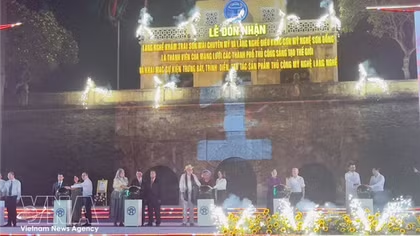
The recognition of Chuyen My and Son Dong craft villages as members of the World Crafts Cities network represents international acknowledgement of the cultural value, artisanal techniques, creativity and sustainable vitality of Vietnam’s traditional craft villages, he said.

Thang Long - Hanoi Festival 2026 to return in September

Thang Long - Hanoi Festival 2026 to return in September

Co-hosted by the municipal People’s Committee, the Department of Culture and Sports, and domestic and foreign agencies, the whole spectacle is meant to honour the city’s millennia-old heritage while reafffirming its strategy of establishing culture as a development engine.

Spreading Vietnamese cultural identity in digital space

Spreading Vietnamese cultural identity in digital space

In the context of deep international integration, cultural identity serves as both a “shield” against assimilation and a defining marker of a nation’s image. Protecting and promoting uniquely Vietnamese cultural values has therefore become a pressing task, particularly in an increasingly complex digital environment.

ITE HCMC 2026 to promote Vietnam’s tourism on global map

ITE HCMC 2026 to promote Vietnam’s tourism on global map

With its large scale, the ITE HCMC 2026 aims to promote tourism cooperation between Vietnam and priority markets such as Northeast Asia, Western Europe, North America, Southeast Asia, and Oceania while also boosting visitor arrivals from the Indian market

Vietnamese puppetry seeks renewal amid preservation challenges

Vietnamese puppetry seeks renewal amid preservation challenges

Although widely regarded as a cultural “speciality” attracting tourists, Vietnamese puppetry is facing multiple challenges in preservation and development, requiring renewed efforts to both safeguard its identity and adapt to contemporary cultural currents.

Project on digital transformation in cultural sector approved

Project on digital transformation in cultural sector approved

By 2030, the project targets the establishment of shared digital platforms across 100% of cultural sectors. All digitised cultural heritage will be standardised under the national data framework and shared in accordance with regulations, while 80% of public digital heritage assets are expected to receive digital identifiers to clarify ownership and management, encouraging organisations and individuals to do the same and support market development.

Vietnam eyes becoming region’s leading tourism destination

Vietnam eyes becoming region’s leading tourism destination

Vietnam has in recent years undergone a notable transformation in its tourism development strategy, placing a strong emphasis on nature-based and eco-tourism. This shift is not merely aligned with global trends, but represents a necessary step towards safeguarding valuable natural resources, while appealing to a growing segment of environmentally conscious travellers.