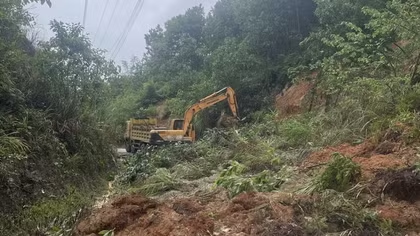
- Hai Phong Police help to remove oil leak on National Highway
- Hải Phòng eases ban on National Highway No 5
Pham Huu Son, director general of Transport Engineering Design Inc (TEDI), the project’s consultant, said previously the MoT had set a target of completing the 1,372km of North-South road by 2020 and proposed that the Government set aside VND70 trillion (US$3.08 billion) for a Public Private Partnership model.
However, in accordance with the State’s medium-term public investment plan, about VND70 trillion from Government bonds will be allocated to the MoT for all projects, including some sections of the expressway. "If all the capital is spent on the North-South Expressway, the other projects will have to stop because of capital shortage," Son told Vietnamplus.vn online newspaper.
Thus, TEDI has adjusted the project plan by dividing it into two phases. Accordingly, about 573km of the expressway will be completed in the first phase from 2017 to 2022, Son said.
The total investment for the first phase will be VND88.5 trillion ($3.9 billion), with the Government expected to cover 46.8 per cent and private investors the rest.
The project’s first phase will focus on upgrading the sections of Cao Bo (Nam Dinh)-Mai Son (Ninh Binh)-Vinh (Nghe An) and Vinh Hao-Phan Thiet (Binh Thuan)-Dau Giay (Dong Nai) into a four-lane expressway.
Construction of the other sections, totalling 799km, is expected to start in 2023 and finish in 2025.
The total investment for the second phase of the project will be VND114.6 trillion ($5 billion). Of these, VND34.3 trillion ($1.5 billion) or 30 per cent of the capital, will be funded by the State and the rest mobilised from private investors.
If the proposal is approved by the Government, the MoT expects to start construction by the end of 2017.
Da Nang moves forward with railway plan
The city of Da Nang has started a pre-feasibility study to relocate the city’s railway station and redevelop the space with an urban project at a total cost of VND15.44 trillion (US$683.2 million).
The city’s chairman, Huynh Duc Tho, announced the plan after a meeting with the city’s relevant agencies, departments and representatives of the World Bank and Asia Development Bank (ADB).
Tho said the project would be a crucial part of dealing with the city’s traffic congestion and act as a face-lift for the city’s future.
As scheduled, the new railway station will be built in Lien Chieu District on a space of 43.1ha, with a new 18.21km rail line and an improvement of 7km of old track, as well as a new 80.1ha cargo station on the site of the current Kim Lien station.
The removal project also covers an upgraded Le Trach cargo station on 9.6ha, a new bridge for trains spanning the Cu De River, and five lane fly-over bridge at the road-railway crossing.
The railway station removal, which costs nearly VND5.8 trillion ($257 million), has been included in the city’s Master Plan for 2030 with a vision to 2050.
The city is also planning an urban redevelopment project with synchronised public transport routes connecting to the new railway station, with total investment of VND9.677 trillion ($428.2 million).
As planned, the new railway station will help link the key North-South railway system with the on-going construction Da Nang-Quang Ngai Expressway, the East-West Economic Corridor and Viet Nam-trans road transport – the National Highway No 1 – and new Lien Chieu deep sea cargo port.
According to the Da Nang railway station management board, the station, which was built in 1902 in the city’s downtown Hai Phong Street, was not able to handle the rising number of train passengers travelling to the city.
Around 20 trains arrive, depart and pass through the station daily, carrying about 75,000 people to the city.
The central city, situated at the end of the East-West Economic Corridor, which links Laos, Thailand, Myanmar and Viet Nam, plays an important role as a logistical centre for the coastal central and Central Highlands regions.
The railway removal project is part of a strategy to develop Da Nang as a green city by 2025, and an economic hub and driving force for boosting development of the central and Central Highlands regions.
Under the adjustment plan, the city will develop public transport with 15 bus routes, eight Bus Rapid Transit (BRT) routes and three metro routes, which aim to reduce carbon emissions, as well as address overcrowding and traffic congestion.
Last year, the Government issued special regulations concerning Da Nang’s investment, budgetary status and decentralisation.
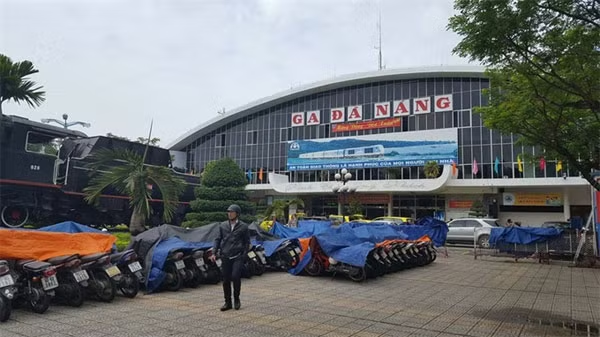 |
| Da Nang’s downtown railway station will be moved to a new location in Lien Chieu District, to ease traffic congestion and develop better connections with a multi-vehicle transport system. |