“Abandoned by Heaven”, a solo exhibition of oil and Dong Ho folk paintings on canvas by Hanoi-based artist Bui Thanh Tam will be held from now to November 2 at Craig Thomas Gallery, 27(i) Tran Nhat Duat Street, Tan Dinh Ward, Dist. 1, HCM City.
At first glance, the paintings of Bui Thanh Tam’s “Abandoned by Heaven” collection project an air of innocence and a pollyanish sense of contentment.
The doe-eyed figures in the paintings look to be in the midst of living happy and prosperous lives, but there is something amiss lying just underneath the surface of the paintings.
The most easily distinguishable signal is given in the form of the twisted branches of the peach blossom trees featured in many of the paintings.
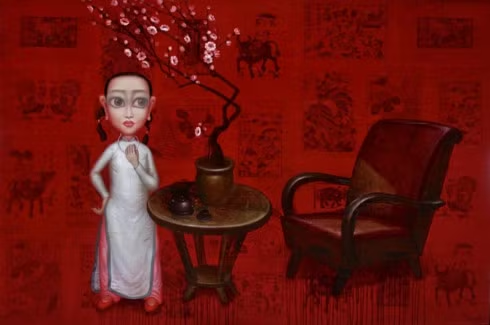 |
They are in full bloom which brings associations of spring and renewal, but the unnatural positions of the branches suggest a conscious contortion that has distorted what was once beautiful and pure.
The central question Tam is asking with his latest series is where Vietnamese society is heading if it fails to cultivate and nurture its centuries’ old traditional folk arts and cultural practices.
The material progress the country has made over the past two decades is undoubtedly a profoundly positive development for the great majority of its citizens, but it also comes with certain costs that can be measured and quantified in terms of environmental degradation and other negative side effects.
In his role as a contemporary artist, Tam feels a responsibility to do a more abstract calculation of the cultural costs that have been associated with Vietnam’s recent period of rapid urbanization and economic development.
“In terms of tangible culture, many historical monuments and artifacts of historical importance have been renovated, or, in some cases, completely destroyed. We have lost whole lines of folk art and many traditional craft villages have disappeared without a trace. In terms of our intangible heritage, the loss and deformation of our culture is happening at an alarming speed,” Tam said.
“Our young people no longer have the desire to preserve our unique forms of poetry, music and theater; our traditional culture is simply being replaced by that of the West. The resulting confused mixture has many negative effects on the behavior, morality and spirituality of our people leading to a loss of identity and what makes us special. The more ‘modern’ our world becomes, the more jealousy, insincerity and cruelty enters into our daily life. I attribute this to a method of teaching culture that is incorrect, and, ultimately, failing us,” he added.
While there is an earnest moral lesson at the heart of his work, Tam leavens the potential didacticism through the use of parody and humor. His often whimsical paintings focus on the ridiculous contradictions between his subjects’ contemporary lives and his view of a more traditional Vietnamese existence.
Tam has spoken of the influence that the Cynical Realism of Chinese painters has had on his work.
Arising in China in the 1990s, the work of the Cynical Realists used humor and irony in confronting their society’s socio-political issues through their art.
Featuring characters that often shared the exaggerated grinning face of the artists themselves, the art of the Cynical Realists focused on the transition from the old to the modern that China was experiencing and the confusion arising therefrom.
In a similar way, Tam’s paintings can be seen as cynical commentaries on the state of contemporary society in Vietnam.
He chooses to use Dong Ho folk paintings in the background of many of his works as an over-arching symbolic representation of traditional Vietnamese culture.
The traditional themes of Dong Ho paintings include good luck signs, historical figures, folk allegories and popular stories.
The compositions tend to reflect the lifestyles and concerns of a rural people living in close commune with nature.
Most commonly associated with Tet, Dong Ho paintings have long been used in Vietnam by craftspeople to express their concerns about social, political and cultural issues. As a metaphor for cultural loss, Tam’s choice of Dong Ho paintings is an apt one.
Once produced by hundreds of craftspeople in a number of villages of Northern Vietnam, the practice has all but died out. Once a proud piece of Vietnam’s cultural heritage, Dong Ho paintings are now likely to be produced on printing presses and sold as kitsch to foreign visitors to the country.
Tam said: “Once there was a fine culture, rich in identity and tradition, made up of Vietnamese men and women who held high standards of humanity, but they are quickly disappearing with time! Even heaven, which lives for all human beings, will eventually abandon us when we are unable to appreciate and protect our own values. Today we tread roughly over the world built by our forefathers through the millennia and destroy their beautiful traditions that have sustained our society since time immemorial. Instead of caring for this invaluable legacy which we have inherited, we care only for personal gain – money, status, and power – with no regard for the negative future consequences this selfishness will reap.”
While Tam’s is an essentially conservative vision, his work should not be viewed as an indictment of Western culture which he calls “civilized, progressive and compelling.”
Tam is disturbed by the less positive side-effects of Vietnam’s modernization including the rampant consumerism and narcissism the process has engendered. His ideal result would be a synthesis between the traditional and the modern that would allow the country to flourish and prosper, but would also retain what is unique and special about Vietnam.
“If we can manage to preserve the roots of our traditional Vietnamese culture as we modernize, in my opinion, the Vietnamese people will be purer and better,” he said.
Tam currently resides in Hanoi. He is a 2009 graduate of the Vietnam Fine Arts University.


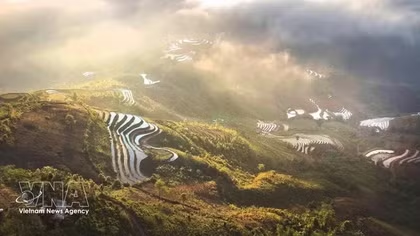
In recent years, Ta Xua, dubbed "the paradise of clouds", has emerged as one of the mountainous destinations attracting strong interest from young travellers, particularly for its spectacular sea of clouds stretching across the mountains in the northwestern region.
Training local young people in filming, audio recording, digital storytelling, data preservation and responsible use of AI can help build a new generation of cultural custodians. This, in turn, can help transform cultural heritage into a resource for economic development while contributing to the country’s broader development.
The exhibits are presented as historical and legal materials proving Vietnam’s sovereignty over Hoang Sa and Truong Sa in the East Sea.
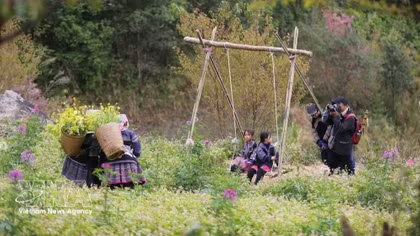
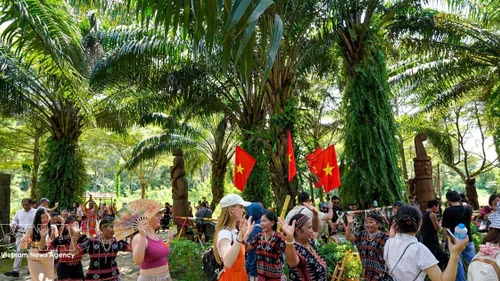
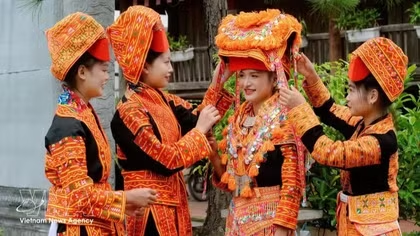
With growing recognition of indigenous knowledge, customs and cultural values as unique assets, ethnic communities in the northern mountainous region are shifting from simply providing tourism services to becoming creators and owners of tourism products, confidently telling their own cultural stories
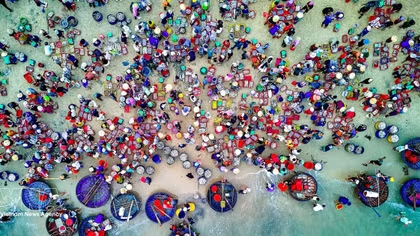
When local people remain the custodians of their resources, tourism can become a reason for them to stay, maintain their livelihoods, and renew community value rather than replacing it.
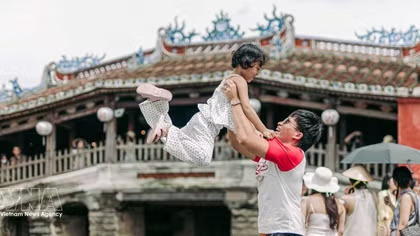
Alongside the RoK, Da Nang has stepped up tourism promotion in India, Japan, China, Russia and CIS countries, Australia, Europe, the Middle East and Southeast Asia.
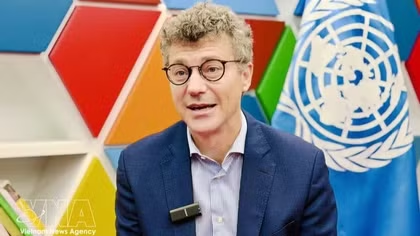
Jonathan Wallace Baker, UNESCO Representative to Vietnam, noted that the official proclamation of the 2027–2036 period as the "International Decade of Culture for Sustainable Development" comes at a particularly important moment. As the international community works to accelerate progress towards the 2030 Agenda while beginning to consider what comes after 2030, the Decade provides a ten-year framework to strengthen the place of culture in development.
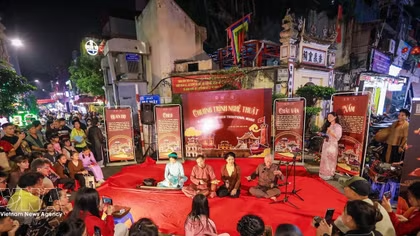
Under Resolution 80-NQ/TW, dated January 7, 2026, November 24 was designated Vietnam Culture Day, to be observed annually. The occasion aims to give the public opportunities to participate in, create and enjoy cultural activities, helping spread positive values and foster pride in Vietnamese culture.
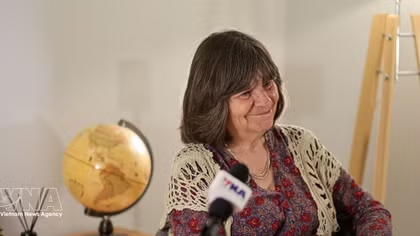
"Vietnam is part of my life," affirmed Patricia Abarzua Munoz, emphasising that the friendship between the Chilean and Vietnamese peoples is built on shared values and mutual respect.

For the MICE tourism sector in both Ho Chi Minh City and Vietnam, growth can no longer be driven merely by increasing the number of events; instead, the focus must shift to enhancing the value of each event and the competitiveness of each destination.
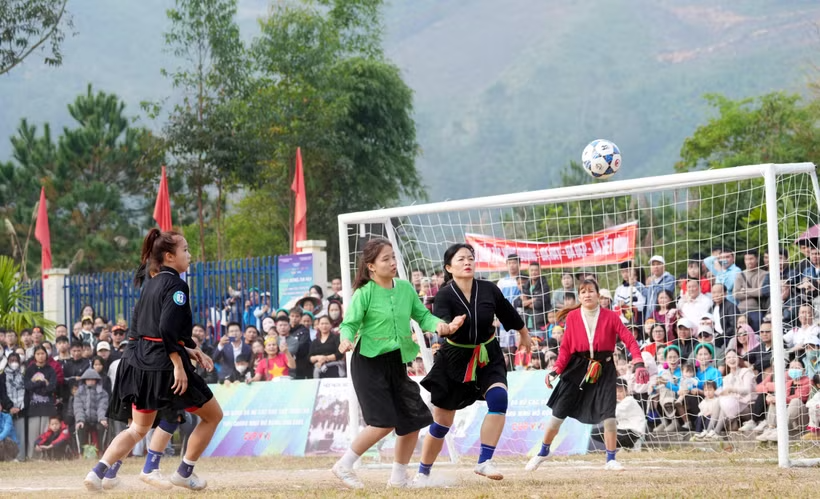
Women’s football movements in local communities have been quietly growing, but they’ve now built up enough momentum to inspire organisers to launch the first Vietnam Ethnic Minority Women’s Football – VTV Cup in 2026.
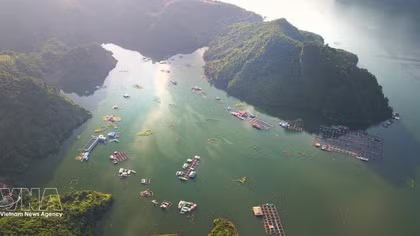
For 2026, Vietnam's tourism sector is targeting 25 million foreign arrivals, 150 million domestic trips and total revenue of 1.125 quadrillion VND (43 billion USD).
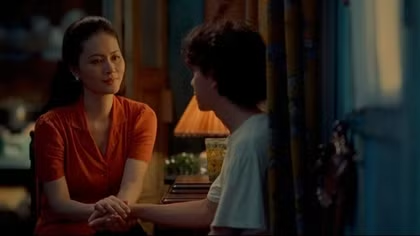
Vietnamese film Quan Ky Nam (Ky Nam Inn) has won several awards at the 25th Imagine India International Film Festival (IIIFF) in Madrid, including Best Director.

According to the magazine, boat trips into Phong Nha Cave and strolls through Paradise Cave (both family-friendly) offer a tantalising glimpse of their astonishing scale, but the real adventure lies deeper within the park, where cavers wade through underground rivers and weave among stalagmites.

Tourism effectiveness should be measured not only by visitor numbers and revenue, but also by spending, length of stay, repeat visits, job quality, visitor satisfaction and environmental carrying capacity, said experts.
The National Statistics Office under the Ministry of Finance reported that Vietnam welcomed nearly 2 million international visitors in August, up 19.7% from July and 18.4% year-on-year. The figure represented 63.6% of the tourism sector’s full-year target of 25 million arrivals.

For the Mong people in Ta Dung, Dak R’mang is not merely a weekly rendezvous, but a space preserving memories of their northwestern hometowns and cultural identity in their new land.

Ngo Phuong Ly, the spouse of General Secretary of the Communist Party of Vietnam Central Committee and President To Lam, said the two countries share similarities in silk weaving and can enrich their cultural heritage through exchanges and experience sharing.

The Ho Chi Minh City Department of Tourism said on late September 2 that the southern metropolis welcomed an estimated 1.65 million domestic visitors and 62,000 foreign tourists over the break.