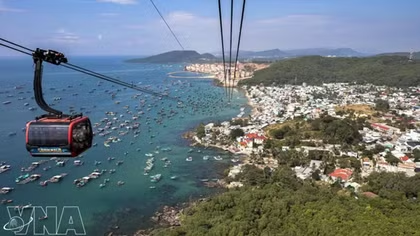
Phu Quoc to welcome foreign tourists under pilot program

Visitors must meet certain requirements including a certificate of full vaccination or recovery from COVID-19 not more than 12 months from the date of their release from hospital to the date of entry.

Phu Quoc to welcome foreign tourists under pilot scheme -0
Phu Quoc to welcome foreign tourists under pilot scheme.

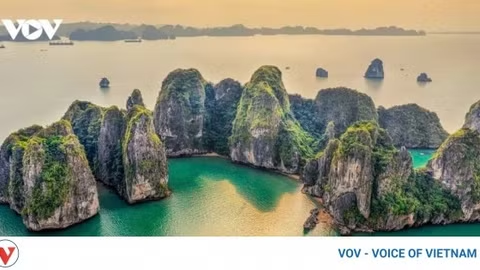
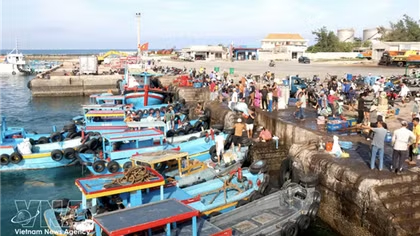
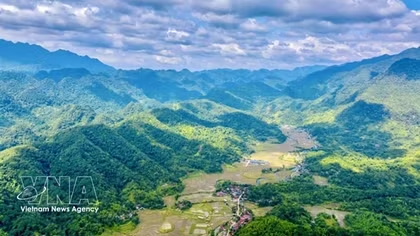
After two years of “freezing”, the Phu Quoc island city in the Mekong Delta province of Kien Giang is expected to be first destination in the country to receive foreign tourists after the Government approved the Ministry of Culture, Sports and Tourism’ proposal on a pilot plan to welcome tourists back under the vaccine passport programme.

Under the plan, visitors from countries with high safety in COVID-19 prevention and control in regions such as Northeast Asia, Europe, the US, the Middle East, and Australia will need to book package tours of travel agencies if they want to go to Phu Quoc.

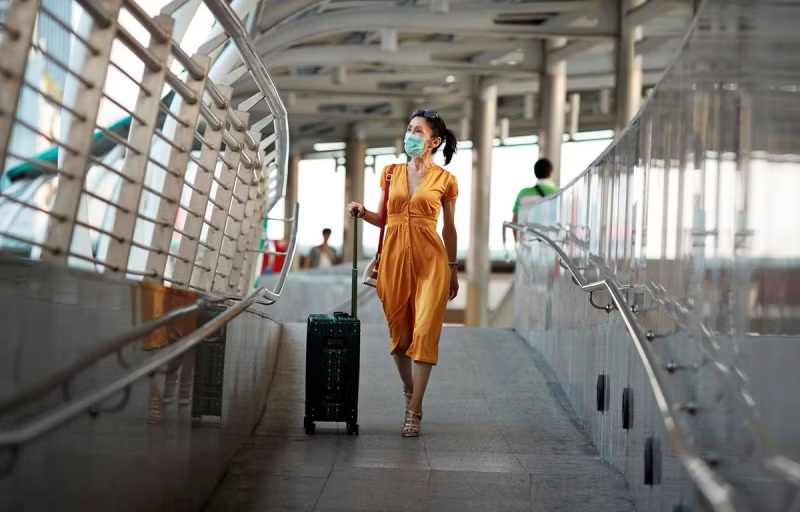
To enter the country, visitors must meet certain requirements including a certificate of full vaccination or recovery from COVID-19 not more than 12 months from the date of their release from hospital to the date of entry. They also have to present a negative COVID-19 testing certificate issued by authorised agencies within 72 hours before departure.

Children under 12 years old have to travel with  their parents or guardians that satisfy the above-mentioned papers.

Visitors are also required to install the Vietnam Safe Travel or the Healthy Vietnam apps and make a medical declaration through those apps. In case visitors do not meet all the necessary requirements, they may be denied entry and bear the cost of returning to their home country or transit.

After arriving in the country, visitors must comply with the Health Ministry’s 5K message – khau trang (face masks), khu khuan (disinfection), khoang cach (distancing), khong tu tap (no gatherings), and khai bao y te (health declarations).

Any tourists who have suspicion symptoms forCOVID-19 at the entry point should follow quarantine measures, and always turn on bluetooth and GPS after installing medical declaration applications.

Visitors have to travel on their designated cars in line with the approved schedule. Service staff, drivers, guides and tourists are required to wear masks throughout the journey.

Depending on the outcome of the first phase, the pilot programme would be scaled up to welcome 5,000-10,000 passengers per month on commercial flights, and the sites opened to foreign visitors might be extended.
By TM

Other News

Vietnam secure berth at FIFA U17 World Cup 2026 for first time

Vietnam secure berth at FIFA U17 World Cup 2026 for first time

Vietnam national U17 football team secured a place at the FIFA U17 World Cup 2026 for the first time after defeating United Arab Emirates national U17 football team 3-2 on in the final Group C match of the AFC U17 Asian Cup 2026 in Saudi Arabia on early May 14 (Vietnam time).

Vietnam’s most beautiful railway station twins with French counterpart

Vietnam’s most beautiful railway station twins with French counterpart

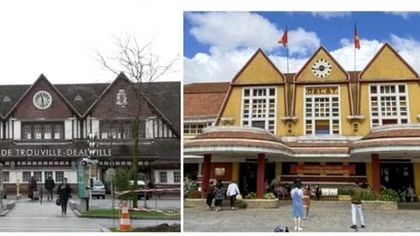
A twinning agreement between Da Lat Railway Station in Vietnam and Trouville-Deauville Railway Station in France was signed at the French Embassy in Vietnam on May 7, creating new opportunities for cooperation in station management and operations, as well as cultural and tourism promotion between the two sides.

Hanoi gains two more craft villages in World Crafts Cities network

Hanoi gains two more craft villages in World Crafts Cities network

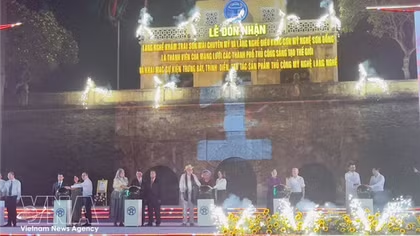
The recognition of Chuyen My and Son Dong craft villages as members of the World Crafts Cities network represents international acknowledgement of the cultural value, artisanal techniques, creativity and sustainable vitality of Vietnam’s traditional craft villages, he said.

Thang Long - Hanoi Festival 2026 to return in September

Thang Long - Hanoi Festival 2026 to return in September

Co-hosted by the municipal People’s Committee, the Department of Culture and Sports, and domestic and foreign agencies, the whole spectacle is meant to honour the city’s millennia-old heritage while reafffirming its strategy of establishing culture as a development engine.

Spreading Vietnamese cultural identity in digital space

Spreading Vietnamese cultural identity in digital space

In the context of deep international integration, cultural identity serves as both a “shield” against assimilation and a defining marker of a nation’s image. Protecting and promoting uniquely Vietnamese cultural values has therefore become a pressing task, particularly in an increasingly complex digital environment.

ITE HCMC 2026 to promote Vietnam’s tourism on global map

ITE HCMC 2026 to promote Vietnam’s tourism on global map

With its large scale, the ITE HCMC 2026 aims to promote tourism cooperation between Vietnam and priority markets such as Northeast Asia, Western Europe, North America, Southeast Asia, and Oceania while also boosting visitor arrivals from the Indian market

Vietnamese puppetry seeks renewal amid preservation challenges

Vietnamese puppetry seeks renewal amid preservation challenges

Although widely regarded as a cultural “speciality” attracting tourists, Vietnamese puppetry is facing multiple challenges in preservation and development, requiring renewed efforts to both safeguard its identity and adapt to contemporary cultural currents.

Project on digital transformation in cultural sector approved

Project on digital transformation in cultural sector approved

By 2030, the project targets the establishment of shared digital platforms across 100% of cultural sectors. All digitised cultural heritage will be standardised under the national data framework and shared in accordance with regulations, while 80% of public digital heritage assets are expected to receive digital identifiers to clarify ownership and management, encouraging organisations and individuals to do the same and support market development.

Vietnam eyes becoming region’s leading tourism destination

Vietnam eyes becoming region’s leading tourism destination

Vietnam has in recent years undergone a notable transformation in its tourism development strategy, placing a strong emphasis on nature-based and eco-tourism. This shift is not merely aligned with global trends, but represents a necessary step towards safeguarding valuable natural resources, while appealing to a growing segment of environmentally conscious travellers.