Phu Yen welcomes UNESCO status for Bai Choi singing

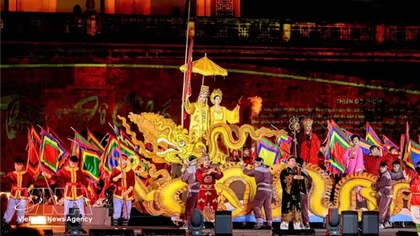
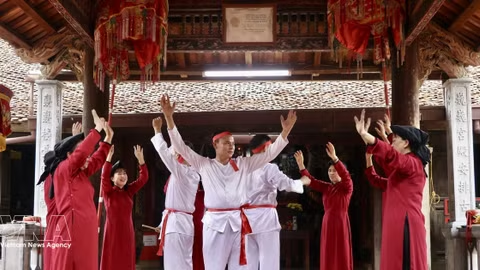
A ceremony was held in Tuy Hoa city, the south central province of Phu Yen, on May 20 to receive a certificate from UNESCO recognising Bai Choi singing, a popular folklore style of singing in central Vietnam, as an Intangible Cultural Heritage of Humanity.

phu yen welcomes unesco status for bai choi singing hinh 0
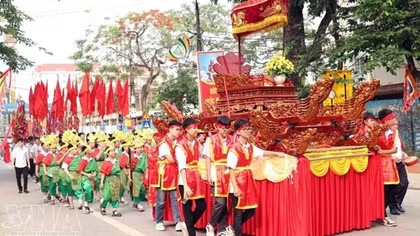
At the ceremony held in Tuy Hoa city, Phu Yen province on May 20 to receive a certificate from UNESCO recognising Bai Choi singing as an Intangible Cultural Heritage of Humanity 

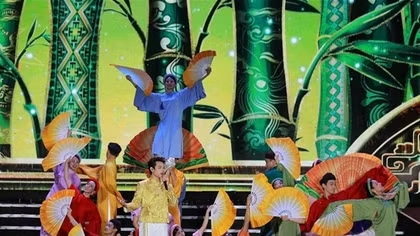
The ceremony featured a parade with the UNESCO certificate held up high and performances of Bai Choi singing, attracting tens of thousands of locals and visitors.

Earlier, the recognition of Bai Choi singing was made during the 12th session of the UNESCO Inter-governmental Committee for the Safeguarding of the Intangible Cultural Heritage in Jeju, the Republic of Korea (RoK), on December 7, 2017.

The folk singing genre is popular in the central provinces of Quang Binh, Quang Tri, Thua Thien-Hue, Quang Nam, Quang Ngai, Binh Dinh, Phu Yen and Khanh Hoa, and Da Nang city.

Bai choi is often seen at local spring festivals and resembles a game, using playing cards and village huts.

The stage for Bai choi performances encompasses nine cottages, each containing five or six ‘players’. One of the cottages, the central house, contains a troupe of musicians and instruments. A deck of playing cards is split in half, with one stack distributed amongst the players, and the other placed in the central house. The cards are stuck onto bamboo poles and erected outside the cottages.

The game singer delivers a flag to each cottage, all the while singing Bai choi, and then draws a card from the central house. Whoever holds the card closest in value to the game singer’s card wins.

The Bai choi songs are about festivals, daily life and work, and are accompanied by musical instruments.

The game and songs were developed by Mandarin Dao Duy Tu (1572-1634) to help locals protect their crops.

According to the Inter-governmental Committee for the Safeguarding of the Intangible Cultural Heritage, Bai Choi is an important cultural activity in Vietnamese villages and communes, meeting the demand for entertainment and arts of the community.

Bai Choi songs are moral lessons, demonstrating patriotism, connectivity in the community and living experience of people.

The Ministry of Culture, Sports and Tourism recognised Bai Choi as national intangible cultural heritage during 2014-2016.

Apart from Bai Choi, the UNESCO Representative List of the Intangible Cultural Heritage of Humanity includes other 11 Vietnamese heritage – the traditional practice of “Tho Mau Tam Phu” (Worship of Mother Goddesses), tug-of-war game, which is also played in Cambodia, the RoK and the Philippines, Nghe Tinh province’s Vi-Giam folk singing, Don ca tai tu (amateur singing in southern Vietnam), Hung King worship ritual, Xoan singing of Phu Tho province, Giong festival and Soc temples in Hanoi, Ca Tru (ceremonial singing), Bac Ninh province’s Quan ho (love duet singing), the space of Gong culture in the Central Highlands and Hue's royal court music.
VNA

Other News

Vietnam secure berth at FIFA U17 World Cup 2026 for first time

Vietnam secure berth at FIFA U17 World Cup 2026 for first time

Vietnam national U17 football team secured a place at the FIFA U17 World Cup 2026 for the first time after defeating United Arab Emirates national U17 football team 3-2 on in the final Group C match of the AFC U17 Asian Cup 2026 in Saudi Arabia on early May 14 (Vietnam time).

Vietnam’s most beautiful railway station twins with French counterpart

Vietnam’s most beautiful railway station twins with French counterpart

A twinning agreement between Da Lat Railway Station in Vietnam and Trouville-Deauville Railway Station in France was signed at the French Embassy in Vietnam on May 7, creating new opportunities for cooperation in station management and operations, as well as cultural and tourism promotion between the two sides.

Hanoi gains two more craft villages in World Crafts Cities network

Hanoi gains two more craft villages in World Crafts Cities network

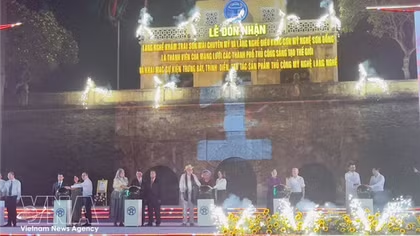
The recognition of Chuyen My and Son Dong craft villages as members of the World Crafts Cities network represents international acknowledgement of the cultural value, artisanal techniques, creativity and sustainable vitality of Vietnam’s traditional craft villages, he said.

Thang Long - Hanoi Festival 2026 to return in September

Thang Long - Hanoi Festival 2026 to return in September

Co-hosted by the municipal People’s Committee, the Department of Culture and Sports, and domestic and foreign agencies, the whole spectacle is meant to honour the city’s millennia-old heritage while reafffirming its strategy of establishing culture as a development engine.

Spreading Vietnamese cultural identity in digital space

Spreading Vietnamese cultural identity in digital space

In the context of deep international integration, cultural identity serves as both a “shield” against assimilation and a defining marker of a nation’s image. Protecting and promoting uniquely Vietnamese cultural values has therefore become a pressing task, particularly in an increasingly complex digital environment.

ITE HCMC 2026 to promote Vietnam’s tourism on global map

ITE HCMC 2026 to promote Vietnam’s tourism on global map

With its large scale, the ITE HCMC 2026 aims to promote tourism cooperation between Vietnam and priority markets such as Northeast Asia, Western Europe, North America, Southeast Asia, and Oceania while also boosting visitor arrivals from the Indian market

Vietnamese puppetry seeks renewal amid preservation challenges

Vietnamese puppetry seeks renewal amid preservation challenges

Although widely regarded as a cultural “speciality” attracting tourists, Vietnamese puppetry is facing multiple challenges in preservation and development, requiring renewed efforts to both safeguard its identity and adapt to contemporary cultural currents.

Project on digital transformation in cultural sector approved

Project on digital transformation in cultural sector approved

By 2030, the project targets the establishment of shared digital platforms across 100% of cultural sectors. All digitised cultural heritage will be standardised under the national data framework and shared in accordance with regulations, while 80% of public digital heritage assets are expected to receive digital identifiers to clarify ownership and management, encouraging organisations and individuals to do the same and support market development.

Vietnam eyes becoming region’s leading tourism destination

Vietnam eyes becoming region’s leading tourism destination

Vietnam has in recent years undergone a notable transformation in its tourism development strategy, placing a strong emphasis on nature-based and eco-tourism. This shift is not merely aligned with global trends, but represents a necessary step towards safeguarding valuable natural resources, while appealing to a growing segment of environmentally conscious travellers.