Press accompanies national development

Vietnam’s revolutionary press began when leader Nguyen Ai Quoc established the “Thanh nien” (Youth) newspaper in 1925.

June 21 is now observed as Vietnam’s Revolutionary Press Day to acknowledge the role and social responsibility of the press, improve relations between news agencies and the public, and strengthen the Party’s press leadership. 

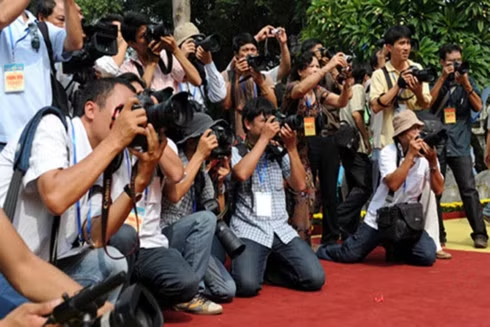
Vietnam has 17,000 licensed reporters working at 838 news agencies. There are 1,100 press publications produced by these news agency, plus 67 radio and TV stations, 74 online newspapers, 336 social networks, and 1,174 web portals. Radio and TV broadcasts reach 90% of the population.

Conditions for press development

The Vietnamese government has paid careful attention to creating an environment in which the mass media can fulfill their tasks and social responsibility and which promotes freedom of speech and freedom of the press.

The Press Law and Decree 72 on managing, providing, and using the Internet and online information have created a legal corridor in which the press can develop. The Ministry of Information and Communications has fine-tuned the draft version of Vietnam Press Planning Until 2020 to build a strong, modern, revolutionary press during Vietnam’s international integration process. 

Policies on the press and the Internet have pushed Vietnam to 3rd place in Southeast Asia and 8th place in Asia Internet usage, and other types of mass media have also been booming.

Social responsibility of the press

The media have provided the public with news and information and created forums for social organizations and individuals to contribute their opinions to government policies, improving democracy and promoting human rights. In many cases the press has been a tool to protect the public interest and civil rights, and to oversee the enforcement of laws by administrative agencies.

Press agencies have actively engaged in the fight against corruption, human rights violations, and other negative phenomena. The mass media have carried discussions of national issues to keep the public informed.

The press accompanies national development and integration

Vietnam’s press plays an important role in national reform and integration. It has inspired and guided the public to be creative and work together for a better society. The media has kept the public informed about State agencies, promoting the principle “people know, people discuss, people monitor”. The press has shown respect for, and reflected, people’s wishes and kept them informed on matters that affect their interests.

VOV

Other News

Vietnam secure berth at FIFA U17 World Cup 2026 for first time

Vietnam secure berth at FIFA U17 World Cup 2026 for first time

Vietnam national U17 football team secured a place at the FIFA U17 World Cup 2026 for the first time after defeating United Arab Emirates national U17 football team 3-2 on in the final Group C match of the AFC U17 Asian Cup 2026 in Saudi Arabia on early May 14 (Vietnam time).

Vietnam’s most beautiful railway station twins with French counterpart

Vietnam’s most beautiful railway station twins with French counterpart

A twinning agreement between Da Lat Railway Station in Vietnam and Trouville-Deauville Railway Station in France was signed at the French Embassy in Vietnam on May 7, creating new opportunities for cooperation in station management and operations, as well as cultural and tourism promotion between the two sides.

Hanoi gains two more craft villages in World Crafts Cities network

Hanoi gains two more craft villages in World Crafts Cities network

The recognition of Chuyen My and Son Dong craft villages as members of the World Crafts Cities network represents international acknowledgement of the cultural value, artisanal techniques, creativity and sustainable vitality of Vietnam’s traditional craft villages, he said.

Thang Long - Hanoi Festival 2026 to return in September

Thang Long - Hanoi Festival 2026 to return in September

Co-hosted by the municipal People’s Committee, the Department of Culture and Sports, and domestic and foreign agencies, the whole spectacle is meant to honour the city’s millennia-old heritage while reafffirming its strategy of establishing culture as a development engine.

Spreading Vietnamese cultural identity in digital space

Spreading Vietnamese cultural identity in digital space

In the context of deep international integration, cultural identity serves as both a “shield” against assimilation and a defining marker of a nation’s image. Protecting and promoting uniquely Vietnamese cultural values has therefore become a pressing task, particularly in an increasingly complex digital environment.

ITE HCMC 2026 to promote Vietnam’s tourism on global map

ITE HCMC 2026 to promote Vietnam’s tourism on global map

With its large scale, the ITE HCMC 2026 aims to promote tourism cooperation between Vietnam and priority markets such as Northeast Asia, Western Europe, North America, Southeast Asia, and Oceania while also boosting visitor arrivals from the Indian market

Vietnamese puppetry seeks renewal amid preservation challenges

Vietnamese puppetry seeks renewal amid preservation challenges

Although widely regarded as a cultural “speciality” attracting tourists, Vietnamese puppetry is facing multiple challenges in preservation and development, requiring renewed efforts to both safeguard its identity and adapt to contemporary cultural currents.

Project on digital transformation in cultural sector approved

Project on digital transformation in cultural sector approved

By 2030, the project targets the establishment of shared digital platforms across 100% of cultural sectors. All digitised cultural heritage will be standardised under the national data framework and shared in accordance with regulations, while 80% of public digital heritage assets are expected to receive digital identifiers to clarify ownership and management, encouraging organisations and individuals to do the same and support market development.

Vietnam eyes becoming region’s leading tourism destination

Vietnam eyes becoming region’s leading tourism destination

Vietnam has in recent years undergone a notable transformation in its tourism development strategy, placing a strong emphasis on nature-based and eco-tourism. This shift is not merely aligned with global trends, but represents a necessary step towards safeguarding valuable natural resources, while appealing to a growing segment of environmentally conscious travellers.