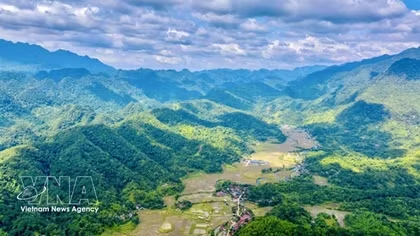
Quan Ho folk singing preserved and fostered in Bac Giang

PSNews - "Quan Ho", the love duet folk singing recognised as an Intangible Cultural Heritage by the United Nations Educational, Scientific and Cultural Organization (UNESCO) in 2009, has been accredited with the Northern province of Bac Ninh for ages. Yet, Bac Giang, Bac Ninh’s neighboring province has developed its own traditional typical tune of Quan Ho that many have never listened to.

Bac Ninh and Bac Giang are separated by the Cau River, in northern Vietnam. For a long time, many villages on the two river banks have been twinned and fostered their close relationship through traditional cultural customs, particularly Quan ho folk singing.

If Quan ho Bac Ninh is well-known, Quan ho Bac Giang is still not very popular. In Bac Giang, there are quite a few old-aged artisans who still love and often practice singing Quan ho. There are a number of Quan ho singing clubs with members aged from 70 to 90 in Trung Dong village (Van Trung commune), Dinh Ca village (Quang Minh commune) or Tam Tang village (Quang Chau commune). 
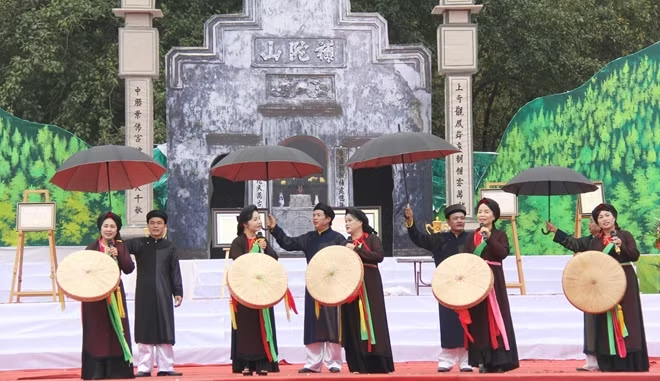
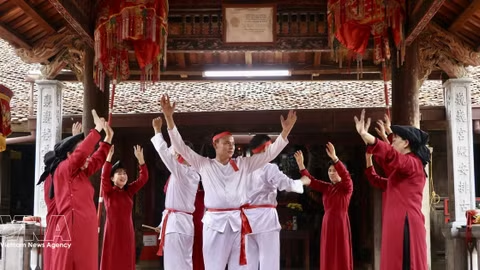
Quan ho is also popular in Bac Giang.
Quan ho is also popular in Bac Giang. 

In spite of their old ages, local artisans still memorize hundreds of ancient Quan ho folk songs. Even though singing without music, they still show the soul and nature of Quan ho singing. Listening to their Quan ho singing, one can feel various emotions, such as faraway lovers’ deep longing, sadness and desire as well as joy and happiness of meeting lovers.

Moreover, those artisans also voluntarily pass on this precious traditional cultural assets to the next generations. The famous Quan ho singing couple named Phu Hiep and Dang Nam (Tho Ha village) are the singers that are fostered grew up by artisans of the clubs.

In 2012, on the occasion of the 40th anniversary of UNESCO, Phu Hiep and Dang Nam became representatives of Vietnam to perform Quan ho folk singing in Paris. 
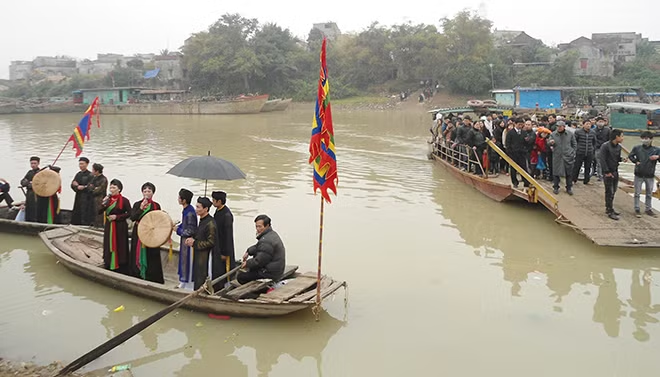
It is known that Bac Giang province has organized and launched various programs to preserve its traditional Quan ho singing, such as organizing a contest to collect and perform ancient Quan ho folk songs, opening free Quan ho singing courses or building Quan ho cultural houses. 

The Quan Ho singing movement has spread widely in almost all villages in the province. They sing Quan ho folk songs at rituals, festivals, contest stages and informal gatherings.

One of the highlights in Quan ho singing conservation in Bac Giang is the annual Quan ho Singing Festival, which has been maintained for decades at the Bon Da festival. This festival has contributed to the implementation of commitments of Vietnam in general and Bac Giang province in particular to UNESCO in conserving and developing Quan ho folk songs.

Quan ho songs express the spirit, philosophy and local identity of the communities in this region, and help forge social bonds within and between villages that share a cherished cultural practice. 

The songs are performed as alternating verses between two women from one village who sing in harmony, and two men from another village who respond with similar melodies, but with different lyrics. The women traditionally wear distinctive large round hats and scarves; the men’s costumes include turbans, umbrellas and tunics.
By Linh Bui

Other News

Vietnam secure berth at FIFA U17 World Cup 2026 for first time

Vietnam secure berth at FIFA U17 World Cup 2026 for first time

Vietnam national U17 football team secured a place at the FIFA U17 World Cup 2026 for the first time after defeating United Arab Emirates national U17 football team 3-2 on in the final Group C match of the AFC U17 Asian Cup 2026 in Saudi Arabia on early May 14 (Vietnam time).

Vietnam’s most beautiful railway station twins with French counterpart

Vietnam’s most beautiful railway station twins with French counterpart

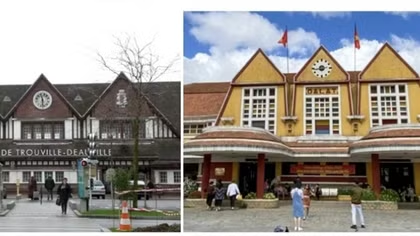
A twinning agreement between Da Lat Railway Station in Vietnam and Trouville-Deauville Railway Station in France was signed at the French Embassy in Vietnam on May 7, creating new opportunities for cooperation in station management and operations, as well as cultural and tourism promotion between the two sides.

Hanoi gains two more craft villages in World Crafts Cities network

Hanoi gains two more craft villages in World Crafts Cities network

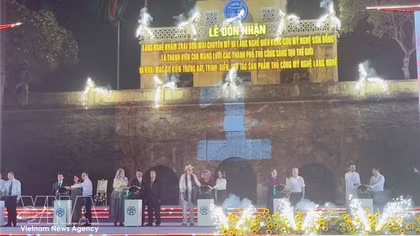
The recognition of Chuyen My and Son Dong craft villages as members of the World Crafts Cities network represents international acknowledgement of the cultural value, artisanal techniques, creativity and sustainable vitality of Vietnam’s traditional craft villages, he said.

Thang Long - Hanoi Festival 2026 to return in September

Thang Long - Hanoi Festival 2026 to return in September

Co-hosted by the municipal People’s Committee, the Department of Culture and Sports, and domestic and foreign agencies, the whole spectacle is meant to honour the city’s millennia-old heritage while reafffirming its strategy of establishing culture as a development engine.

Spreading Vietnamese cultural identity in digital space

Spreading Vietnamese cultural identity in digital space

In the context of deep international integration, cultural identity serves as both a “shield” against assimilation and a defining marker of a nation’s image. Protecting and promoting uniquely Vietnamese cultural values has therefore become a pressing task, particularly in an increasingly complex digital environment.

ITE HCMC 2026 to promote Vietnam’s tourism on global map

ITE HCMC 2026 to promote Vietnam’s tourism on global map

With its large scale, the ITE HCMC 2026 aims to promote tourism cooperation between Vietnam and priority markets such as Northeast Asia, Western Europe, North America, Southeast Asia, and Oceania while also boosting visitor arrivals from the Indian market

Vietnamese puppetry seeks renewal amid preservation challenges

Vietnamese puppetry seeks renewal amid preservation challenges

Although widely regarded as a cultural “speciality” attracting tourists, Vietnamese puppetry is facing multiple challenges in preservation and development, requiring renewed efforts to both safeguard its identity and adapt to contemporary cultural currents.

Project on digital transformation in cultural sector approved

Project on digital transformation in cultural sector approved

By 2030, the project targets the establishment of shared digital platforms across 100% of cultural sectors. All digitised cultural heritage will be standardised under the national data framework and shared in accordance with regulations, while 80% of public digital heritage assets are expected to receive digital identifiers to clarify ownership and management, encouraging organisations and individuals to do the same and support market development.

Vietnam eyes becoming region’s leading tourism destination

Vietnam eyes becoming region’s leading tourism destination

Vietnam has in recent years undergone a notable transformation in its tourism development strategy, placing a strong emphasis on nature-based and eco-tourism. This shift is not merely aligned with global trends, but represents a necessary step towards safeguarding valuable natural resources, while appealing to a growing segment of environmentally conscious travellers.