Quang Ngai develops Ly Son Marine Protected Area

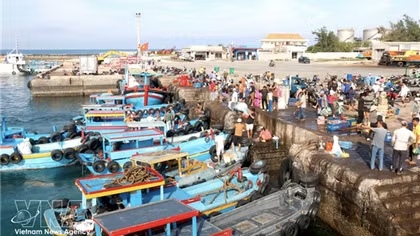
PSNews – Recently, the Quang Ngai Provincial People’s Committee announced that they has allocated funds of VND42 billion to protect and develop ecosystem recovery and biodiversity supervision of the Ly Son Marine Protected Area (MPA) for the 2018 – 2022 period. 

Representative of the central province of Quang Ngai said the funds will be used to rebuild coral reefs and sea weed and aquatic species, raising awareness among community members of the need for marine protection and supporting fishermen living in the core zone of strict protected area in the MPA in changing their livelihoods.

The fund will also aim to conserve over-exploited unique seafood products including abalone, holothurian, giant clam and pearl that are threatened with extinction. 
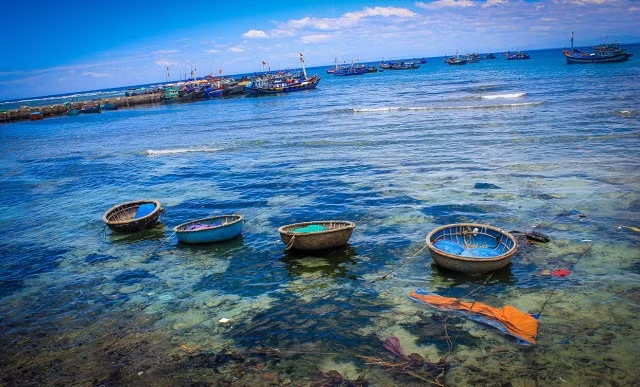
Photo: Internet
Photo: Internet 

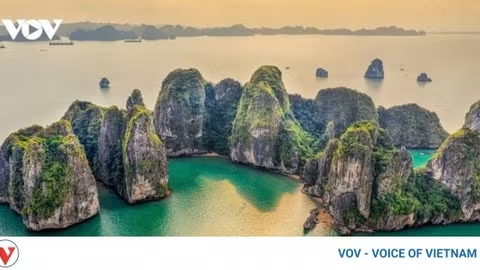
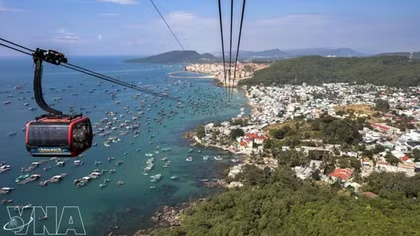
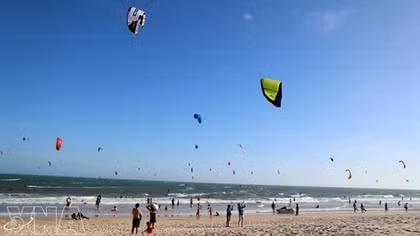
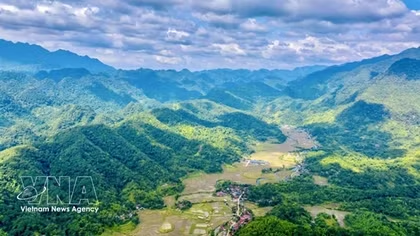
The Ly Son MPA, in the waters off Ly Son Island, 30km off the coast of Quang Ngai province, is the remains of eruptions from a dormant volcano. The terrain of the island was structured from volcanoes millions of years ago, leaving landscapes with rocks, caves, cliffs, rock arches and a lake.

However, the rapid development of resorts, hotels and entertainment projects in the Island threaten to seriously damage the ancient geography and ecology of the area.

The islands and a vast coastal area in districts of Binh Son, Tra Bong, Ba To, Sa Huynh, Nghia Hanh and Quang Ngai city on a total of 2,000sq.km are being considered for designation as a Global Geo-Park by UNESCO.

According to head of the Ly Son MPA management board Phung Dinh Toan, the Ly Son MPA was one of 16 nationwide MPAs approved by the Prime Minister in a Master Plan to 2020.

He said the MPA, which covers more than 7,900ha including 7,113ha of sea water, was home to 700 marine fauna species (coral reefs, fish, seaweed and crustaceans), of which 25 were endangered or in danger of extinction.

He also said that more than 400ha of land on the island had been seriously eroded by rising sea levels in the past 40 years. The Island, where 18 hotel projects and 56 home-stay services were developed in the past few decades, hosts around 200,000 tourists each year.

Ly Son Island, known as the kingdom of garlic in Vietnam, has around 21,000 inhabitants, of whom 73 percent make their living from farming garlic and spring onions, alongside fishing.
By Linh Bui

Other News

Vietnam secure berth at FIFA U17 World Cup 2026 for first time

Vietnam secure berth at FIFA U17 World Cup 2026 for first time

Vietnam national U17 football team secured a place at the FIFA U17 World Cup 2026 for the first time after defeating United Arab Emirates national U17 football team 3-2 on in the final Group C match of the AFC U17 Asian Cup 2026 in Saudi Arabia on early May 14 (Vietnam time).

Vietnam’s most beautiful railway station twins with French counterpart

Vietnam’s most beautiful railway station twins with French counterpart

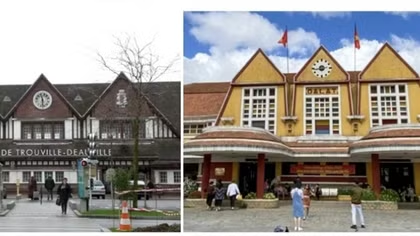
A twinning agreement between Da Lat Railway Station in Vietnam and Trouville-Deauville Railway Station in France was signed at the French Embassy in Vietnam on May 7, creating new opportunities for cooperation in station management and operations, as well as cultural and tourism promotion between the two sides.

Hanoi gains two more craft villages in World Crafts Cities network

Hanoi gains two more craft villages in World Crafts Cities network

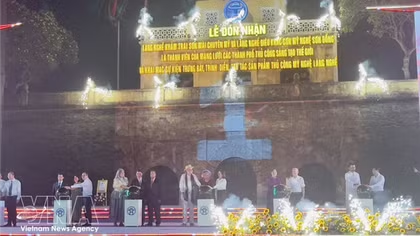
The recognition of Chuyen My and Son Dong craft villages as members of the World Crafts Cities network represents international acknowledgement of the cultural value, artisanal techniques, creativity and sustainable vitality of Vietnam’s traditional craft villages, he said.

Thang Long - Hanoi Festival 2026 to return in September

Thang Long - Hanoi Festival 2026 to return in September

Co-hosted by the municipal People’s Committee, the Department of Culture and Sports, and domestic and foreign agencies, the whole spectacle is meant to honour the city’s millennia-old heritage while reafffirming its strategy of establishing culture as a development engine.

Spreading Vietnamese cultural identity in digital space

Spreading Vietnamese cultural identity in digital space

In the context of deep international integration, cultural identity serves as both a “shield” against assimilation and a defining marker of a nation’s image. Protecting and promoting uniquely Vietnamese cultural values has therefore become a pressing task, particularly in an increasingly complex digital environment.

ITE HCMC 2026 to promote Vietnam’s tourism on global map

ITE HCMC 2026 to promote Vietnam’s tourism on global map

With its large scale, the ITE HCMC 2026 aims to promote tourism cooperation between Vietnam and priority markets such as Northeast Asia, Western Europe, North America, Southeast Asia, and Oceania while also boosting visitor arrivals from the Indian market

Vietnamese puppetry seeks renewal amid preservation challenges

Vietnamese puppetry seeks renewal amid preservation challenges

Although widely regarded as a cultural “speciality” attracting tourists, Vietnamese puppetry is facing multiple challenges in preservation and development, requiring renewed efforts to both safeguard its identity and adapt to contemporary cultural currents.

Project on digital transformation in cultural sector approved

Project on digital transformation in cultural sector approved

By 2030, the project targets the establishment of shared digital platforms across 100% of cultural sectors. All digitised cultural heritage will be standardised under the national data framework and shared in accordance with regulations, while 80% of public digital heritage assets are expected to receive digital identifiers to clarify ownership and management, encouraging organisations and individuals to do the same and support market development.

Vietnam eyes becoming region’s leading tourism destination

Vietnam eyes becoming region’s leading tourism destination

Vietnam has in recent years undergone a notable transformation in its tourism development strategy, placing a strong emphasis on nature-based and eco-tourism. This shift is not merely aligned with global trends, but represents a necessary step towards safeguarding valuable natural resources, while appealing to a growing segment of environmentally conscious travellers.