Seven Palestinians killed in border protests: Gaza health officials

Israeli forces killed seven Palestinians on Friday in protests along Gaza’s border, Gaza health officials said. Israel said its troops had shot a group who broke through the fence with a bomb and attacked an army post.

The Palestinian deaths bring to around 200 the number of Gazans killed since the border protests began on March 30, according to Palestinian Health Ministry figures.

Gaza medics said that, in addition to the seven dead, around 140 others were wounded.
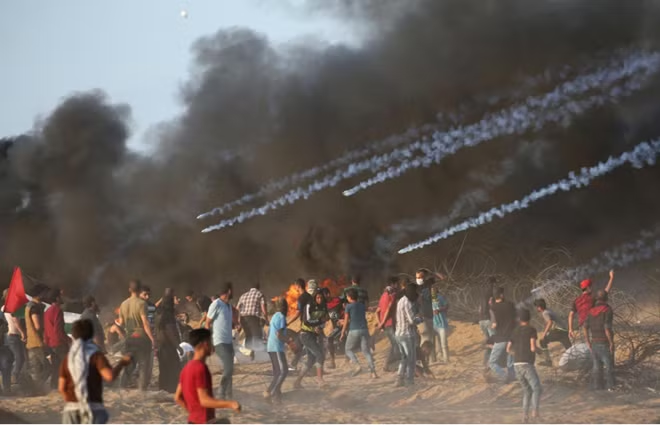
Tear gas canisters are fired by Israeli troops towards Palestinian demonstrators during a protest calling for lifting the Israeli blockade on Gaza and demanding the right to return to their homeland, at the Israel-Gaza border fence in the southern Gaza Strip October 12, 2018. REUTERS/Ibraheem Abu Mustafa

The Israeli military said that the demonstrators, numbering around 15,000, had been “hurling rocks, explosive devices, firebombs and grenades” at Israeli troops and at the fence.

Israeli military spokesman Lt. Col Jonathan Conricus tweeted that one group had “detonated a bomb on the Israel-Gaza border fence”, allowing around 20 people to climb through the hole.

He said around five of the group had then launched an organised attack against a military post inside Israel and all had been killed by the troops.

The Palestinian protesters are demanding an end to an Israeli and Egyptian blockade on the narrow coastal strip, which is home to around 2 million Gazans. They also seek the right to return to lands that Palestinians fled or were driven from upon Israel’s founding in 1948.
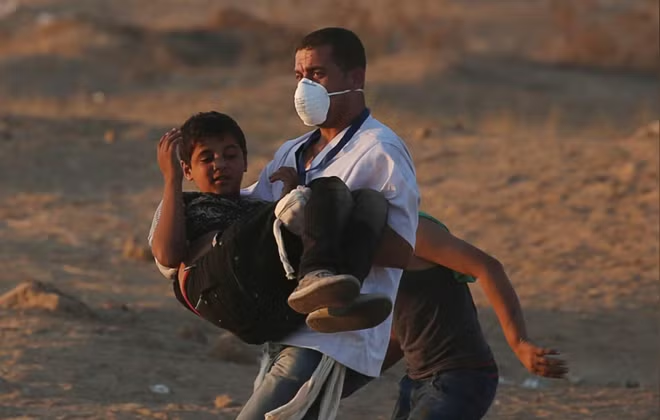
A wounded Palestinian boy is evacuted during a protest calling for lifting the Israeli blockade on Gaza and demanding the right to return to their homeland, at the Israel-Gaza border fence in the southern Gaza Strip October 12, 2018. REUTERS/Ibraheem Abu Mustafa
 A wounded Palestinian boy is evacuted during a protest calling for lifting the Israeli blockade on Gaza and demanding the right to return to their homeland, at the Israel-Gaza border fence in the southern Gaza Strip October 12, 2018. REUTERS/Ibraheem Abu Mustafa

Israel accuses the Islamist group Hamas, which controls Gaza, of orchestrating the protests along the border fence to provide cover for attacks and to distract from Gaza’s economic plight. Hamas denies the allegations.

The Israeli military has been criticised by Palestinians and international human rights groups for its lethal response to the protests. It says its troops have used “riot dispersal means” and have fired “in accordance with standard operating procedures”.

One Israeli soldier has been killed by a Palestinian sniper during the weekly protests, and tracts of Israeli land have been scorched by incendiary kites and balloons.

Hamas seized control of Gaza from Western-backed Palestinian President Mahmoud Abbas in 2007 and has since fought three wars with Israel, most recently in 2014.

Hamas chief Ismail Haniyeh, addressing a conference in Istanbul from Gaza, said on Friday that Hamas was seeking to reach understandings with several parties, including Qatar, Egypt and the United Nations. He expressed hope that the efforts “could lead to calm in return for breaking the siege”.
Reuters

Other News

Vietnam supports UNESCO's people-centred approach, multilateral cooperation: official

Vietnam supports UNESCO's people-centred approach, multilateral cooperation: official

Van affirmed Vietnam’s support for the UNESCO80 reform roadmap, focusing on the organisation’s core mandate, priority areas, interdisciplinary approach, and the special status of the Vietnam National Commission for UNESCO, and UNESCO representative offices, alongside efforts to diversify resources and strengthen global partnerships to enhance the organisation’s effectiveness.

Regional media highlight significant step in Vietnam’s leadership structure

Regional media highlight significant step in Vietnam’s leadership structure

Under General Secretary and President Lam’s leadership, Vietnam is expected to maintain a balanced foreign policy, strengthen its regional standing and accelerate economic development, thereby improving living standards and creating new opportunities for international investors, according to the India-based platform Devdiscourse.

Laos identifies 10 key tasks to build independent, self-reliant economy

Laos identifies 10 key tasks to build independent, self-reliant economy

Laos will step up agricultural production to ensure food security, meet domestic demand and expand exports; encourage the development of agro-processing industries, including those related to rubber, aquatic products, cassava and sugarcane, as well as fertiliser and animal feed production, in order to increase added value and create jobs in rural areas.

Malaysia steps up cyber security resilience

Malaysia steps up cyber security resilience

To ensure accountability, Malaysia plans to finalise the Cybercrime Bill this year which addresses both cyber-dependent and cyber-enabled offences, introducing stricter penalties and prison terms to enhance deterrence.

US public opinion positive about PM Pham Minh Chinh’s visit

US public opinion positive about PM Pham Minh Chinh’s visit

Public opinion in the US is generally positive about Vietnamese Prime Minister Pham Minh Chinh’s trip to the US from September 17-23 to attend the 78th session of the United Nations General Assembly, which took place immediately after the upgrading of the Vietnam - US relations to a comprehensive strategic partnership on the occasion of US President Joe Biden’s official visit to Vietnam.