Significance of Tet

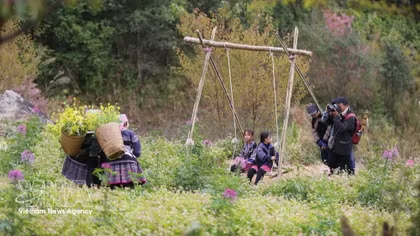
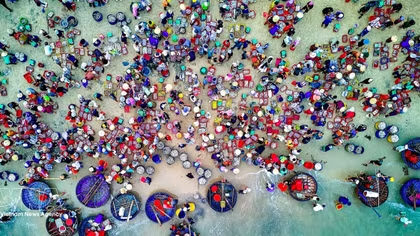
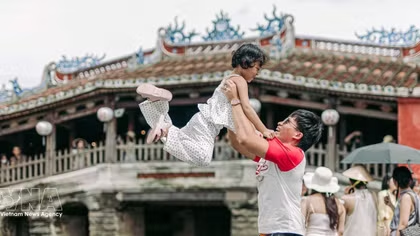
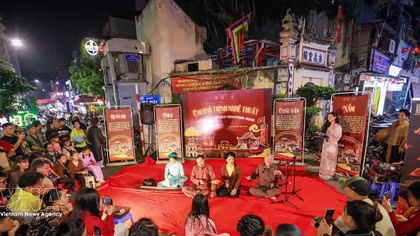
Lunar New Year (Tet) is the largest festival in Vietnam's traditional celebrations, marking the transition between the old year and the new one. It is a moment that signifies the changing cycle of the heavens, earth, and all living things.

Significance of Tet -0

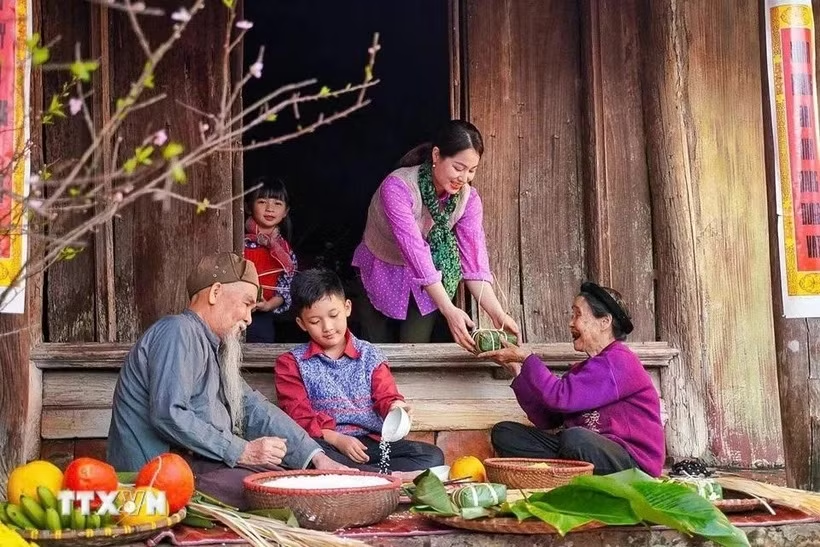
Lunar New Year (Tet) is the largest festival in Vietnam's traditional celebrations. (Photo: VNA)

Lunar New Year in Vietnam reflects the enduring cycle of life and the human aspiration for harmony between Heaven, Earth, and Humankind. It symbolises the relationship between humans and nature, deeply rooted in agricultural culture; the bond in families and villages in the spirit of community; and the sacred, profound beliefs in spiritual life.

Tet also represents the connection between heaven, earth, humans, and deities. From the perspective of the relationship between humans and nature, Tet is aligned with the cycle of the universe, represented by the changing seasons of Spring, Summer, Autumn, and Winter. This holds special significance for a society where the economy is still predominantly based on agriculture.

For farmers, Tet is also a time to honour deities associated with the prosperity or loss of the harvest, such as the Earth God, Rain God, Thunder God, Water God, and Sun God. It is a moment to express gratitude towards the animals, plants, and elements that have supported and sustained them, from the rice grains to the cattle, livestock, and poultry, during the course of the year.

Every year, as Tet approaches, Vietnamese people, regardless of their profession or where they are, eagerly look forward to returning to their homes for the three days of Tet. It is a time for practising the tradition of worshipping ancestors, reliving cherished memories from childhood, and experiencing the warmth of family reunions. "Going home for Tet" is not just a simple journey, it is a pilgrimage to one's roots, to the place where they were born and raised.

For the Vietnamese, Tet is a time for reunion and togetherness, where family and community ties are strengthened, creating shared values across society.

Tet is also a time to reunite with those who have passed away. On the evening of the 30th, just before the New Year’s Eve, families light incense to invite the spirits of ancestors and deceased loved ones to join them for a meal and celebrate Tet together. In every Vietnamese household, the ancestor altar holds significant importance. During Tet, the altar is a symbol of respect and remembrance for ancestors and deceased loved ones, with carefully selected five-fruit trays and offerings of traditional foods that the departed once enjoyed.

Throughout the Tet period, the incense smoke on the ancestor altar merges with the sacred atmosphere of the universe, bringing family members closer together than ever before. After Tet, life begins a new cycle, and people return to their everyday routines, carrying the warmth and love of family from the Tet days to face the joys and challenges of the year ahead.

Vietnamese people believe that the joyous first days of the year signal a prosperous year ahead. The passing of the old year leaves behind bad luck, and the new year brings hope and optimism. If the previous year was lucky, that luck is believed to carry over into the next. In this sense, Tet is a day filled with optimism and hope for the future.

VNA

Other News

Vietnam secure berth at FIFA U17 World Cup 2026 for first time

Vietnam secure berth at FIFA U17 World Cup 2026 for first time

Vietnam national U17 football team secured a place at the FIFA U17 World Cup 2026 for the first time after defeating United Arab Emirates national U17 football team 3-2 on in the final Group C match of the AFC U17 Asian Cup 2026 in Saudi Arabia on early May 14 (Vietnam time).

Vietnam’s most beautiful railway station twins with French counterpart

Vietnam’s most beautiful railway station twins with French counterpart

A twinning agreement between Da Lat Railway Station in Vietnam and Trouville-Deauville Railway Station in France was signed at the French Embassy in Vietnam on May 7, creating new opportunities for cooperation in station management and operations, as well as cultural and tourism promotion between the two sides.

Hanoi gains two more craft villages in World Crafts Cities network

Hanoi gains two more craft villages in World Crafts Cities network

The recognition of Chuyen My and Son Dong craft villages as members of the World Crafts Cities network represents international acknowledgement of the cultural value, artisanal techniques, creativity and sustainable vitality of Vietnam’s traditional craft villages, he said.

Thang Long - Hanoi Festival 2026 to return in September

Thang Long - Hanoi Festival 2026 to return in September

Co-hosted by the municipal People’s Committee, the Department of Culture and Sports, and domestic and foreign agencies, the whole spectacle is meant to honour the city’s millennia-old heritage while reafffirming its strategy of establishing culture as a development engine.

Spreading Vietnamese cultural identity in digital space

Spreading Vietnamese cultural identity in digital space

In the context of deep international integration, cultural identity serves as both a “shield” against assimilation and a defining marker of a nation’s image. Protecting and promoting uniquely Vietnamese cultural values has therefore become a pressing task, particularly in an increasingly complex digital environment.

ITE HCMC 2026 to promote Vietnam’s tourism on global map

ITE HCMC 2026 to promote Vietnam’s tourism on global map

With its large scale, the ITE HCMC 2026 aims to promote tourism cooperation between Vietnam and priority markets such as Northeast Asia, Western Europe, North America, Southeast Asia, and Oceania while also boosting visitor arrivals from the Indian market

Vietnamese puppetry seeks renewal amid preservation challenges

Vietnamese puppetry seeks renewal amid preservation challenges

Although widely regarded as a cultural “speciality” attracting tourists, Vietnamese puppetry is facing multiple challenges in preservation and development, requiring renewed efforts to both safeguard its identity and adapt to contemporary cultural currents.

Project on digital transformation in cultural sector approved

Project on digital transformation in cultural sector approved

By 2030, the project targets the establishment of shared digital platforms across 100% of cultural sectors. All digitised cultural heritage will be standardised under the national data framework and shared in accordance with regulations, while 80% of public digital heritage assets are expected to receive digital identifiers to clarify ownership and management, encouraging organisations and individuals to do the same and support market development.

Vietnam eyes becoming region’s leading tourism destination

Vietnam eyes becoming region’s leading tourism destination

Vietnam has in recent years undergone a notable transformation in its tourism development strategy, placing a strong emphasis on nature-based and eco-tourism. This shift is not merely aligned with global trends, but represents a necessary step towards safeguarding valuable natural resources, while appealing to a growing segment of environmentally conscious travellers.