Suicide attackers target headquarters of Libya's electoral commission

 A group of militants including suicide bombers stormed the head offices of Libya’s electoral commission in Tripoli on Wednesday, killing at least 11 people and setting fire to the building, officials said.

Security forces engaged in a gun battle with the assailants as they tried to regain control of the offices, said electoral commission spokesman Khaled Omar, who fled the building with other staff as the attack unfolded.

There was no immediate claim of responsibility for the attack, but it appeared aimed at derailing efforts to organize elections in Libya by the end of this year, part of a U.N.-led attempt to unify and stabilize the country after years of turmoil.

The commission recently registered nearly one million new voters across Libya, though no date has been set for polls.

Wednesday’s attack was the first of its kind in Tripoli for several years. Though security across Libya remains volatile, violence in the capital has recently been limited to localized clashes between armed groups.
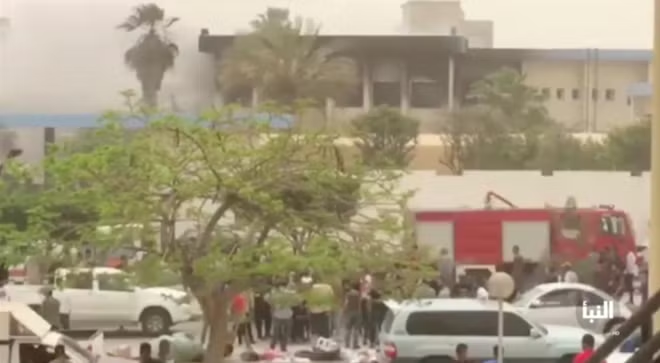
The site of suicide attack on Libyan electoral commission is seen in Tripoli, Libya, May 2, 2018 in this still picture obtained from social media video. AL NABAA CHANNEL/via REUTERS

Pictures posted on social media showed thick black smoke billowing from the site of the attack, in the Ghout al-Shaal district west of central Tripoli.

“I saw two suicide bombers myself... they were shouting Allahu Akbar (God is greatest),” said Omar, adding that he had seen bombers’ body parts strewn on the ground.

“A suicide bomber blew up himself inside the commission and the others set a part of the building on fire.”

The victims included three employees of the commission and four members of local security forces, Omar said. The health ministry put the toll at 11 dead and two wounded.

Libya has been in a state of turmoil since a 2011 civil war resulted in the overthrow of longstanding ruler Muammar Gaddafi by rebel fighters backed by NATO air strikes.

Elections in 2014 were disputed, resulting in rival governments backed by competing military alliances in Tripoli and the east.

Militants linked to Islamic State have carried out suicide bombings across the north of the country in recent years, though the group lost most of its fighters in Libya when it was driven out of its stronghold in the central city of Sirte in 2016.

Libyan and Western officials say militants, including fighters loyal to Islamic State and al Qaeda, are now concentrated in remote desert areas, but also have sleeper cells in coastal cities including Tripoli.

Some Libyans and members of the international community have questioned the push for new elections this year, expressing concern about the lack of security as well as legal and logistical challenges.

Reuters

Other News

Vietnam supports UNESCO's people-centred approach, multilateral cooperation: official

Vietnam supports UNESCO's people-centred approach, multilateral cooperation: official

Van affirmed Vietnam’s support for the UNESCO80 reform roadmap, focusing on the organisation’s core mandate, priority areas, interdisciplinary approach, and the special status of the Vietnam National Commission for UNESCO, and UNESCO representative offices, alongside efforts to diversify resources and strengthen global partnerships to enhance the organisation’s effectiveness.

Regional media highlight significant step in Vietnam’s leadership structure

Regional media highlight significant step in Vietnam’s leadership structure

Under General Secretary and President Lam’s leadership, Vietnam is expected to maintain a balanced foreign policy, strengthen its regional standing and accelerate economic development, thereby improving living standards and creating new opportunities for international investors, according to the India-based platform Devdiscourse.

Laos identifies 10 key tasks to build independent, self-reliant economy

Laos identifies 10 key tasks to build independent, self-reliant economy

Laos will step up agricultural production to ensure food security, meet domestic demand and expand exports; encourage the development of agro-processing industries, including those related to rubber, aquatic products, cassava and sugarcane, as well as fertiliser and animal feed production, in order to increase added value and create jobs in rural areas.

Malaysia steps up cyber security resilience

Malaysia steps up cyber security resilience

To ensure accountability, Malaysia plans to finalise the Cybercrime Bill this year which addresses both cyber-dependent and cyber-enabled offences, introducing stricter penalties and prison terms to enhance deterrence.

US public opinion positive about PM Pham Minh Chinh’s visit

US public opinion positive about PM Pham Minh Chinh’s visit

Public opinion in the US is generally positive about Vietnamese Prime Minister Pham Minh Chinh’s trip to the US from September 17-23 to attend the 78th session of the United Nations General Assembly, which took place immediately after the upgrading of the Vietnam - US relations to a comprehensive strategic partnership on the occasion of US President Joe Biden’s official visit to Vietnam.