Tan Hoa village in Quang Binh: rising from rural hardship to "best tourism village in the world"

Once an impoverished rural village, Tan Hoa in Quang Binh Province used to grapple with floods every year. But today it has been dubbed the "best tourism village in the world". Tan Hoa in Minh Hoa District is around 75 km from the Son Doong Cave, which is the world's largest in Phong Nha - Ke Bang National Park.

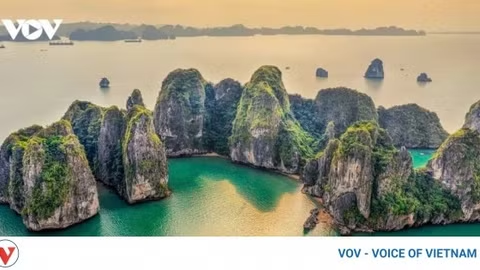
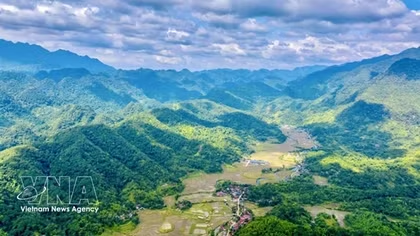
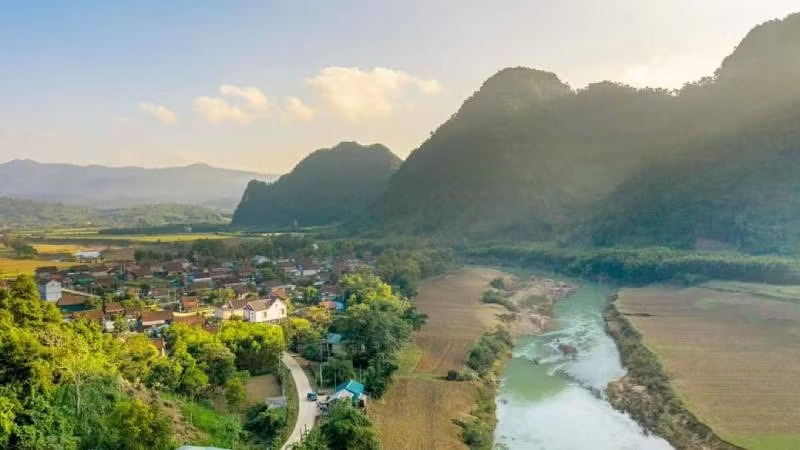
Surrounded by spectacular limestone karst mountains and the Rao Nan river which resembles a jade silk ribbon snaking through peaks, Tan Hoa offers a peaceful heaven. From Quy Dat town, it’s about 8km to Tan Hoa which offers scenic beauty. However, its unique terrain also puts Tan Hoa at risks when flooding season comes from mid-September to mid-November every year.
Tan Hoa village in Quang Binh: rising from rural hardship to
Tan Hoa tourism village in the central province of Quang Binh.

he historic flooding in 2010 with water rising to 12 metres inundated local houses, and forced people to evacuate to nearby karst mountains. Properties swept away and poultry and crops damaged, local residents returned home empty-handed, and tried to rebuild their lives from almost zero. To live safely along with floods, Tan Hoa villagers created floating houses of about 20 sq. m from wood with empty barrels underneath and poles to hold the houses in place.

During 2012-2020, Oxalis Adventure tour operator, through the “Tu Lan Race” event, called for financial support to build nearly 200 floating houses for poor families.

The houses were constructed with stainless steel frame, walls and roof covered with corrugated iron sheets, and large enough for a family of at least six people and necessities to survive during monsoon season. As of October 2023, more than 620 floating houses had been built for Tan Hoa locals with financial support from domestic individuals and organisations.

Now, floating houses are not only a place for Tan Hoa locals to live in but also a way for them to earn a living. With support from Oxalis, 10 Tan Hoa households transformed their floating houses into climate-adaptive lodging facilities. Costing some 150 million VND (6,100 USD), each homestay offers 26-40 square metres of space for 1-3 people, with a private bathroom.

The UNWTO’s recognition has affirmed the local authorities’ resolve to develop Tan Hoa into an excellent weather-adaptive tourism model in Vietnam and the Southeast Asia at large. This is a global initiative to highlight villages and tourism sites’ efforts to preserve and promote community-based values, making contributions to realising sustainable development goals through tourism.

It was honored with the "Best Tourism Villages 2023" title by the World Tourism Organization (UNWTO), after an evaluation of 260 applications from 60 countries.  Its transformation began circa 2014 when it opened its doors to tourism, with a focus on exploring the Tu Lan Cave system.

Tu Lan is an enchanting cave system with six wet and dry caves known for their stalactites, stalagmites and unique features. From 2013 to 2023, the village has welcomed approximately 63,000 visitors in total. In the past three years alone, the village has witnessed remarkable growth in visitor numbers, surging from fewer than 4,000 a year to over 9,000.

Visitors to Tan Hoa can also partake in thrilling morning adventures with all-terrain vehicles (ATVs), a popular activity among tourists alongside cave exploration.

Over the past years, local residents have engaged in tourism activities to help sustainably reduce poverty. With support from businesses, Tan Hoa has become a weather-adaptive tourism village with many unique and typical tourism products.

Launched in 2021, the Best Tourism Villages by UNWTO initiative is part of the UNWTO Tourism for Rural Development Programme. The programme works to foster development and inclusion in rural areas, combat depopulation, advance innovation and value chain integration through tourism, and encourage sustainable practices.

The villages are evaluated under nine key areas, namely cultural and natural resources; promotion and conservation of cultural resources; economic sustainability; social sustainability; environmental sustainability; tourism development and value chain integration; governance and prioritisation of tourism; infrastructure and connectivity; and health, safety, and security.

By TM

Other News

Vietnam secure berth at FIFA U17 World Cup 2026 for first time

Vietnam secure berth at FIFA U17 World Cup 2026 for first time

Vietnam national U17 football team secured a place at the FIFA U17 World Cup 2026 for the first time after defeating United Arab Emirates national U17 football team 3-2 on in the final Group C match of the AFC U17 Asian Cup 2026 in Saudi Arabia on early May 14 (Vietnam time).

Vietnam’s most beautiful railway station twins with French counterpart

Vietnam’s most beautiful railway station twins with French counterpart

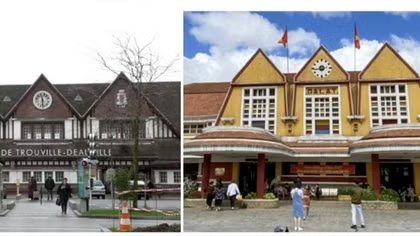
A twinning agreement between Da Lat Railway Station in Vietnam and Trouville-Deauville Railway Station in France was signed at the French Embassy in Vietnam on May 7, creating new opportunities for cooperation in station management and operations, as well as cultural and tourism promotion between the two sides.

Hanoi gains two more craft villages in World Crafts Cities network

Hanoi gains two more craft villages in World Crafts Cities network

The recognition of Chuyen My and Son Dong craft villages as members of the World Crafts Cities network represents international acknowledgement of the cultural value, artisanal techniques, creativity and sustainable vitality of Vietnam’s traditional craft villages, he said.

Thang Long - Hanoi Festival 2026 to return in September

Thang Long - Hanoi Festival 2026 to return in September

Co-hosted by the municipal People’s Committee, the Department of Culture and Sports, and domestic and foreign agencies, the whole spectacle is meant to honour the city’s millennia-old heritage while reafffirming its strategy of establishing culture as a development engine.

Spreading Vietnamese cultural identity in digital space

Spreading Vietnamese cultural identity in digital space

In the context of deep international integration, cultural identity serves as both a “shield” against assimilation and a defining marker of a nation’s image. Protecting and promoting uniquely Vietnamese cultural values has therefore become a pressing task, particularly in an increasingly complex digital environment.

ITE HCMC 2026 to promote Vietnam’s tourism on global map

ITE HCMC 2026 to promote Vietnam’s tourism on global map

With its large scale, the ITE HCMC 2026 aims to promote tourism cooperation between Vietnam and priority markets such as Northeast Asia, Western Europe, North America, Southeast Asia, and Oceania while also boosting visitor arrivals from the Indian market

Vietnamese puppetry seeks renewal amid preservation challenges

Vietnamese puppetry seeks renewal amid preservation challenges

Although widely regarded as a cultural “speciality” attracting tourists, Vietnamese puppetry is facing multiple challenges in preservation and development, requiring renewed efforts to both safeguard its identity and adapt to contemporary cultural currents.

Project on digital transformation in cultural sector approved

Project on digital transformation in cultural sector approved

By 2030, the project targets the establishment of shared digital platforms across 100% of cultural sectors. All digitised cultural heritage will be standardised under the national data framework and shared in accordance with regulations, while 80% of public digital heritage assets are expected to receive digital identifiers to clarify ownership and management, encouraging organisations and individuals to do the same and support market development.

Vietnam eyes becoming region’s leading tourism destination

Vietnam eyes becoming region’s leading tourism destination

Vietnam has in recent years undergone a notable transformation in its tourism development strategy, placing a strong emphasis on nature-based and eco-tourism. This shift is not merely aligned with global trends, but represents a necessary step towards safeguarding valuable natural resources, while appealing to a growing segment of environmentally conscious travellers.