Tourist attractions along Da river

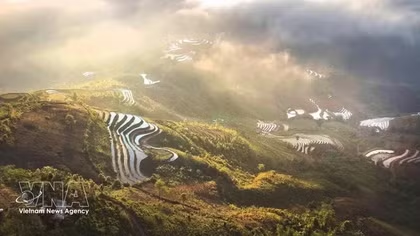
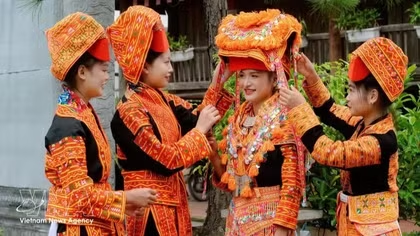
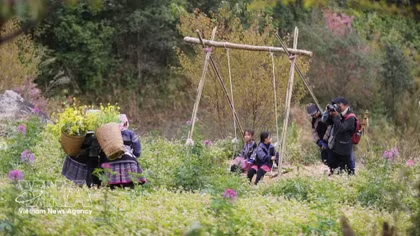
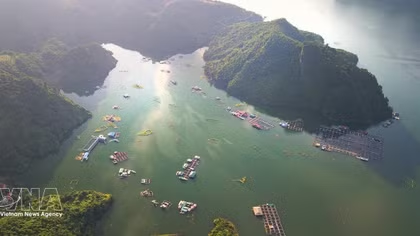
Quynh Nhai district in Son La province is regarded as an inland Halong Bay in the northwestern region thanks to a 10,000-hectre hydroelectric reservoir and magnificent landscape. Local residents living on the two banks of the Da river still preserve their colorful culture. 
tourist attractions along da river hinh 0

The first attraction for visitors to Quynh Nhai is a temple in Muong Giang commune worshiping a female general called Han. Legend has it that Lady Han expelled invaders on the last day of a lunar year and ordered her soldiers to wash their hair and bathe in the river to welcome the new year and salute their victory. 

Since then, the hair washing ritual has become a tradition of the local white Thai people at year’s end to wash off all the difficulties, bad fortunes, and diseases in the waters while praying for a new year full of good luck, health, and bumper crops. Other activities are also held on the river for both visitors and locals. 

Dieu Chinh Hien, deputy head of the Culture and Information Office of Quynh Nhai district, said “The Son La hydropower plant has created stunning views in Quynh Nhai which has been dubbed an inland Halong Bay. Tourists can take a yacht to enjoy the scenery of the Da river at the beginning of the year when we also hold festivities such as a boat race on the 10th day of the first lunar month”.

The Pa Uon bridge across the Da river links Son La province with other northwestern provinces of Lai Chau, Dien Bien, and Lao Cai. From afar, the bridge looks like a white silk strip over blue water background. Pa Uon bridge was recognized by the Vietnam Records Organization as the country’s highest abutment of 98.6 meters.

The most-awaited activity for tourists is taking a boat trip in the reservoir of the Son La hydropower plant, the biggest of its kind in Southeast Asia. Dieu Chinh Hien elaborated “Before the hydropower plant was constructed, there had been only modest water flows creeping into the ravines. The plant, once completed, raised the water that flooded the ravines so we now can see only mountain peaks undulating above the water surface that look like islets in Halong Bay”.

The boat begins at Pa Uon wharf and sails up the Da river among the  lime rocks, bringing tourists to a milestone on Cao Po hill which is surrounded by water and where the Quynh Nhai TV transmission station used to be installed. The islets along the way are painted by magnificent colors: the green of the forest, yellow of the rice fields, and red of the stilt house tiles. 
VOV5

Other News

Vietnam secure berth at FIFA U17 World Cup 2026 for first time

Vietnam secure berth at FIFA U17 World Cup 2026 for first time

Vietnam national U17 football team secured a place at the FIFA U17 World Cup 2026 for the first time after defeating United Arab Emirates national U17 football team 3-2 on in the final Group C match of the AFC U17 Asian Cup 2026 in Saudi Arabia on early May 14 (Vietnam time).

Vietnam’s most beautiful railway station twins with French counterpart

Vietnam’s most beautiful railway station twins with French counterpart

A twinning agreement between Da Lat Railway Station in Vietnam and Trouville-Deauville Railway Station in France was signed at the French Embassy in Vietnam on May 7, creating new opportunities for cooperation in station management and operations, as well as cultural and tourism promotion between the two sides.

Hanoi gains two more craft villages in World Crafts Cities network

Hanoi gains two more craft villages in World Crafts Cities network

The recognition of Chuyen My and Son Dong craft villages as members of the World Crafts Cities network represents international acknowledgement of the cultural value, artisanal techniques, creativity and sustainable vitality of Vietnam’s traditional craft villages, he said.

Thang Long - Hanoi Festival 2026 to return in September

Thang Long - Hanoi Festival 2026 to return in September

Co-hosted by the municipal People’s Committee, the Department of Culture and Sports, and domestic and foreign agencies, the whole spectacle is meant to honour the city’s millennia-old heritage while reafffirming its strategy of establishing culture as a development engine.

Spreading Vietnamese cultural identity in digital space

Spreading Vietnamese cultural identity in digital space

In the context of deep international integration, cultural identity serves as both a “shield” against assimilation and a defining marker of a nation’s image. Protecting and promoting uniquely Vietnamese cultural values has therefore become a pressing task, particularly in an increasingly complex digital environment.

ITE HCMC 2026 to promote Vietnam’s tourism on global map

ITE HCMC 2026 to promote Vietnam’s tourism on global map

With its large scale, the ITE HCMC 2026 aims to promote tourism cooperation between Vietnam and priority markets such as Northeast Asia, Western Europe, North America, Southeast Asia, and Oceania while also boosting visitor arrivals from the Indian market

Vietnamese puppetry seeks renewal amid preservation challenges

Vietnamese puppetry seeks renewal amid preservation challenges

Although widely regarded as a cultural “speciality” attracting tourists, Vietnamese puppetry is facing multiple challenges in preservation and development, requiring renewed efforts to both safeguard its identity and adapt to contemporary cultural currents.

Project on digital transformation in cultural sector approved

Project on digital transformation in cultural sector approved

By 2030, the project targets the establishment of shared digital platforms across 100% of cultural sectors. All digitised cultural heritage will be standardised under the national data framework and shared in accordance with regulations, while 80% of public digital heritage assets are expected to receive digital identifiers to clarify ownership and management, encouraging organisations and individuals to do the same and support market development.

Vietnam eyes becoming region’s leading tourism destination

Vietnam eyes becoming region’s leading tourism destination

Vietnam has in recent years undergone a notable transformation in its tourism development strategy, placing a strong emphasis on nature-based and eco-tourism. This shift is not merely aligned with global trends, but represents a necessary step towards safeguarding valuable natural resources, while appealing to a growing segment of environmentally conscious travellers.