Tram Chim National Park - a Ramsar site in southern Vietnam

Tram Chim National Park in the Mekong Delta, the 2,000th Ramsar site globally, is a wetland site designated to be of international importance under the Ramsar Convention.

Tram Chim National Park - a Ramsar site in southern Vietnam ảnh 1


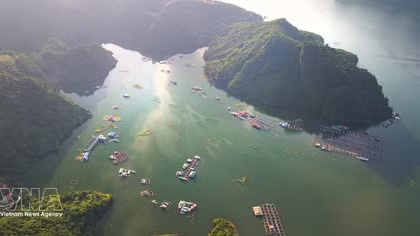
In the high-rise water season between August and November, the national park turns picturesque. The blue sky is reflected in the water and this vast blue is embellished by lotuses, lilies, and melaleuca flowers.

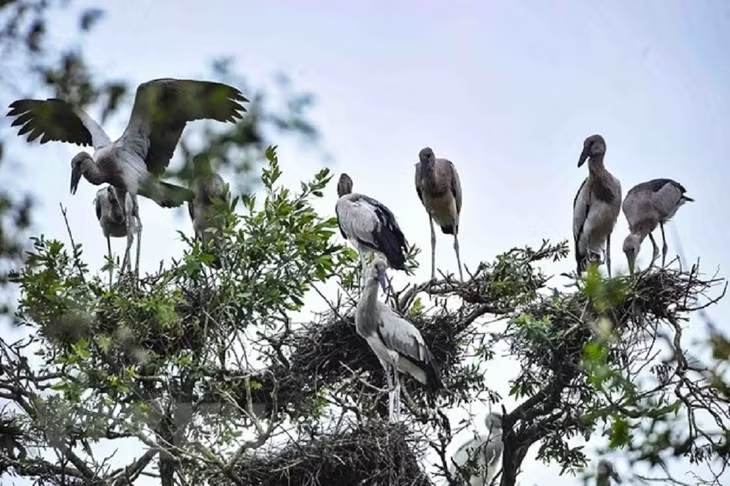
35 kilometers from Cao Lanh city, Dong Thap province, the 7,300-hectare Tram Chim National Park spans five communes and Tram Chim township. This is the habitat of 130 plants and 200 wetland birds, including white storks and mallards. 

Eight years ago, Tram Chim National Park was recognized as the 2,000th Ramsar site globally, and the fourth site in Vietnam to receive the honor.

Nguyen Van Vui, a tour guide at the national park, says, “The Ramsar Convention was created to protect wetlands and the precious birds living there. Tram Chim National Park was honored for meeting all the standards. It’s a natural forest which also protects over 150 species of freshwater fish.”

In the dry season, between the 5th and the 12th lunar month, canoes glide through the canals, taking visitors around to admire the peaceful landscape of Tram Chim, where the grass fields and the breezes are soothing to one’s soul.

“Capujut trees cover approximately 3,000 hectares of Tram Chim National Park. The rest is covered with water chestnut, eleocharis, ferns, and flowers,” the guide reveals.

In January, when the alum content is high, the water is clear, and photosynthesis is strong, thin purple three-petal flowers cover the wavy waters of Tram Chim National Park.

“The fragile purple flowers bloom on the water for several kilometers. They are in full swing deep in the national park for 30 to 40 days,” notes Vui.

Sitting in a canoe creeping through the wetlands, visitors are mesmerized by darting birds, quickly hiding, then quickly showing themselves. Sometimes they may encounter just a few white storks in the trees.

Sometimes, a flock of hundreds of mallards may spread their wings in a red sunset sky. Such a marvelous scene is a great pay-off for those who wait patiently for the sun to go down.

If visitors wake up early enough, they might see clusters of birds on top of the trees, preening their feathers before they scatter in search of food. Such gifts of nature are once in a lifetime sights for many.

“You can watch the storks hunt for food. Even when a fish is in their sight, they don’t attack immediately but wait patiently until the fish thinks there is no threat and lets its guard down. A stork stands very still and doesn’t move," says Vui.

"When the fish swims to its feet, the bird darts its head down to catch the fish, but doesn’t eat the fish right away. Instead, it carries the live fish to a small pond deep in the wetland where the storks pile up food to feed the flock in the winter when the weather is harsh,” Vui adds.

Some visitors are lucky enough to see a red-crowned crane, which is listed in Vietnam’s red book of endangered species.

“In the dry season, water chestnut is the favorite food of the red-crowned cranes. These birds are extremely faithful. If one individual of a couple dies, its mate will go on a hunger strike until it, too, dies. It will not accept a new mate."

"A female red-crowned crane lays only two eggs, and only one of the two babies that hatch from these eggs will be raised by the parents. That’s why the two little cranes fight each other for the food they need to survive. Only the stronger one will live for very long,” Vui also reveals.         

Tram Chim National Park is divided into five sub-regions. Tourism activities are allowed in only two of the five.

The other three sub-regions serve as a breeding ground for birds, a preservation zone for fish species, and a feeding ground for red-crowned cranes, who migrate when the water is high and return in the dry season.

VOV

Other News

Vietnam secure berth at FIFA U17 World Cup 2026 for first time

Vietnam secure berth at FIFA U17 World Cup 2026 for first time

Vietnam national U17 football team secured a place at the FIFA U17 World Cup 2026 for the first time after defeating United Arab Emirates national U17 football team 3-2 on in the final Group C match of the AFC U17 Asian Cup 2026 in Saudi Arabia on early May 14 (Vietnam time).

Vietnam’s most beautiful railway station twins with French counterpart

Vietnam’s most beautiful railway station twins with French counterpart

A twinning agreement between Da Lat Railway Station in Vietnam and Trouville-Deauville Railway Station in France was signed at the French Embassy in Vietnam on May 7, creating new opportunities for cooperation in station management and operations, as well as cultural and tourism promotion between the two sides.

Hanoi gains two more craft villages in World Crafts Cities network

Hanoi gains two more craft villages in World Crafts Cities network

The recognition of Chuyen My and Son Dong craft villages as members of the World Crafts Cities network represents international acknowledgement of the cultural value, artisanal techniques, creativity and sustainable vitality of Vietnam’s traditional craft villages, he said.

Thang Long - Hanoi Festival 2026 to return in September

Thang Long - Hanoi Festival 2026 to return in September

Co-hosted by the municipal People’s Committee, the Department of Culture and Sports, and domestic and foreign agencies, the whole spectacle is meant to honour the city’s millennia-old heritage while reafffirming its strategy of establishing culture as a development engine.

Spreading Vietnamese cultural identity in digital space

Spreading Vietnamese cultural identity in digital space

In the context of deep international integration, cultural identity serves as both a “shield” against assimilation and a defining marker of a nation’s image. Protecting and promoting uniquely Vietnamese cultural values has therefore become a pressing task, particularly in an increasingly complex digital environment.

ITE HCMC 2026 to promote Vietnam’s tourism on global map

ITE HCMC 2026 to promote Vietnam’s tourism on global map

With its large scale, the ITE HCMC 2026 aims to promote tourism cooperation between Vietnam and priority markets such as Northeast Asia, Western Europe, North America, Southeast Asia, and Oceania while also boosting visitor arrivals from the Indian market

Vietnamese puppetry seeks renewal amid preservation challenges

Vietnamese puppetry seeks renewal amid preservation challenges

Although widely regarded as a cultural “speciality” attracting tourists, Vietnamese puppetry is facing multiple challenges in preservation and development, requiring renewed efforts to both safeguard its identity and adapt to contemporary cultural currents.

Project on digital transformation in cultural sector approved

Project on digital transformation in cultural sector approved

By 2030, the project targets the establishment of shared digital platforms across 100% of cultural sectors. All digitised cultural heritage will be standardised under the national data framework and shared in accordance with regulations, while 80% of public digital heritage assets are expected to receive digital identifiers to clarify ownership and management, encouraging organisations and individuals to do the same and support market development.

Vietnam eyes becoming region’s leading tourism destination

Vietnam eyes becoming region’s leading tourism destination

Vietnam has in recent years undergone a notable transformation in its tourism development strategy, placing a strong emphasis on nature-based and eco-tourism. This shift is not merely aligned with global trends, but represents a necessary step towards safeguarding valuable natural resources, while appealing to a growing segment of environmentally conscious travellers.