Tran Thuong Temple festival named national intangible heritage

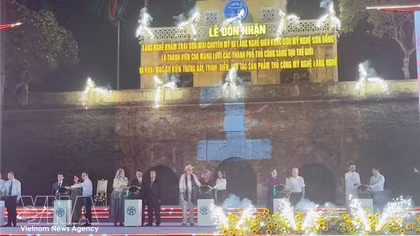
Tran Thuong Temple’s food-distributing festival in the northern province of Ha Nam was officially recognised as national intangible heritage at a ceremony on February 10, the 14th day of the first lunar month.

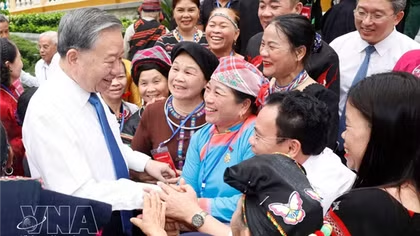
Vice State President Dang Thi Ngoc Thinh joined leaders from ministries, agencies and Ha Nam province to attend the ceremony.

Holding historical, cultural, and spiritual values, the temple is dedicated to Tran Hung Dao (1228-1300), the Supreme Commander of Vietnam in the Tran Dynasty, who repelled three major Mongolian invasions in the 13th century.
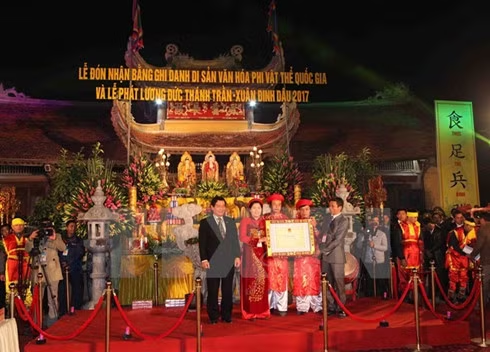
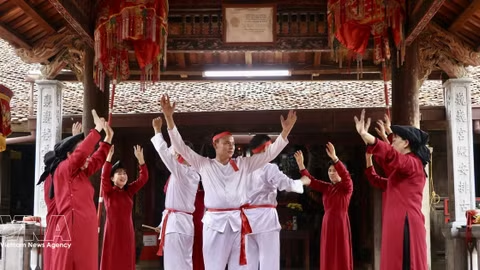
Scene at the ceremony recognising Tran Thuong Temple festival as national intangible heritage.

It is located in Nhan Dao commune of Ly Nhan district, which was chosen by Tran Hung Dao as a food storage area to supply his army during the fight against the Mongolian invaders.

In honour of the past event, a food-distributing festival is held annually at the Tran Thuong Temple on the 14th day of the first lunar month.    

This year, about 150,000 food parcels that contained corn, soybeans, and rice – key staples produced by Ly Nhan residents – were handed out to participants across 37 locations.

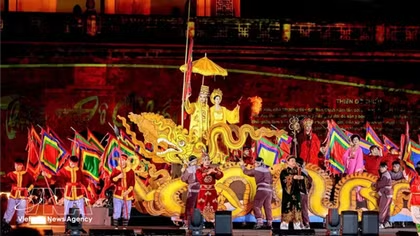
The same day, a seal opening ceremony took place at the Tran Kings temple relic site in the northern province of Nam Dinh to pray for a new year of happiness and bumper harvest. 

The ceremony re-enacted a custom dating back to the Tran Dynasty (1225-1400), when mandarins took out their seals after the Tet holiday, resuming administrative activities, including rewarding and conferring titles. 

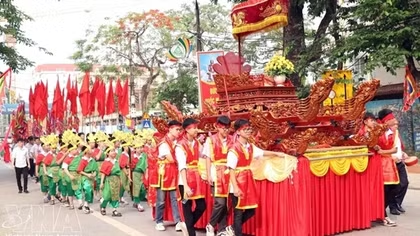
The event opened with a procession to take the seal from Co Trach temple to Thien Truong temple, where 14 kings of the Tran Dynasty are worshipped.

Following a short speech of a local official praising the great accomplishments of the Tran Dynasty, the seal opening ceremony was held solemnly in line with the traditional rites, with the participation of 120 Tuc Mac villagers from all walks of life. 

The site was closed to visitors during the ceremony and then opened at 23:55 pm last night. 

It has become a tradition for Vietnamese to come here to get a stamp in hope for good luck and happiness. 

The lucky stamps have been distributed among visitors starting 5am on February 12.
VNA

Other News

Vietnam secure berth at FIFA U17 World Cup 2026 for first time

Vietnam secure berth at FIFA U17 World Cup 2026 for first time

Vietnam national U17 football team secured a place at the FIFA U17 World Cup 2026 for the first time after defeating United Arab Emirates national U17 football team 3-2 on in the final Group C match of the AFC U17 Asian Cup 2026 in Saudi Arabia on early May 14 (Vietnam time).

Vietnam’s most beautiful railway station twins with French counterpart

Vietnam’s most beautiful railway station twins with French counterpart

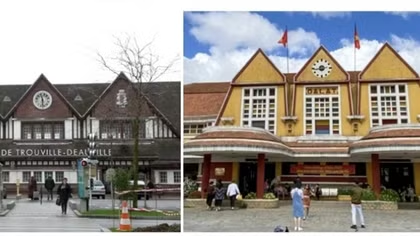
A twinning agreement between Da Lat Railway Station in Vietnam and Trouville-Deauville Railway Station in France was signed at the French Embassy in Vietnam on May 7, creating new opportunities for cooperation in station management and operations, as well as cultural and tourism promotion between the two sides.

Hanoi gains two more craft villages in World Crafts Cities network

Hanoi gains two more craft villages in World Crafts Cities network

The recognition of Chuyen My and Son Dong craft villages as members of the World Crafts Cities network represents international acknowledgement of the cultural value, artisanal techniques, creativity and sustainable vitality of Vietnam’s traditional craft villages, he said.

Thang Long - Hanoi Festival 2026 to return in September

Thang Long - Hanoi Festival 2026 to return in September

Co-hosted by the municipal People’s Committee, the Department of Culture and Sports, and domestic and foreign agencies, the whole spectacle is meant to honour the city’s millennia-old heritage while reafffirming its strategy of establishing culture as a development engine.

Spreading Vietnamese cultural identity in digital space

Spreading Vietnamese cultural identity in digital space

In the context of deep international integration, cultural identity serves as both a “shield” against assimilation and a defining marker of a nation’s image. Protecting and promoting uniquely Vietnamese cultural values has therefore become a pressing task, particularly in an increasingly complex digital environment.

ITE HCMC 2026 to promote Vietnam’s tourism on global map

ITE HCMC 2026 to promote Vietnam’s tourism on global map

With its large scale, the ITE HCMC 2026 aims to promote tourism cooperation between Vietnam and priority markets such as Northeast Asia, Western Europe, North America, Southeast Asia, and Oceania while also boosting visitor arrivals from the Indian market

Vietnamese puppetry seeks renewal amid preservation challenges

Vietnamese puppetry seeks renewal amid preservation challenges

Although widely regarded as a cultural “speciality” attracting tourists, Vietnamese puppetry is facing multiple challenges in preservation and development, requiring renewed efforts to both safeguard its identity and adapt to contemporary cultural currents.

Project on digital transformation in cultural sector approved

Project on digital transformation in cultural sector approved

By 2030, the project targets the establishment of shared digital platforms across 100% of cultural sectors. All digitised cultural heritage will be standardised under the national data framework and shared in accordance with regulations, while 80% of public digital heritage assets are expected to receive digital identifiers to clarify ownership and management, encouraging organisations and individuals to do the same and support market development.

Vietnam eyes becoming region’s leading tourism destination

Vietnam eyes becoming region’s leading tourism destination

Vietnam has in recent years undergone a notable transformation in its tourism development strategy, placing a strong emphasis on nature-based and eco-tourism. This shift is not merely aligned with global trends, but represents a necessary step towards safeguarding valuable natural resources, while appealing to a growing segment of environmentally conscious travellers.