USCIRF on April 21 released the annual report on religious freedom situation around the world, including a part mentioning the religious practice situation in Vietnam.
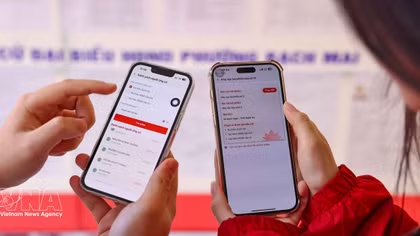
The report has acknowledged that Vietnam has made some progress in ensuring religious freedom and religious practice. Accordingly, the Vietnamese government has built and put in use a digital intersectional system to supervise the implementation of the Law on Belief and Religion, as well as to address disputes and complaints from religious organizations and individuals, resettle and legalize free-migrant Christians of the Hmong ethnicity without permanent residence permit in Residential Subdivision 179, Lam Dong province, and released A Dao, a political dissident, one on the USCIRF’s so-called list “Religious Prisoners of Conscience” (RPOC).
However, USCIRF has still alleged that the religious freedom situation in Vietnam in 2020 has generally seen little progress in comparison with 2019, and recommended the U.S. Department of State to designate Vietnam as a “country of particular concern” (CPC) for religious freedom.
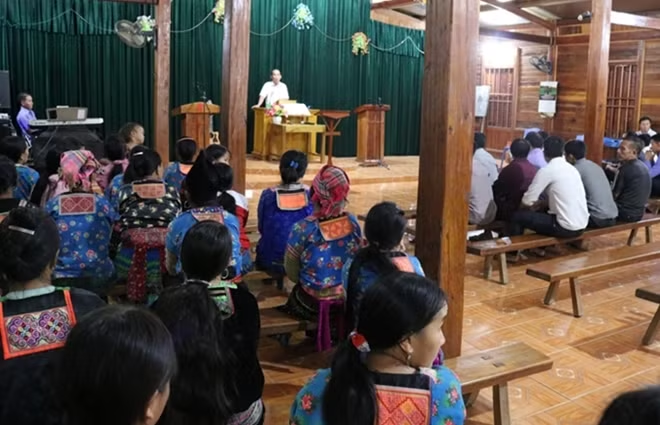 |
| A religious group in Muong Nhe, Dien Bien. |
Notably, the USCIRF 2021 annual report has a structure and tone similar to its 2020 edition, when making slanderous accusations of the Law on Belief and Religion of Vietnam. The only thing USCIRF has added to this year’s report is its irrational concern over the Cyber security Law and the Law on Protection of State Secrets of Vietnam. In fact, such laws that have been adopted by many countries around the world to ensure national security of countries on cyberspace.
While USCIRF’s annual report released, several hostile websites such as RFA and BPSOS also published articles distorting the ethnic minority situation in the Central Highlands of Vietnam. These websites already hostile to the Vietnamese Government and people have used false information and wrong views on ethnic issues in Vietnam with the aim of undermining the Vietnamese great national unity bloc.
In fact, their articles include untrue information and groundless allegations.
One with common sense visiting Vietnam can see that the Party and the State always attaches much importance to ensuring equality among ethnic minority groups and religions as well as to promoting the right of religion and guaranteeing the practice of freedom of religion
Over the past years, the Party and State of Vietnam has invested much in Dak Doa District, Gia Lai Province, home to a large number of ethnic minority people following the Protestant Church. The Party and State of Vietnam still creates favorable conditions for the local people to practice religious activities even after some locals made use of the religion to provoke a separatist movement called “Dega State.” No-one who had left the country to join the separatist movement has been punished when realizing their wrongdoings and returning the home country. The local authorities even have offered support and livelihoods to them.
Today, Vietnam has more than 25 million followers of different religions, account for 27% of the population. The country has 55,710 religious dignitaries, 145,721 religious positions. The Vietnamese State pursues a consistent policy to protect freedom of religion and create favorable conditions for religions and religious people to practice religious activities in line with the laws. So far, 43 religious organizations of 16 religions have been recognized and licensed to practice in Vietnam.
For the religious organizations that have not been licensed, local authorities still permit their followers to practice religious activities at their homes or legally registered places provided they abide by the laws.
By 2020, the Central Highlands region had approximately 580,000 Protestants of 33 Protestant organizations, denominations, and groups. They are divided into 311 chapters, which have 183 churches and over 1,700 registered religious venues.
In the Northern mountainous area, there are 14 Protestant chapters with 250,000 followers. They often practice religious activities in over 1,600 religious venues, of which the local authorities have officially licensed nearly 800 places.
People with beliefs and religions in Vietnam are free to express their religious faith and do religious activities at home, or in worshiping sites and places registered with the authorities. Religious organizations can carry out religious activities according to their legal charters and regulations and in line with the laws. They are allowed to print and distribute their scriptures and other religious books as well as to upgrade and build new worshiping sites, and promote relations with international religious organizations.
Indeed, religions in Vietnam are practiced in harmony with the local community and the nation. Religious dignitaries and followers actively participate in social movements, charity activities and poverty reduction in their localities, making practical contributions to the development of the country.
Thus, it must be said that there are various beliefs and religions in Vietnam today. Religious organizations, particularly recognized ones, and religious followers have freedom to carry out religious activities in various forms at registered places in accordance with the laws.
From the above evidence and argument, it is necessary for USCIRF or anyone to have an objective, fair and evidence-based perspective and fact-based approach when assessing the religious situation in Vietnam, instead of distorting or slandering the situation for political purposes of calling for activities against the State of Vietnam.