Vietnam advised to get stronger int’l support in East Sea issues

Vietnam should make greater efforts to get stronger support from the international community in the South China Sea (called the East Sea in Vietnam) issues and hold more activities similar to South China Sea International Conferences, a leading foreign expert has suggested.
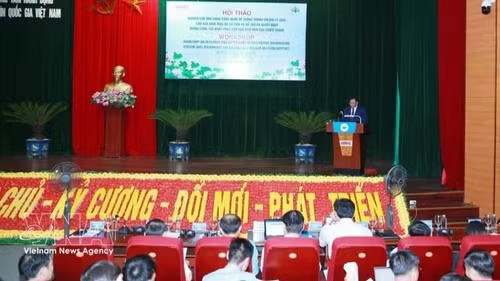
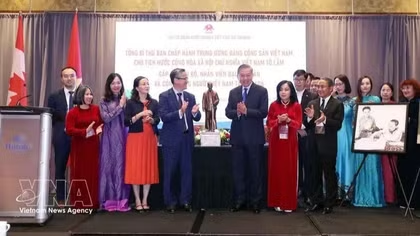
Delegates on the sidelines of the conference (Source: VNA)

Delegates on the sidelines of the conference (Source: VNA)

Vietnam should make greater efforts to get stronger support from the international community in the South China Sea (called the East Sea in Vietnam) issues and hold more activities similar to South China Sea International Conferences, a leading foreign expert has suggested.

Talking with reporters on the sidelines of the 11th South China Sea International Conference in Hanoi on November 6 and 7, Carl Thayer, Emeritus Professor at the University of New South Wales, Australia, said Vietnam should also make the most of the ASEAN chairmanship in 2020 to take the lead in raising voices against China’s unsuitable actions in the waters.

Thayer said China is promoting its nine-dash line claim in an attempt to unilaterally conquer the South China Sea to serve its ambition to become a rising power in Asia.

Sharing this view, Greg Poling, Director of the Asia Maritime Transparency Initiative at the US-based Center for Strategic & International Studies, said by making the nine-dash line claim, China is attempting to prevent Southeast Asian nations, including Vietnam, from carrying out oil and gas projects in the South China Sea.

China wants to force the regional nations to either stop exploration for oil and gas in the South China Sea or partnering with Chinese companies, Poling elaborated.

The expert said China has sent more and more ships to the South China Sea and chased vessels and fishermen of other countries away from the waters. These are not actions of a nation that wishes to partner with regional states, he said, adding that China is seeking to force other countries to do what it wants.

To cope with China’s aggressive actions in the South China Sea, Dr. Tomotaka Shoji from the Japan National Institute for Defense Studies suggested that the observance of international law must be closely monitored not only in the waters but also in any regions in the world.

Nations across the world should step up cooperation with the regional countries and it is necessary to encourage the settlement of disagreements and disputes in the South China Sea and other international oceans based on regulations of the 1982 United Nations Convention on the Law of the Sea (UNCLOS) to ensure safety and freedom of navigation and aviation, he said.

Meanwhile, James Kraska, Emeritus Professor at the US-based Stockton Center for International Law, advised the regional nations to put aside disagreements and reach consensus on the settlement of disputes in the South China Sea.

The regional states should also expand commercial, diplomatic and military ties with outside nations to gain wider support from the international community to oppose China’s violations of international law, he added.


VNA

Other News

Hanoi ready to implement Capital Law 2026, unlocking new development momentum

Hanoi ready to implement Capital Law 2026, unlocking new development momentum

The effectiveness of the Capital Law 2026 will be measured not by the number of legal documents issued but by tangible improvements in governance and public administration, better services for people and businesses, faster administrative procedures, stronger investment attraction and higher economic growth.

Vietnamese students earn honours at ROBOG Asia Cup 2026

Vietnamese students earn honours at ROBOG Asia Cup 2026

Three teams from Chu Van An Secondary School in Vietnam’s Thai Nguyen province have earned First Prize honours and advanced to the quarterfinals at the ROBOG Asia Cup 2026, a regional robotics and artificial intelligence (AI) competition for students held in Hong Kong, China.

Hanoi sets out new investment blueprint with century-long development vision

Hanoi sets out new investment blueprint with century-long development vision

As of early June, Hanoi had attracted 74.6 billion USD in foreign direct investment (FDI) through more than 9,250 valid projects. FDI inflows in the first six months were projected at 3.2 billion USD, surpassing the annual target by 116%, while nearly 16,000 new businesses were established in the first five months, up 34.4% year-on-year.

Vietnam promotes legal cooperation and rule of law at global forum

Vietnam promotes legal cooperation and rule of law at global forum

Vietnam’s development and international integration have gone hand in hand with the improvement of its legal system, the incorporation of international commitments into domestic legislation, and legal reforms aimed at fostering development, openness and global integration. The country regards international law as an essential instrument for building fair, mutually beneficial relations among nations.

Hanoi to hold investment promotion event on June 29

Hanoi to hold investment promotion event on June 29

At the event, Hanoi authorities plan to grant investment policy decisions and investment registration certificates to 20 exemplary projects in the fields of transportation infrastructure, industrial parks, urban development, social housing, environment, science and technology, and foreign investment attraction.

Hanoi's Red River urban area development draws widespread attention

Hanoi's Red River urban area development draws widespread attention

Located south of the Red River and extending from the historic inner city to newly developing areas in the south and the west, the central urban area along Red River’s right bank covers approximately 45,317 hectares and is projected to accommodate around 6.365 million residents by 2045 and 6.455 million by 2065.

Hanoi's Red River urban area development draws widespread attention

Hanoi's Red River urban area development draws widespread attention

Located south of the Red River and extending from the historic inner city to newly developing areas in the south and the west, the central urban area along Red River’s right bank covers approximately 45,317 hectares and is projected to accommodate around 6.365 million residents by 2045 and 6.455 million by 2065.

Regional cooperation strengthened to combat cross-border drug crime

Regional cooperation strengthened to combat cross-border drug crime

Vietnam, China, Laos and Myanmar face common challenges as drug syndicates increasingly exploit the Mekong River, cross-border transport networks, e-commerce platforms, international logistics services, cyberspace and cryptocurrencies to organise drug transactions and smuggling operations.