Vietnam makes a UNESCO push for Dan Bau-monochord zither

Vietnamese agencies, including the National Institute of Music, Folk Arts Association of Vietnam and Vietnam Musicians’ Association, are aiming to ally with the Ministry of Culture, Tourism and Sports to propose to UNESCO to recognise dan bau as a world heritage.

The campaign was announced by Chairman of the Folk Arts Association of Vietnam To Ngoc Thanh in a workshop on dan bau and its role in Vietnam culture held by National Institute of Music on October 21.

The workshop drew researchers, artists and scholars, including artist Thanh Tam, Nguyen Tien, who have significantly contributed to promote dan bau, Head of the National Institute of Music, Nguyen Binh Dinh, artist Bui Le Chi, Hoang Anh Tu and Nguyen Thuy Loan.

The workshop focused on the history, development the role of dan bau in Vietnamese culture, and it discussed the path to preserving the instrument. 
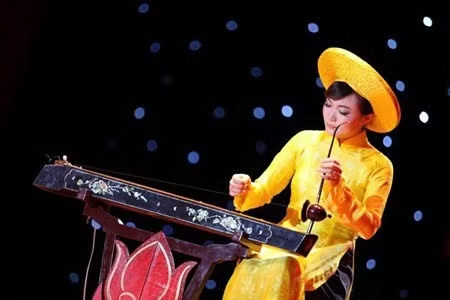
Dan bau is a unique instrument which represents Vietnamese people’s language and soul. (Photo: baomoi.vn)
“If we were to choose an instrument to represent Vietnam’s traditional music, to introduce and promote Vietnam and its people, dan bau would definitely be the one,” said Binh Dinh.

“ Dan bau is the most unique instrument which represents Vietnamese people’s language and soul,” said artist Nguyen Tien.

Though it is hard to clarify the exact time when dan bau was created, most scholars agree that it is an indigenous instrument of Vietnam and was used before 19th century, said Head of the National Institute of Music, Nguyen Binh Dinh.

Nguyen dynasty historians noted in Dai Nam Thuc Luc, (The true record of Vietnam history) that dan bau was born in the 18th century and Ton That Duc, a scholar who was keen on learning and excellent at literature and music created this instrument, said Dang Hoanh Loan.

In Vietnam, there also exist many legends associated with the birth of dan bau . According to these legends, dan bau were often given to warmhearted yet overworked people by Buddha so that they could make ends meet from playing this instrument. These people then spread the popularity through teaching and performance, artist Thanh Tam said.

“This instrument was very close to life of ordinary people. It initially accompanied buskers in singing to make ends meet in the markets of rural villages and urban areas,” said Thanh Tam.

Dan bau has experienced ups and downs of history--as well as reforms over different periods--but it has become one of the most unique instruments in Vietnam.

“Among traditional instruments of Vietnam, dan bau is the one that attracts the most interest from composers and researchers. This can be proved by the dominant number of works composed inclusively for dan bau , the number and the scope of studies on dan bau ,” said Dinh.

In addition, dan bau performance is among the must-haves for traditional art events for international audiences and diplomats as well as big events held domestically, said Dinh.

In wars against France and America, dan bau and sao truc (bamboo flute) performance were also the favourites for soldiers.

“From 1970s to early 1990s, dan bau was performed in many countries in Europe, Africa and Americas. The performing artists often said the international audience understood more about Vietnam and its people thanks to dan bau . It has been considered as a representative and symbol of Vietnam culture,” said Dinh.

Dan bau played an important place in Vietnam music in 1990s as there was an increasing number of people pursuing this instrument and Vietnamese artists granted awards like artists Nguyen Tien, Thanh Tam, Hoang Anh Tu, Bui Le Chi, Hoang Xuan Binh and Phan Kim Thanh, said Thanh Tam.

Many well-known composers also composed beautiful masterpieces for dan bau , including composer Huy Thuc, Xuan Khai, Duc Nhuan and Ngo Quoc Tinh, said Thanh Tam.

Vietnam needs to carry out some urgent solutions to protect and promote the values of cultural heritages, including dan bau , said Dinh.

Relevant agencies need to co-ordinate a proposal for UNESCO recognition for dan bau to assert cultural sovereignty for this instrument, said To Ngoc Thanh. Bui Le Chi recommended that training talents in arts field must start from an early age. In addition, initiatives like granting awards or financial support to encourage artists and teachers to engage more in composing work for dan bau are essential.
VNA

Other News

Vietnam secure berth at FIFA U17 World Cup 2026 for first time

Vietnam secure berth at FIFA U17 World Cup 2026 for first time

Vietnam national U17 football team secured a place at the FIFA U17 World Cup 2026 for the first time after defeating United Arab Emirates national U17 football team 3-2 on in the final Group C match of the AFC U17 Asian Cup 2026 in Saudi Arabia on early May 14 (Vietnam time).

Vietnam’s most beautiful railway station twins with French counterpart

Vietnam’s most beautiful railway station twins with French counterpart

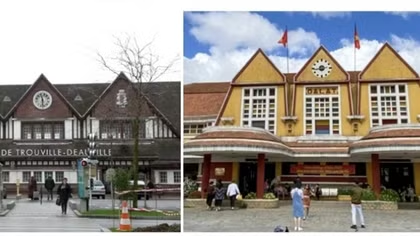
A twinning agreement between Da Lat Railway Station in Vietnam and Trouville-Deauville Railway Station in France was signed at the French Embassy in Vietnam on May 7, creating new opportunities for cooperation in station management and operations, as well as cultural and tourism promotion between the two sides.

Hanoi gains two more craft villages in World Crafts Cities network

Hanoi gains two more craft villages in World Crafts Cities network

The recognition of Chuyen My and Son Dong craft villages as members of the World Crafts Cities network represents international acknowledgement of the cultural value, artisanal techniques, creativity and sustainable vitality of Vietnam’s traditional craft villages, he said.

Thang Long - Hanoi Festival 2026 to return in September

Thang Long - Hanoi Festival 2026 to return in September

Co-hosted by the municipal People’s Committee, the Department of Culture and Sports, and domestic and foreign agencies, the whole spectacle is meant to honour the city’s millennia-old heritage while reafffirming its strategy of establishing culture as a development engine.

Spreading Vietnamese cultural identity in digital space

Spreading Vietnamese cultural identity in digital space

In the context of deep international integration, cultural identity serves as both a “shield” against assimilation and a defining marker of a nation’s image. Protecting and promoting uniquely Vietnamese cultural values has therefore become a pressing task, particularly in an increasingly complex digital environment.

ITE HCMC 2026 to promote Vietnam’s tourism on global map

ITE HCMC 2026 to promote Vietnam’s tourism on global map

With its large scale, the ITE HCMC 2026 aims to promote tourism cooperation between Vietnam and priority markets such as Northeast Asia, Western Europe, North America, Southeast Asia, and Oceania while also boosting visitor arrivals from the Indian market

Vietnamese puppetry seeks renewal amid preservation challenges

Vietnamese puppetry seeks renewal amid preservation challenges

Although widely regarded as a cultural “speciality” attracting tourists, Vietnamese puppetry is facing multiple challenges in preservation and development, requiring renewed efforts to both safeguard its identity and adapt to contemporary cultural currents.

Project on digital transformation in cultural sector approved

Project on digital transformation in cultural sector approved

By 2030, the project targets the establishment of shared digital platforms across 100% of cultural sectors. All digitised cultural heritage will be standardised under the national data framework and shared in accordance with regulations, while 80% of public digital heritage assets are expected to receive digital identifiers to clarify ownership and management, encouraging organisations and individuals to do the same and support market development.

Vietnam eyes becoming region’s leading tourism destination

Vietnam eyes becoming region’s leading tourism destination

Vietnam has in recent years undergone a notable transformation in its tourism development strategy, placing a strong emphasis on nature-based and eco-tourism. This shift is not merely aligned with global trends, but represents a necessary step towards safeguarding valuable natural resources, while appealing to a growing segment of environmentally conscious travellers.