Vietnam, RoK push for stronger economic cooperation

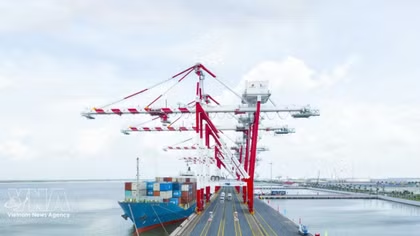
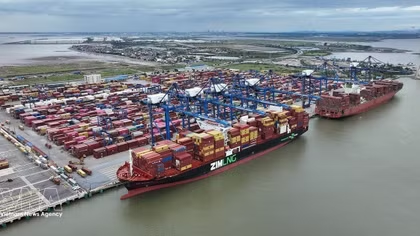
The nation is currently the Republic of Korea (RoK)’s third largest trading partner, while the RoK has developed into the largest direct investor in country.

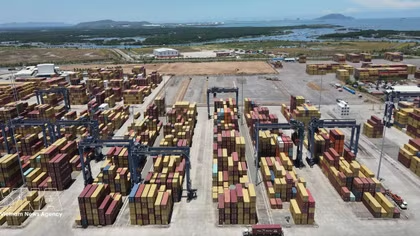
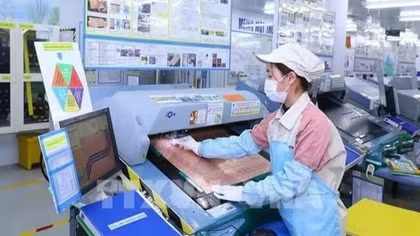
vietnam, rok push for stronger economic cooperation picture 1

The Korea Institute for International Economic Policy (KIEP) is poised to organise an international seminar on RoK-Vietnam economic co-operation to mark the occasion of the 30th anniversary of bilateral relations between both sides.

According to economist Kawk Sung-il, director of the Center for Economic Security Strategy at the Korea Institute for International Economic Policy, the primary goal of the seminar is to hold in-depth discussions on issues related to bilateral co-operation. He added that relations between the two nations have developed strongly over the past three decades and have recorded a number of great achievements, especially in the field of economics.

However, in order for this relationship to continue to develop in a sustainable manner moving forward, more exchanges and discussions on co-operation methods are needed.

For this reason, scholars from the two nations’ have co-ordinated efforts to conduct diverse in-depth studies across multiple fields as a means of creating a foundation for them to be published at the upcoming seminar.

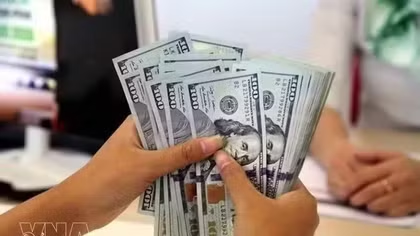
Economic co-operation is therefore an important achievement and a bright spot in bilateral ties. In line with this, bilateral trade turnover stood at only US$490 million, equivalent to 0.3% of the RoK's total trade turnover since the establishment of diplomatic ties back in 1992. However, after 28 years this figure so far accounts for 7% of the total trade turnover of the East Asian nation.

The Korean community residing in Vietnam run a diverse range of economic activities. Although investment in the Vietnamese market has decreased due to the impact of the COVID-19 pandemic in 2021, many Korean companies continue to view the nation as the most promising country among the 10 ASEAN member states.

This unevenness in terms of the trade balance is one of the main limitations in bilateral economic co-operation, particularly as the trade turnover between the two countries is increasing and the general scale of the trade imbalance is also in the process of gradually expanding.

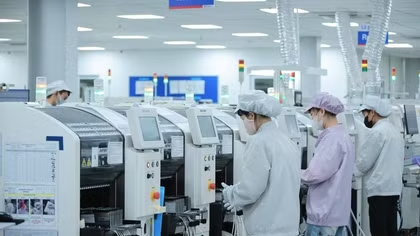
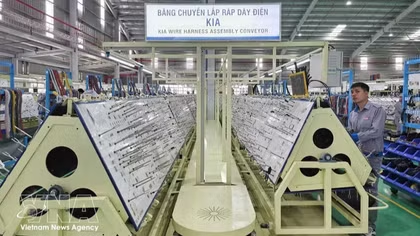
The main reason behind this is that most Korean exports to the Vietnamese market are intermediate goods, semi-finished products, which can be understood as a result of the Korean direct investment in the country.

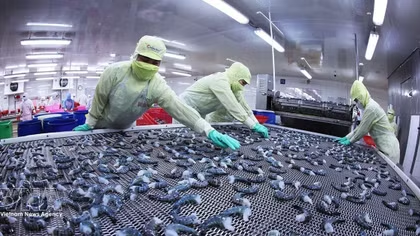
There are an array of opinions that could contribute to increasing Vietnamese agricultural exports to the RoK, thereby helping to solve the trade imbalance, although this would only be a short-term remedy. Agricultural and aquatic exports would only be able to make Vietnam a low value-added exporter. Instead, it is more important to attract greater investment from the RoK in order to create an environment where Vietnamese companies can become more deeply involved in the Korean production network.

Through this process, in the event that a strong supply chain between the two countries can be formed, the bilateral mutual relationship can be promoted more sustainably, Sung-il went on to say.

The Korean expert said assessed that the Vietnamese side needs to promote its production capacity and technology to participate more deeply in the supply chain. In fact, when a Korean corporation or company invests in the Vietnamese market, then they become a legal entity of the country.

However, due to Korean companies often investing in the nation in the form of 100% FDI, technology transfer also faces plenty of difficulties.

Sung-il stated that when analysing Vietnamese export value, it can be seen that the proportion of domestic value added remains low.

This means that the majority of the production of components and spare parts are located abroad, with the product localisation rate remaining low. By the end of 2017, only 600 out of a total of 26,700 FDI projects in the country had technology transfer contracts.

In comparison to neighbouring ASEAN member states such as Indonesia, Malaysia, the Philippines, and Thailand, the proportion of added value in Vietnamese products can be considered low.

As a result of this, Vietnamese companies must pay close attention to developing their own technology in parallel with international co-operation. Therefore, efforts to boost transfer technology through co-operation with foreign companies that have already penetrated the domestic market will prove to be effective.

In addition, it can be considered necessary to devise policies which encourage and protect Korean companies, thereby ensuring that they are able to see the parallel benefits in technology transfer, he added.
VOV

Other News

Private economic sector poised for breakthrough growth

Private economic sector poised for breakthrough growth

More than a year after the Politburo's Resolution No. 68-NQ/TW on private sector development came into effect, expectations now extend beyond increasing the number of enterprises. The goal is to build a stronger business community with greater resilience, larger ambitions and the capacity to compete in global supply chains.

Vietnam remains ASEAN growth leader in 2026 despite global headwinds: WB

Vietnam remains ASEAN growth leader in 2026 despite global headwinds: WB

Vietnam is expected to remain one of ASEAN’s fastest-growing economies in 2026, supported by resilient exports, strong investment inflows and an ambitious reform agenda, despite mounting global uncertainties, according to the World Bank’s latest Vietnam Economic Update released on May 15.

Ministry establishes monitoring framework for carbon market

Ministry establishes monitoring framework for carbon market

Under a new circular, the exchange of greenhouse gas emission quotas and carbon credits is conducted on the domestic carbon credit exchange through the carbon trading system, which is interconnected with the national registration system.

Biofuel ready for nationwide rollout

Biofuel ready for nationwide rollout

For biofuels, particularly E10, to develop successfully, stronger and more coordinated policies are needed, especially pricing mechanisms capable of creating a sufficiently attractive gap between E10 and mineral-based petrol, an expert has said.

Vietnamese farm produce promoted at African investment, trade forum

Vietnamese farm produce promoted at African investment, trade forum

The 12th Africa Forum for Investment & Commerce (AFIC 12) opened in Algiers, the capital of Algeria, on May 9, drawing around 2,000 participants, including officials, economists, businesses, financial and development organizagtions from 43 African countries and international partners, including Vietnam.

Int'l medical, pharmaceutical expo opens in Hanoi

Int'l medical, pharmaceutical expo opens in Hanoi

The exhibition, which runs until May 9 at the Hanoi International Centre for Exhibition, showcases advanced products and technologies across a range of fields, including pharmaceuticals, drug manufacturing machinery and equipment, medical devices, hospital and clinic services and dental equipment.

Mega projects to transform Ho Chi Minh City urban landscape

Mega projects to transform Ho Chi Minh City urban landscape

Leading the charge in this massive building spree is the new central city square in the core of the Thu Thiem new urban area. Spanning more than 20 ha, it’s the crown jewel of the Central Square and new administrative center complex.

Vietnam establishes itself as one of region’s most dynamic manufacturing and supply bases

Vietnam establishes itself as one of region’s most dynamic manufacturing and supply bases

The country’s stable political and economic environment provides a critical foundation for long-term sourcing strategies. At the same time, Vietnam has demonstrated a strong ability to scale up manufacturing, supported by a continuously expanding industrial base capable of meeting both high-volume demand and increasingly complex technical and quality requirements.

Vietnamese pomelos gain broader access to Australian market

Vietnamese pomelos gain broader access to Australian market

The update by Australia’s Department of Agriculture, Fisheries and Forestry to its Biosecurity Import Conditions system (BICON) on April 10, officially setting out import conditions for Vietnamese pomelos, is regarded as a major milestone in market access efforts.

Vietnam's industry spearheads transition to circular economy

Vietnam's industry spearheads transition to circular economy

The circular economy is no longer just a policy choice. It has become an inevitable trend for delivering sustainable and green growth, sharpening competitiveness at home and abroad, and meeting Vietnam’s net-zero emissions target by 2050. It is now a prerequisite to sustain long-term economic expansion, particularly in industrial production and supporting industries.

Nearly 100 tonnes of Vietnamese fruits, vegetables airlifted to UAE

Nearly 100 tonnes of Vietnamese fruits, vegetables airlifted to UAE

Vietnamese fresh produce and processed foods are increasingly recognised for their quality, with items such as cashew nuts, coffee and spices gaining popularity among Middle East consumers. In 2025, Vietnam’s farm produce exports to the UAE exceeded 445 million USD, up nearly 24% year-on-year.