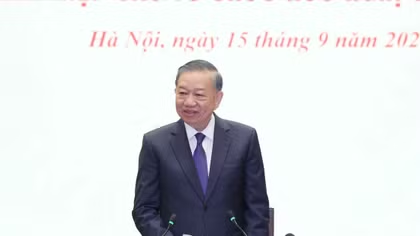
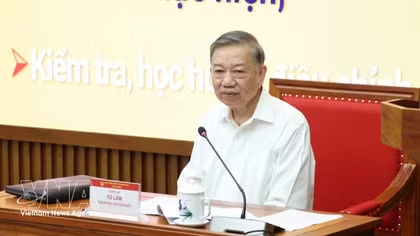
This marks the first overseas working trip by Party General Secretary and State President To Lam to the UN, the U.S., and Canada following Vietnam's successful organization of the 14th National Party Congress and the elections for the 16th National Assembly and People's Councils at all levels for the 2026–2031 term.
According to Deputy Minister of Foreign Affairs Dang Hoang Giang, the top leader's working trip and bilateral engagements in the U.S. will contribute to implementing the common perceptions reached by the high-level leaders of both nations. It will also further propel the Comprehensive Strategic Partnership toward stable, substantive, effective, and sustainable development. Furthermore, this is an opportunity for both sides to enhance high-level interactions, exchange views on issues of long-term and strategic significance to bilateral ties, and foster mutual understanding while rallying support from various U.S. circles for Vietnam and the Vietnam – U.S. relationship.
Since the normalization of diplomatic relations in July 1995, the Vietnam – U.S. relationship has traversed a developmental path characterized by increasingly deep and broad strides, transitioning from healing the wounds of the past to building a foundation of cooperation for peace and sustainable development.
Consolidating political trust, expanding cooperation
A notable highlight of Vietnam – U.S. relations is the robust development of high-level contacts, exchanges, and bilateral dialogue mechanisms.
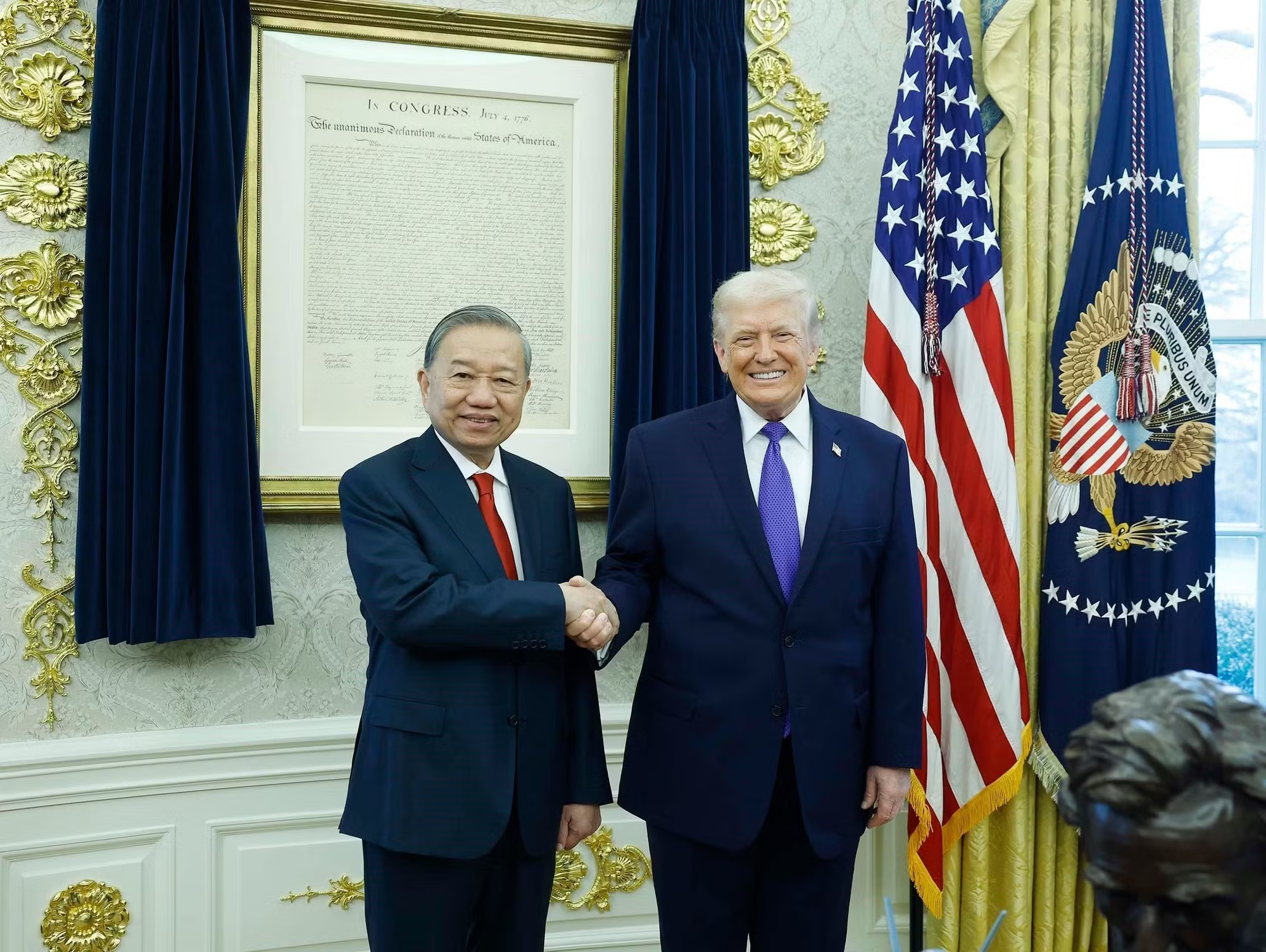
Following the upgrade of ties in September 2023, the two countries have maintained engagements across multiple levels. In 2026, these activities were further accelerated, highlighted by the meeting between General Secretary To Lam and U.S. President Donald Trump at the White House; the U.S. visit by Permanent Deputy Prime Minister Nguyen Hoa Binh; the meeting between Foreign Minister Le Hoai Trung and U.S. Secretary of State Marco Rubio, alongside numerous visits to Vietnam by high-ranking U.S. delegations.
Concurrently, both sides have maintained regular bilateral dialogue mechanisms spanning politics, security, defense, and law enforcement. These exchanges and contacts have been instrumental in sustaining mutual understanding, consolidating trust, and creating conducive conditions for both nations to discuss matters of mutual interest.
During these discussions, the U.S. side consistently reaffirmed the importance it attaches to its relations with Vietnam, expressing support for a strong, independent, self-reliant, and prosperous Vietnam. The U.S. also voiced its desire to advance relations based on mutual respect for each other's independence, sovereignty, territorial integrity, and political systems.
As noted by Deputy Minister Dang Hoang Giang, "political trust has been continuously consolidated, with both sides regularly maintaining exchange and contact activities at all levels." This serves as a cornerstone for the Vietnam – U.S. relationship to further expand in both the scale and scope of cooperation.
The advancement of bilateral ties is also reflected in the two countries' joint efforts to address international issues. In 2026, Vietnam joined the Gaza Peace Council as a founding member, partnering with the U.S. and the international community to contribute to efforts promoting a long-term, comprehensive solution for the Middle East peace process, in accordance with international law and the UN Charter.
Economy, trade, and investment remain the driving engines
Alongside political and diplomatic relations, economic, trade, and investment cooperation remains a crucial pillar of the Vietnam – U.S. relationship.
In the first seven months of 2026, two-way trade turnover reached $118 billion. The U.S. continues to be Vietnam's largest export market, while Vietnam ranks as the 8th largest trading partner of the U.S. and its largest trading partner within ASEAN.
Investment ties have also seen continued expansion. The U.S. is the 11th largest foreign investor in Vietnam, while Vietnam also operates investment projects in the U.S. Numerous U.S. enterprises continue to show interest in and expand their investments in Vietnam, particularly technology, logistics, and energy corporations. Conversely, Vietnamese enterprises are also scaling up their investments in the U.S. market.
These outcomes demonstrate the growing cohesion and complementarity between the two economies. As Deputy Minister Dang Hoang Giang assessed, economics, trade, and investment have become the driving forces of bilateral ties.
Notably, the cooperative space is broadening into new, strategic, and future-shaping sectors. Science and technology, innovation, the semiconductor industry, artificial intelligence (AI), energy transition, and high-quality human resource development are emerging as priority areas of mutual interest.
These are fields that align Vietnam's developmental needs with the U.S.'s strengths and cooperative resources, charting new pathways for bilateral relations in the upcoming phase.
Addressing war legacies – a bright spot in relations
Throughout the evolution of Vietnam – U.S. relations, cooperation in overcoming the consequences of war remains a matter of profound significance.
Both sides have been stepping up efforts to search for U.S. service members missing in action (MIA), locate the remains of Vietnamese martyrs, remediate dioxin contamination, clear unexploded ordnance, and support persons with disabilities. These activities are carried out in tandem with defense, security, and law enforcement cooperation.
Defense and security ties also continue to witness positive developmental strides. The two sides maintain annual dialogue mechanisms, implement humanitarian cooperation programs, and foster collaboration in security and law enforcement, including combating transnational crime.
In addition, cooperation in education, healthcare, culture, and people-to-people exchanges is increasingly expanding. Educational collaboration is notably gaining momentum in training human resources for the semiconductor industry, while English language training programs continue to be deployed.
Relations between localities of the two countries have also been increasingly strengthened. U.S. states and cities and Vietnamese localities maintain various forms of cooperation, including sister-city programs and memorandums of understanding.
The Vietnamese community in the U.S. continues to serve as a vital bridge, making active contributions to bilateral relations. They are an essential component of people-to-people exchange activities, helping to deepen mutual understanding between the two nations.
From the normalization of relations to a Comprehensive Partnership, and now a Comprehensive Strategic Partnership, Vietnam – U.S. relations have made profound and broad strides across multiple domains. This trajectory demonstrates that the bilateral relationship is increasingly built upon a foundation of substantive cooperation, mutual respect, and a shared orientation toward areas of mutual benefit.
The continued coordination between the two countries on regional and international issues, including within UN and ASEAN mechanisms, also helps expand the space for cooperation. The U.S. continues to reaffirm its support for ASEAN's centrality and solidarity, while highly valuing Vietnam's position and role within ASEAN, the Asia-Pacific region, and across international forums.