Vietnam welcomes 17.7 million international visitors in January - September

September alone saw 1.77 million foreign visitors arrive in Vietnam, up 16.1% from the same month last year.

Vietnam welcomed more than 17.7 million international visitors in the first nine months of 2026, up 14.5% year-on-year, reaching nearly 71% of its target, according to the Vietnam National Authority of Tourism.

September alone saw 1.77 million foreign visitors arrive in Vietnam, up 16.1% from the same month last year.

1.jpg
International tourists at Kem Beach in the Phu Quoc Special Economic Zone (An Giang). (Photo: VNA)

Air travel remained the dominant mode, accounting for 83.2% of total international arrivals in the nine-month period, followed by land travel at 15.4% and sea travel at 1.4%.

China and the Republic of Korea remained Vietnam’s largest source markets, together accounting for nearly 40% of total arrivals. China topped the list with 3.9 million visitors, or 22.4%, followed by the RoK with 3 million, or 17.3%.

Russia ranked third with around 1.1 million arrivals, making it Vietnam’s largest European source market. It was followed by Taiwan (China) with 964,000, and the US with 764,000.

Other markets among the top 10 included Cambodia with 688,000 arrivals, Japan 674,000, the Philippines 523,000, India 505,000 and Australia 485,000.
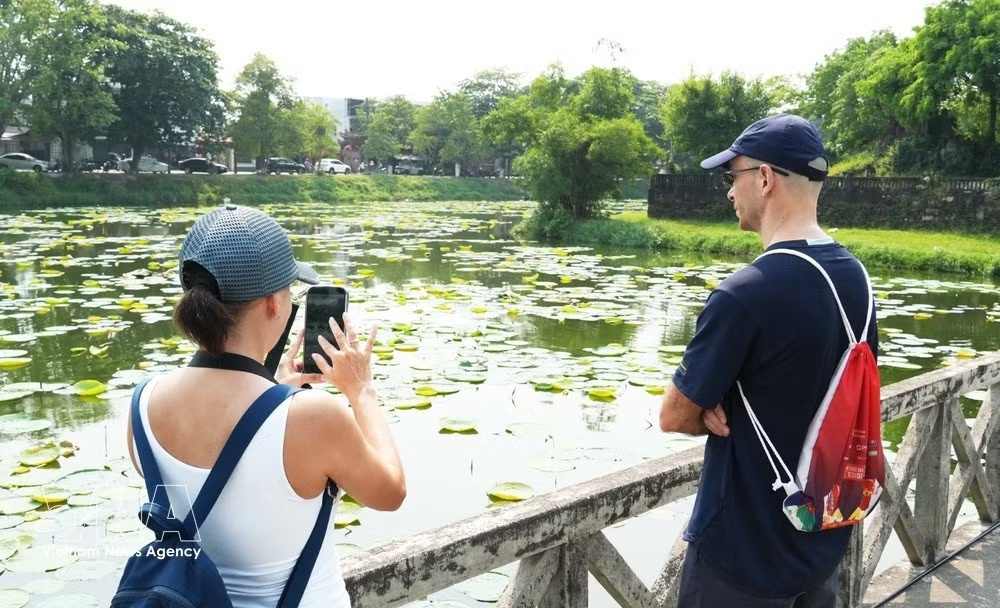
International tourists visiting Tinh Tam Lake in the Hue Imperial Citadel. (Photo: VNA)

European markets posted the strongest growth, rising 55% year-on-year, while arrivals from Oceania, the Americas and Africa increased 21%, 20% and 29.4%, respectively. The Asian market grew 7.6%.

Russia recorded particularly strong growth, with more than 1 million visitors, up 160.6%. The market has strong demand for beach holidays, long stays and winter escapes, supported by improved air connectivity and Vietnam’s growing resort capacity.

Other European markets also posted solid growth, including France at 13.6%, the UK at 9.7%, Germany at 16.1%, Poland at 49%, the Czech Republic at 26.6%, Belgium at 19.5%, Sweden at 23.6% and Switzerland at 25.7%.

Asia remained Vietnam’s largest source region, accounting for 74.5% of total international arrivals. However, growth was relatively modest as major Northeast Asian markets saw limited gains or declines. Chinese arrivals rose 1.5%, while those from the RoK fell 5.5% and Taiwan (China) increased 4.1%.

Meanwhile, Southeast Asian markets delivered robust growth, led by the Philippines at 55.2%, Cambodia 40.5%, Singapore 29.8%, Indonesia 25.5%, Malaysia 18.1% and Thailand 10.1%. India and Australia also recorded strong increases of 33% and 21%, respectively.

Vietnam’s tourism growth came amid continued challenges facing global travel, including geopolitical tensions, sluggish economic conditions, high transport and energy costs, intensifying competition among destinations and rapidly changing travel demand.

Against this backdrop, Vietnam’s double-digit growth in the first nine months reflects the country’s growing appeal of the destination, supported by safety and stability, market diversification, a wide range of tourism products, improved air connectivity and growing service capacity.

The Vietnam National Authority of Tourism said the results indicate that the sector is gradually shifting towards deeper, quality-oriented and sustainable growth. The focus is increasingly on not only attracting more visitors but also extending their stays, increasing spending and enhancing the quality and added value of tourism experiences.

en.vietnamplus.vn

Other News

Ta Xua named Asia's leading emerging tourism destination 2026

Ta Xua named Asia's leading emerging tourism destination 2026

In recent years, Ta Xua, dubbed "the paradise of clouds", has emerged as one of the mountainous destinations attracting strong interest from young travellers, particularly for its spectacular sea of clouds stretching across the mountains in the northwestern region.

Digital transformation key to preserving, promoting ethnic cultural values

Digital transformation key to preserving, promoting ethnic cultural values

Training local young people in filming, audio recording, digital storytelling, data preservation and responsible use of AI can help build a new generation of cultural custodians. This, in turn, can help transform cultural heritage into a resource for economic development while contributing to the country’s broader development.

Indigenous culture becomes tourism asset in northern highlands

Indigenous culture becomes tourism asset in northern highlands

With growing recognition of indigenous knowledge, customs and cultural values as unique assets, ethnic communities in the northern mountainous region are shifting from simply providing tourism services to becoming creators and owners of tourism products, confidently telling their own cultural stories

UNESCO ready to work with Vietnam to implement International Decade of Culture for Sustainable Development initiative: Representative

UNESCO ready to work with Vietnam to implement International Decade of Culture for Sustainable Development initiative: Representative

Jonathan Wallace Baker, UNESCO Representative to Vietnam, noted that the official proclamation of the 2027–2036 period as the "International Decade of Culture for Sustainable Development" comes at a particularly important moment. As the international community works to accelerate progress towards the 2030 Agenda while beginning to consider what comes after 2030, the Decade provides a ten-year framework to strengthen the place of culture in development.

Traditional culture finds new life in contemporary Vietnam

Traditional culture finds new life in contemporary Vietnam

Under Resolution 80-NQ/TW, dated January 7, 2026, November 24 was designated Vietnam Culture Day, to be observed annually. The occasion aims to give the public opportunities to participate in, create and enjoy cultural activities, helping spread positive values and foster pride in Vietnamese culture.

Vietnam prioritises MICE tourism as strategic product

Vietnam prioritises MICE tourism as strategic product

For the MICE tourism sector in both Ho Chi Minh City and Vietnam, growth can no longer be driven merely by increasing the number of events; instead, the focus must shift to enhancing the value of each event and the competitiveness of each destination.

Potential of ethnic minority women's football

Potential of ethnic minority women's football

Women’s football movements in local communities have been quietly growing, but they’ve now built up enough momentum to inspire organisers to launch the first Vietnam Ethnic Minority Women’s Football – VTV Cup in 2026.

Phong Nha - Ke Bang named among Vietnam's 11 most beautiful destinations

Phong Nha - Ke Bang named among Vietnam's 11 most beautiful destinations

According to the magazine, boat trips into Phong Nha Cave and strolls through Paradise Cave (both family-friendly) offer a tantalising glimpse of their astonishing scale, but the real adventure lies deeper within the park, where cavers wade through underground rivers and weave among stalagmites.

Tourism seeks new growth momentum under Resolution 26

Tourism seeks new growth momentum under Resolution 26

Tourism effectiveness should be measured not only by visitor numbers and revenue, but also by spending, length of stay, repeat visits, job quality, visitor satisfaction and environmental carrying capacity, said experts.

Vietnam welcomes nearly 2 million international visitors in August, up 19.7% from July and 18.4% year-on-year. (Illustrative photo: VNA)

Vietnam tourism maintains strong growth, expands international markets

The National Statistics Office under the Ministry of Finance reported that Vietnam welcomed nearly 2 million international visitors in August, up 19.7% from July and 18.4% year-on-year. The figure represented 63.6% of the tourism sector’s full-year target of 25 million arrivals.

First ladies of Vietnam, Myanmar visit Van Phuc silk village

First ladies of Vietnam, Myanmar visit Van Phuc silk village

Ngo Phuong Ly, the spouse of General Secretary of the Communist Party of Vietnam Central Committee and President To Lam, said the two countries share similarities in silk weaving and can enrich their cultural heritage through exchanges and experience sharing.