Online newspaper Hanoimoi.com.vn cited Makoto Nakamura, an international trade consultant at the Japan External Trade Organisation as saying that when consuming food products, health and safety was the top priority of Japanese people and then the price.
Agricultural and food products that entered the Japanese market had to undergo animal and plant quarantine inspections. Also, these goods had to comply with Japan’s regulations on environmental sanitation.
Vietnamese trade counsellor in Japan Ta Duc Minh suggested Vietnamese enterprises document links from production and preservation to transportation while meeting Japan’s regulations on standards if they wanted to enhance their foothold and then expand in the Japanese market.
Minh said though retail systems in Japan had strict requirements and most of Vietnam’s exports were made through intermediaries, Vietnamese enterprises should try to directly work with Japanese importers to enhance the value of their brands.
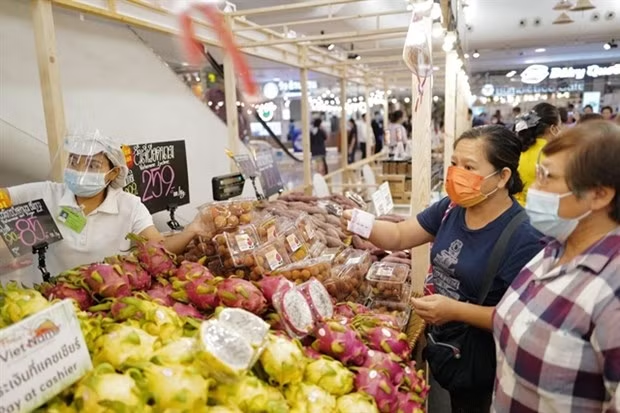 |
| Vietnamese products on sale at a foreign mall (Photo: VNA) |
Minh suggested enterprises that wanted to enter the Japanese market should first participate in fairs and exhibitions in Japan where they could find new partners, as well as learn about consumer trends.
For the US, another lucrative market for Vietnamese goods, Vince Tran, a representative of Walmart supermarkets in Vietnam advised Vietnamese businesses to dive deeper into the US consumer market. He said they should develop products that were suitable to the tastes of US consumers and ensure their production capacities had adequate volume to produce competitively priced goods.
According to the Director-General of the European-American Market Department under the Ministry of Industry and Trade (MoIT) Ta Hoang Linh, over the past years, Vietnamese enterprises had improved their understanding of international import-export standards. However, the firms needed to make greater efforts in cementing the foothold of their products on international supermarket shelves.
Linh said the MoIT would continue to support Vietnamese businesses to export and sell goods on cross-border e-commerce platforms. This would aim to not only increase the number of enterprises with products available in foreign retail systems, contributing to increasing the nation’s export turnover but also to make Vietnam an important source of goods for major foreign markets.
The MoIT and a number of distribution groups launched a set of manuals to guide Vietnamese enterprises to export more effectively. The MoIT said the manual provided basic and useful information about different markets while explaining the supplier selection process, requirements and standards of some products when exporting to each distribution system such as Aeon, Decathlon, Lotte, Center Retail and Mega Market.
In June, over 150 Vietnamese products of high quality were showcased in the Vietnamese Goods Week jointly held in Thailand's Udon Thani province by the Vietnamese Trade Office in Thailand and the Central Group.
The event themed "A Flavour of Vietnam" had 20 Vietnamese firms, including Dalat Hasfarm, which sold fresh flowers and plants, the Lam Dong Pharmaceutical JSC, Dong Xuan knitting company, Hong Ha and Thien Long stationery companies.
In the same month, about 350 stores and supermarkets of retail giant AEON spread across Japan, along with its website, displayed a number of Vietnamese products for the Vietnamese Goods Week.
The products on display included fresh fruits like lychee and banana, food, garments-textiles, leather and footwear, household utensils, and handicrafts. AEON imported 30 tonnes of lychee from Vietnam’s northern provinces of Bac Giang and Hai Duong to serve the event.
The annual Vietnamese Goods Week aims to raise AEON’s sales of Vietnamese products in Japan to 1 billion USD by 2025. Through the event, more than 100 businesses from 21 Vietnamese cities and provinces introduced their products to Japanese consumers.
June also saw Vietnamese lychee available on the shelves of Asian supermarkets in the Netherlands, France, Germany, and Norway with the price of more than 500,000 VND per kilo for the first time. This was considered a good beginning for lychee and many types of Vietnamese goods accessing the European market.
At the same time, Vietnamese trade offices in other foreign countries also facilitated the import of Vietnamese goods. Notably, in July, the Vietnamese Trade Office in Australia helped bring rice, dragon fruit, mango, litchi and longan from Vietnam into the Australian supermarkets.
A promotional programme titled “Vietnamese green mango, homeland flavour” is underway in Australia until the end of this month.
According to the Vietnamese Trade Office in Australia, stores and supermarkets in Melbourne and Sydney are selling Vietnamese green mangoes for 15-17 AUD per kilo.
The MoIT said that thousands of Vietnamese businesses have been connecting with foreign distributors such as Aeon in Japan, Central Retail and Mega Market in Thailand, Lotte in the Republic of Korea and Walmart in the US. It was estimated that over the past five years, Vietnam's average annual export turnover through foreign distribution systems was about 2 billion USD.