Vietnam’s auto industry in need of a kick start

In order to help boost the Vietnamese automobile industry – one of the most important contributors to national economic growth – the country could do with focusing on its policy stability, market expansion, support industry development, and connectivity reinforcement, according to insiders.

vietnam’s auto industry in need of a kick start hinh 0

The dream of a Vietnamese automobile has been nurtured by many Vietnamese enterprises for a long time. After nearly 30 years, Vingroup – one of the largest private companies in Vietnam – made the dream come true by rolling out its two Vinfast cars at the 120th Paris Motor Show in October.

Experts assessed that together with the strength of big names like Truong Hai Auto Corporation (Thaco) and Hyundai Thanh Cong Company, the event was a firm foundation, creating a breakthrough for the development of the domestic automobile industry after years of slow growth.

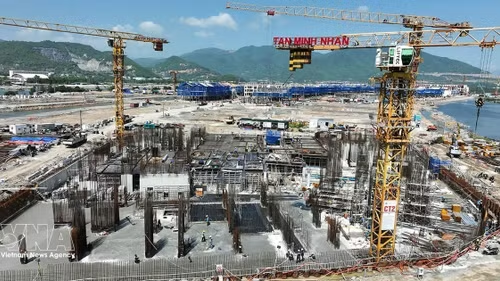
The fact shows that the industry has developed rapidly over the past two years with several major projects being carried out, including a Vinfast automobile manufacturing complex project, which has a total investment of VND35 trillion (US$1.49 billion) and a capacity of 500,000 units per year; a Thaco Mazda automobile plant project totalling VND12 trillion with a yearly capacity of 100,000 units; and a VND1.32 trillion Hyundai Thai Cong automobile factory project which has a capacity of 40,000 units annually.

According to the Ministry of Industry and Trade, the output of locally manufactured and assembled automobiles surpassed 200,000 units for the first time in 2015, up 51% compared with that of the previous year. In 2016, domestic automobile manufacturing reached 283,300 units. Some kinds of vehicles have been exported to Laos, Cambodia, Myanmar, and the Central American region.

However, the localisation rate of the automobile industry remains low due to the lack of a network of material suppliers and large-scale parts producers. According to the ministry’s Department of Industry, although the target rate was set at 40% for 2005 and 60% for 2010, it sits at just 7 to 10% on average. Thaco leads among manufacturers with a rate of 15 to 18%, while Toyota Motor Vietnam reaches 37% for the Innova model alone.

Currently, Vietnam has 358 automobile-related manufacturing enterprises, including 50 assembly businesses, 45 chassis and body manufacturers, and 214 parts producers. The number of auto parts producers is reportedly much lower than in Thailand, which has 2,500 enterprises.

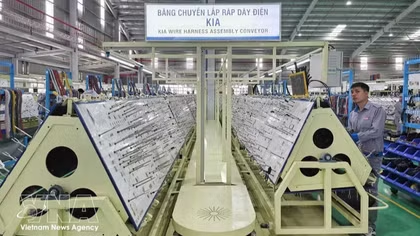
The industry just produces a number of simple parts such as components for chassis, trunks, cabinets, doors, tires and tubes, radiators, brake lines, electrical wires, and wheel rims. 

Luong Duc Toan, an official from the Ministry of Industry and Trade’s Department of Industry, stated that the support industry is one of the most decisive factors for the prices of locally manufactured or assembled cars. However, a weak-performing support industry has made Vietnam’s automobile production costs higher than those of imported ones from other ASEAN countries from 10-20%.

Toan said the market capacity was limited by auto assemblers and many different models, which makes it difficult for automakers and part producers to invest in developing production.

Deputy General Director of Toyota Motor Vietnam (TMV) Shinjiro Kajikawa said that the market scale plays an important role in the development of the auto sector and support industry. 

However, the Vietnamese automobile market scale is quite small, he said, adding that under 300,000 units of different models are sold each year. The scale is just one-tenth of the Thai market and one-fourth of the Indonesian market.

He stressed that the Vietnamese automobile market has not had stable regulations, leaving investors hesitant and keeping domestic production low.

To expand the localisation rate, he suggested the Vietnamese Government consider effective policies to reduce investment costs and launch a concerted policy system, especially in taxation policies.

Toan underlined the need to improve the capacity of enterprises operating in the support industry so as to meet the requirements of the global production chain.

He proposed the formation of a preferential credit package, similar to the one to develop high-tech agriculture, to develop the support industry for the automobile sector, as well as the establishment of industrial support centres to attract foreign investment, especially from the world’s leading spare parts manufacturers.

VNA

Other News

Vietnam – one of most attractive destinations for leading US semiconductor companies: expert

Vietnam – one of most attractive destinations for leading US semiconductor companies: expert

Vietnam has built a solid semiconductor and electronics industry before joining ITSI, attracting major US semiconductor companies. Intel Products Vietnam is one of Intel's largest assembly and testing facilities worldwide, while chip design companies such as Synopsys, Cadence, Marvell and Qualcomm have established engineering and research centres in the Southeast Asian country.

Vietnam targets higher-quality FDI under Resolution 10

Vietnam targets higher-quality FDI under Resolution 10

During the first seven months of 2026, Vietnam attracted more than 38 billion USD in registered FDI, up nearly 58% year-on-year. More importantly, the increase was driven by large-scale, high-tech projects rather than a surge in the number of new investments, signalling a significant improvement in the quality of capital inflows.

Manufacturing, engineering drive hiring growth in H1: report

Manufacturing, engineering drive hiring growth in H1: report

Manufacturing and engineering posted the strongest recruitment growth, with hiring demand surging 70% year-on-year, driven by production expansion, supply chain restructuring and sustained investment inflows in high-tech manufacturing.

Government proposes special mechanisms to unblock APEC 2027 projects in Phu Quoc

Government proposes special mechanisms to unblock APEC 2027 projects in Phu Quoc

The projects in Phu Quoc have been implemented under tight deadlines. Since May 2025, the Prime Minister has directed preparations for APEC 2027, including accelerated infrastructure development on the special zone. An Giang province and investors have subsequently launched a number of major projects involving complex technical requirements and demanding construction schedules.

Financial market reform plan targets high, sustained growth through 2045

Financial market reform plan targets high, sustained growth through 2045

The plan seeks to develop a balanced and modern financial market that is closely integrated with regional and global markets, strengthens the mobilisation and allocation of domestic and foreign capital, and enhances the market’s role as a key provider of medium- and long-term capital for the economy and as a major driver of sustained high economic growth.

An Giang aims to become leading maritime economic hub

An Giang aims to become leading maritime economic hub

Under the province's master plan for 2021–2030 with a vision to 2050, An Giang will prioritise investment in five strategic sectors: strategic infrastructure; processing industries and clean energy; trade, services, logistics and border-gate economy; high-quality tourism; and high-tech agriculture, ecological development and the circular economy.

Lien Khuong International Airport set to reopen on August 19

Lien Khuong International Airport set to reopen on August 19

Once operations stabilise, Lien Khuong International Airport in the Central Highlands province of Lam Dong is projected to serve approximately 6,800 passengers a day, nearly 1,000 more than before its temporary closure. Passenger throughput during the final four months of 2026 is forecast to reach around 816,000.

Global buyers turn to Ho Chi Minh City for sourcing

Global buyers turn to Ho Chi Minh City for sourcing

The growing number of international retailers and importers choosing Ho Chi Minh City as a sourcing destination underscores the city's transformation from a trade promotion venue into a regional procurement hub.

PM's conclusions set to clear bottlenecks, spur corporate growth

PM's conclusions set to clear bottlenecks, spur corporate growth

The PM called on the business community, business associations and the Vietnam Chamber of Commerce and Industry (VCCI) to strengthen self-reliance, innovation and competitiveness by improving governance, adopting advanced technologies, enhancing product quality and using capital more efficiently.

Incentive policies for high-tech agricultural zones

Incentive policies for high-tech agricultural zones

Under Decree No. 263/2026/ND-CP, qualified projects are given priority to participate in State support programmes as well as funds and policies on research and development, technological innovation, technology transfer, human resource training, investment promotion and trade promotion.