- Week to highlight great national unity and cultural heritage kicks off
- Traditional bronze casting receives National Intangible Cultural Heritage title
- National cultural heritage exhibition to run in Hanoi this November
- Thua Thien-Hue hosts Asia-Pacific conference on intangible cultural heritage
- Vietnam has six more national intangible cultural heritages
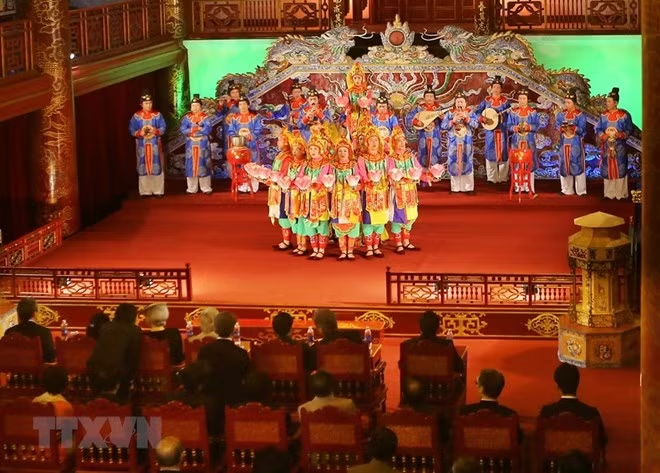 |
| Nha Nhac - Vietnamese court music (Photo: VNA) |
1. Nha Nhac - Vietnamese court music
Inscribed in 2008 on the Representative List of the Intangible Cultural Heritage of Humanity (originally proclaimed in 2003), Nha Nhac, meaning “elegant music” refers to a broad range of musical and dance styles performed at the Vietnamese royal court from the 15th to the mid-20th century.
Nha Nhac was generally featured at the opening and closing of ceremonies associated with anniversaries, religious holidays, coronations, funerals and official receptions. Among the numerous musical genres that developed in Vietnam, only Nha Nhac can claim a nationwide scope and strong links with the traditions of other East Asian countries.
Nha Nhac performances formerly featured numerous singers, dancers and musicians dressed in sumptuous costumes. Large-scale orchestras included a prominent drum section and many other types of percussion instruments as well as a variety of wind and string instruments.
All performers had to maintain a high level of concentration since they were expected to follow each step of the ritual meticulously. Nha Nhac developed during the Le dynasty (1427-1788) and became highly institutionalised and codified under the Nguyen monarchs (1802-1945).
As a symbol of the dynasty’s power and longevity, Nha Nhac became an essential part of the court’s ceremonies. However, the role of Nha Nhac was not limited to musical accompaniment for court rituals: it also provided a means of communicating with and paying tribute to the gods and kings as well as transmitting knowledge about nature and the universe. Certain forms of Nha Nhac have been maintained in popular rituals and religious ceremonies and serve as a source of inspiration for contemporary Vietnamese music.
2. Space of gong culture
Inscribed in 2008 on the Representative List of the Intangible Cultural Heritage of Humanity (originally proclaimed in 2005), the cultural space of the gongs in the Central Highlands of Vietnam is closely linked to the daily life of local people. Their belief systems form a mystical world where the gongs produce a privileged language between men, divinities and the supernatural world.
Behind every gong hides a god or goddess. Every family possesses at least one gong, which indicates the family’s wealth, authority and prestige. While a range of brass instruments is used in the various ceremonies, the gong alone is present in all the rituals of community life.
Each instrumentalist carries a different gong measuring between 25 and 80 cm in diameter. From three to twelve gongs are played by the village ensembles, which are made up of men or women. Different arrangements and rhythms are adapted to the context of the ceremony, for example, the ritual sacrifice of the bullocks, the blessing of the rice or mourning rites.
3. Quan ho Bac Ninh folk songs
Inscribed in 2009 on the Representative List of the Intangible Cultural Heritage of Humanity, the Quan ho Bac Ninh folk songs are performed as alternating verses between two women from one village who sing in harmony, and two men from another village who respond with similar melodies, but with different lyrics. The women traditionally wear distinctive large round hats and scarves; the men’s costumes include turbans, umbrellas and tunics.
The song lyrics express people’s emotional states of longing and sadness upon separation and the happiness of the meeting of lovers.
Quan ho singing is common at rituals, festivals, competitions and informal gatherings, where guests will perform a variety of verses for their hosts before singing farewell. Younger musicians of both sexes may practice the four singing techniques – restrained, resonant, ringing and staccato – at parties organised around singing.
Quan ho songs demonstrate the spirit, philosophy and local identity of the communities in this region, and help forge social bonds within and between villages that share a cherished cultural practice.
4. Ca Tru singing
Inscribed in 2009 on the List of Intangible Cultural Heritage in Need of Urgent Safeguarding, Ca tru is a complex form of sung poetry found in the north of Vietnam using lyrics written in traditional Vietnamese poetic forms.
Ca tru groups comprise three performers: a female singer who uses breathing techniques and vibrato to create unique ornamented sounds, while playing the clappers or striking a wooden box, and two instrumentalists who produce the deep tone of a three-stringed lute and the strong sounds of a praise drum.
Some Ca tru performances also include dance. The varied forms of Ca tru fulfill different social purposes, including worship singing, singing for entertainment, singing in royal palaces and competitive singing.
Ca tru has 56 different musical forms or melodies, each of which is called “the cach”. Folk artists transmit the music and poems that comprise Ca tru pieces by oral and technical transmission, formerly, within their family line, but now to any who wish to learn.
5. Giong festival of Phu Dong and Soc temples
Inscribed in 2010 on the Representative List of the Intangible Cultural Heritage of Humanity, the Giong festival of Phu Dong and Soc temples is celebrated annually in outlying districts of Hanoi, the capital of Vietnam.
Each spring, before the rice harvest, Vietnamese people honour the mythical hero, god and saint, Thanh Giong, who is credited with defending the country from foreign enemies, and is worshipped as the patron god of the harvest, national peace and family prosperity.
The festival at Phu Dong temple, which takes place in the fourth lunar month in the village of his birth, symbolically re-enacts his feats through the riding of a white horse into battle and the orchestration of an elaborate flag dance to symbolise the battle itself. Young men receive extensive training to play the roles of Flag Master, Drum Master, Gong Master, Army Master and Children’s Master, while 28 girls aged 9 to 13 are selected to play the enemy generals. The Flag Master’s dancing movements and drum and gong sounds convey the development of the battle, and paper butterflies released from the flag symbolically disperse the invaders.
The arrival of rains after the festival is seen as a blessing from the saint for an abundant harvest. The celebrations at Soc temple, where Saint Giong ascended to heaven, take place in the first lunar month and include the ritual of bathing his statue and a procession of bamboo flowers to the temple as offerings to the saint.
6. Xoan singing of Phu Tho province
Inscribed in 2017 on the Representative List of the Intangible Cultural Heritage of Humanity, Xoan singing in the northern province of Phu Tho includes singing, dancing, drumming and clapper beating.
It is closely linked to the worship of the Hung Kings, a belief rooted in the ancestor worship practice of Vietnamese people. Bearers and practitioners form four guilds, in which the male and female “Trum” play the most important role: they preserve the songs, select students, transmit the singing styles and repertoires and organise practices. They are also active in introducing and teaching Xoan singing in clubs and guilds.
As a community performing art, Xoan singing fosters cultural understanding, community cohesion and mutual respect. The Vietnamese Institute for Musicology has collected 31 Xoan songs, and thanks to the efforts of several Xoan artists, four guilds have been established. Thirty-three dedicated clubs also exist, and seminars are held to expand the knowledge of Xoan. Senior Xoan artists transmit the singing orally, combined with the use of written songs and audio and visual recordings.
7. Worship of Hung Kings in Phu Tho
Inscribed in 2012 on the Representative List of the Intangible Cultural Heritage of Humanity, the worship of Hung Kings in the northern province of Phu Tho draws millions of people annually to commemorate their ancestors and pray for good weather, abundant harvests, good luck and good health.
The largest ceremony, the ancestral anniversary festival of the Hing Kings, is celebrated for about one week at the beginning of the third lunar month. People from surrounding villages dress in splendid costumes and compete to provide the best palanquin and most highly valued objects of worship for the key rite in which drums and gongs are conveyed to the main temple site.
Communities make offerings of rice-based delicacies such as square cakes and glutinous cakes, and there are verbal and folk arts performances, bronze drum beating, Xoan singing, prayers and petitions.
8. Art of Don ca tai tu music and song in southern Vietnam
Inscribed in 2013 on the Representative List of the Intangible Cultural Heritage of Humanity, the art of “Don ca tai tu” music and song is an indispensable part of the spiritual activity and cultural heritage of people in the south of Vietnam.
The music and songs evoke the people’s life and work on the land and rivers of the Mekong Delta region. Performed at numerous events such as festivals, death anniversary rituals and celebrations, “Don ca tai tu” is thus intimately connected with other cultural practices and customs, oral traditions and handicrafts.
Performers express their feelings by improvising, ornamenting and varying the skeletal melody and main rhythmic patterns of these pieces. “Don ca tai tu” is played on a variety of different instruments, including the moon-shaped lute, two-stringed fiddle, sixteen-stringed zither, pear-shaped lute, percussion, monochord and bamboo flute. Its repertoire is based on twenty principal songs and seventy-two classical songs.
The musical art is passed on through oral transmission, based on imitation, from master instrumentalists and singers to students. Musicians need to study for at least three years to learn the basic instrumental techniques and master the musical modes to express different moods and emotions. Vocal students study the traditional songs and learn to improvise subtly, using different ornamentation techniques.
9. Vi and Giam folk songs of Nghe Tinh
Inscribed in 2014 on the Representative List of the Intangible Cultural Heritage of Humanity, Vi and Giam songs are sung by a wide range of communities in the north-central provinces of Nghe An and Ha Tinh.
Specific songs are sung without instrumental accompaniment while people cultivate rice in the fields, row boats, make conical hats or lull children to sleep.
Vi and Giam lyrics use the specific dialect and linguistic idioms of the Nghe Tinh region and practitioners sing with the particular singing voice of local people.
Many of the songs focus on key values and virtues including respect for parents, loyalty, care and devotion, the importance of honesty and a good heart in the maintenance of village customs and traditions.
Singing provides people with a chance to ease hardship while working, to relieve sorrow in their lives, express feelings of sentiment between men and women, and exchange feelings of love between unmarried boys and girls.
Today Vi and Giam are commonly performed at community cultural events and are sung by artists in theatres.
10. Tugging rituals and games
Inscribed in 2015 on the Representative List of the Intangible Cultural Heritage of Humanity, tugging rituals and games in the rice-farming cultures of East Asia and Southeast Asia are enacted among communities to ensure abundant harvests and prosperity.
They promote social solidarity, provide entertainment and mark the start of a new agricultural cycle. Many tugging rituals and games also have profound religious significance. Most variations include two teams, each of which pulls one end of a rope attempting to tug it from the other. The intentionally uncompetitive nature of the event removes the emphasis on winning or losing, affirming that these traditions are performed to promote the well-being of the community, and reminding members of the importance of cooperation.
Many tugging games bear the traces of agricultural rituals, symbolising the strength of natural forces, such as the sun and rain while also incorporating mythological elements or purification rites.
Tugging rituals and games are often organised in front of a village’s communal house or shrine, preceded by commemorative rites to local protective deities. Village elders play active roles in leading and organising younger people in playing the game and holding accompanying rituals.
They also serve to strengthen unity and solidarity and sense of belonging and identity among community members.
11. Practices related to Vietnamese beliefs in the Mother Goddesses of Three Realms
Inscribed in 2016 on the Representative List of the Intangible Cultural Heritage of Humanity, the practices in the Mother Goddesses of Three Realms (heaven, water, and mountains and forests) aim to meet spiritual needs and everyday wishes of Vietnamese people.
The Mother Goddesses include Lieu Hanh (a nymph who descended to earth, lived as a human and became a Buddhist nun) referred to as the Mother of the World, and other spirits considered legendary heroes. The traditional practice involves daily worship and participation in ceremonies, rituals like the spirit possession ritual and festivals such as Phu Day that take place at temples dedicated to the Mother Goddesses. These activities associated with the practice help to maintain part of the community’s history, cultural heritage and identity with some aspects incorporating traditional costumes, music and dance.
Bearers and practitioners are members of the public, temple guardians, ritual priests, spirit mediums, assistants and musicians who transmit knowledge and skills orally to newcomers and family members. The practice of shared values and strong beliefs in the compassion and grace of the Mother Goddesses provides a basis for social relations connecting members of participating communities.
The worshipping of the Mother Goddesses also contributes to the appreciation of women and their roles in society.
12. The art of Bai Choi in central Vietnam
Inscribed in 2017 on the Representative List of the Intangible Cultural Heritage of Humanity, the art of Bai Choi in central Vietnam is a diverse art combining music, poetry, acting, painting and literature.
It takes two main forms: Bai Choi games and Bai Choi performance. Bai Choi games involve a card game played in bamboo huts during the Lunar New Year. In Bai Choi performances, male and female artists perform on a rattan mat, either moving from place to place or in private occasions for families.
The art of Bai Choi is an important form of culture and recreation within village communities. Performers and their families play a major role in safeguarding the practice by teaching song repertoires, singing skills, performance techniques and card-making methods to younger generations. Together with communities, these performers have set up nearly 90 Bai Choi teams, groups and clubs to practise and transmit the art form, which attracts wide community participation.
Most performers of the art learn their skills within the family and the skills are mainly transmitted orally, but artists specialising in Bai Choi also transmit knowledge and skills in clubs, schools and associations.
With 12 intangible cultural heritages recognized by UNESCO, Vietnam now ranks eighth out of 177 member nations of the Convention for the Safeguarding of the Intangible Cultural Heritage.