Visiting the Clay Cracker Festival in Hai Duong

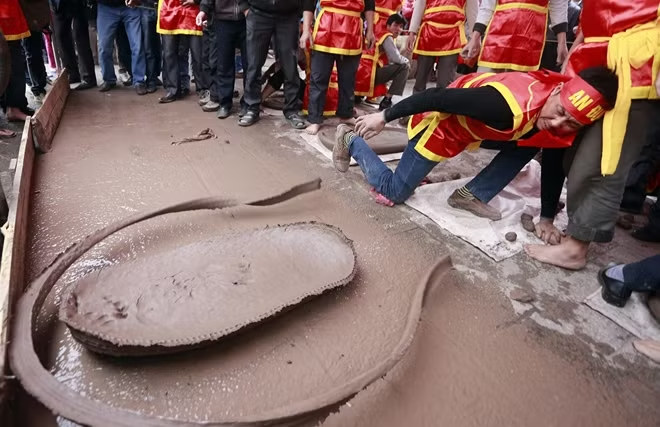
Clay cracker, a traditional game that involves hurling clay crackers to produce noise, originated in Vietnam’s northern delta region.

Clay cracker festival is organized in the spring to entertain locals and pray for a bumper crop.

When the Lunar New Year comes, 7 communes in Hai Duong province start practicing for the clay cracker contest and odd sounds echo throughout the village. 

People living and working far from home now return for the annual festival.

Pham Van Phuc, a native of Quyet Thang commune, Ninh Giang district, said, “From the first to the third lunar month, a clay cracker festival is held almost every day. There are contests between hamlets, communes, districts, and provinces. The farmers immerse themselves in the festival’s cheerful ambience and pray for a new year of luck and happiness.”

The clay cracker game is believed to have first appeared in Hai Ba Trung era in the first century. 
Source: Haiduongtv
Source: Haiduongtv

In wartime, Vietnamese used the noise of the crackers as a diversionary tactic and in peacetime as entertainment. Hurling clay crackers requires fitness and strength. 

Nguyen Van Chinh in Ninh Hoa commune, Ninh Giang district said, “I began playing clay cracker when I was 15 years old. Strong male villagers were chosen to form a team to compete for the title. The contest is fun.”

The clay is kneaded to make it elastic and soft. The skill in hurling the cracker is very important. A cracker whose edge bursts the longest is the winner. 

40-year-old Nguyen Xuan Truong, a member of Quang Khai commune’s clay cracker team in Tu Ky district, said when hurling the cracker, a player should stand with his feet shoulder width apart and his arms close to his body, gather force in his knees, and use the force of his arms to throw the clay.

He said, “The most difficult part is hurling the clay. If you hurl well, the cracker’s noise is loud. The longer the cracker’s edge is torn apart, the louder the noise is. A clay cracker can last 10 years. We wrap the cracker with a nylon sheet and keep it in a cool place.”

The prize for the winner is just a pennant and a small amount of cash. But the festival attracts a lot of revelers, reminding people of the good old days and promoting communal solidarity. 

This is one of the reasons the clay cracker game is still around. 

Do Manh Thang, Chairman of Ninh Hoa Commune’s People’s Committee, Hai Duong province, said, “The festival is held annually in our commune and receives a warn response from local men and women, young and old alike. We teach people the importance of clay cracker as a healthy, traditional game.”

Hai Duong province includes a clay cracker contest in its famous Spring Conson-Kiep Bac Festival to promote the local cultural tradition and tourism. 

VOV

Other News

Reasons why Phu Quoc shines even during rainy season

Reasons why Phu Quoc shines even during rainy season

Recently named by Expedia among the "10 Best Islands to Visit in 2026" for offering premium holidays at reasonable prices, Phu Quoc is far from being just a dry season destination. Even during the rainy months, Pearl Island offers enough experiences to fill every hour of the day, with short tropical showers rarely disrupting the journey.

Van Phuc silk weaving village officially recognised as Hanoi tourist destination

Van Phuc silk weaving village officially recognised as Hanoi tourist destination

With its millennia-old heritage and growing integration of preservation and innovation, Van Phuc silk weaving village is poised to become a distinctive cultural destination, helping promote Hanoi’s sustainable cultural tourism and bring the quintessence of Vietnamese silk weaving closer to domestic and international visitors.

Ho Chi Minh City: Free bus fares drive increase in bus, metro ridership

Ho Chi Minh City: Free bus fares drive increase in bus, metro ridership

According to Deputy Director of the Ho Chi Minh City Public Transport Management Centre Le Hoan, the bus network operated nearly 478,000 trips in July, serving more than 8.48 million passengers. Weekly growth accelerated throughout the month, rising from 33% in the first week to 45% in the fourth week.

My Son inscriptions set sights on UNESCO documentary heritage status

My Son inscriptions set sights on UNESCO documentary heritage status

Located in Thu Bon commune, Da Nang city, My Son is renowned for its architectural heritage, but it also preserves an exceptional archive engraved on stone. These inscriptions have enabled scholars to unravel the history of the sanctuary and trace the rise and development of the ancient Champa kingdom over many centuries.

Hanoi brings new life to suburban tourism villages

Hanoi brings new life to suburban tourism villages

Hanoi has long been known for the heritage cachet of a thousand-year-old capital. Hoan Kiem Lake, the Old Quarter, the Temple of Literature, the Thang Long Imperial Citadel and a network of craft villages have given the city a singular pull.

Resolution paves way for Vietnam to unleash soft power

Resolution paves way for Vietnam to unleash soft power

The implementation of Resolution No. 06 alongside the cultural diplomacy strategy sends a clear message: by combining its rich cultural heritage with proactive diplomacy, innovation and digital transformation, Vietnam would strengthen its competitiveness on the global stage.

Vietnam Summer Camp 2026 wrapped up

Vietnam Summer Camp 2026 wrapped up

Held from July 12 to 25 across eight cities and provinces, Vietnam Summer Camp 2026 offered a rich array of experiences. Participants explored historical landmarks, visited iconic cultural heritage sites such as the imperial city of Hue, Hoi An ancient town, and the My Son Sanctuary, and engaged in charitable activities valued at over 300 million VND (11,400 USD), including the installation of a "Youth Bookshelf."

Enjoy Danang Festival 2026 kicks off

Enjoy Danang Festival 2026 kicks off

The Enjoy Danang Festival 2026 features a rural market-themed culinary space at East Sea Park showcasing Quang region cuisine, a beachfront art route, a light kite night featuring around 500 illuminated kites, and a seaside light party combining visual arts, music and local cuisine.

Railways reinvent themselves with tourism, heritage trains

Railways reinvent themselves with tourism, heritage trains

One of the most notable successes is the premium Hoa Phuong Do (Flamboyant Flower) train operating between Hanoi and Hai Phong city. Since entering service in May 2025, the train has completed nearly 3,000 trips and carried around 1.33 million passengers.

Da Nang proves Lonely Planet right as Asia's must visit summer destination

Da Nang proves Lonely Planet right as Asia's must visit summer destination

According to Lonely Planet, Da Nang stands out for its harmonious blend of beautiful beaches, an energetic yet relaxed lifestyle, a rich culinary scene and a diverse range of experiences spanning nature, culture, leisure and entertainment. The city is also praised as an ideal gateway to central Vietnam, offering convenient access to Hoi An, Hue and My Son Sanctuary.

Vietnam invites travellers on multi-sensory journey

Vietnam invites travellers on multi-sensory journey

Vietnam's appeal lies not in a single attraction but in the seamless combination of authentic experiences rooted in local culture. From colourful highland markets and traditional festivals to centuries-old craft villages, all remain an integral part of everyday life.

Promoting souvenir industry to spread national image

Promoting souvenir industry to spread national image

Experts said that with market-oriented development, improved functionality, stronger storytelling and greater involvement from designers, businesses and market-connecting organisations, souvenirs could become a bridge linking Vietnam with the world while contributing to the growth of cultural industries and the creative economy.

Interactive sound exhibition breathes new life into cultural heritage

Interactive sound exhibition breathes new life into cultural heritage

One of the exhibition's highlights is the "Our Sound" installation, where visitors become part of the artwork itself. As multiple participants interact simultaneously, sound and light merge into a shared composition, conveying messages of connection, sharing and collective responsibility for building sustainable communities in harmony with nature.