With right policies and investment, Southeast Asia can take its Digital Economy to next level

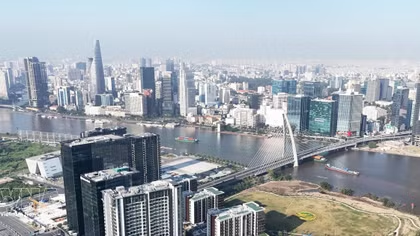
While the digital revolution has already brought many benefits to Southeast Asia, the region has a unique opportunity to achieve even faster progress by reinforcing the foundations of its growing digital economy. 
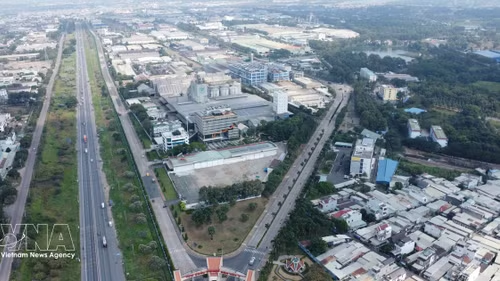
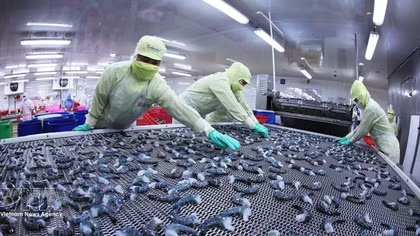
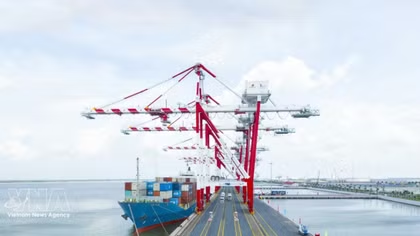
Photo for illustration. Source: Internet.
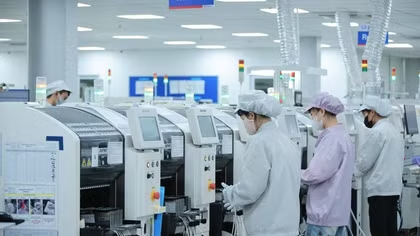
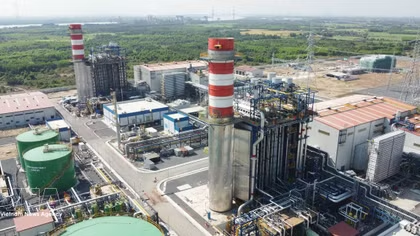
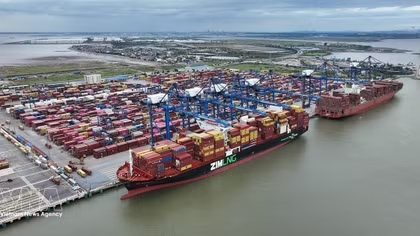
Photo for illustration. Source: Internet. 

To realize this vision, a new World Bank report, The Digital Economy in Southeast Asia – Strengthening the Foundations for Future Growth, analyzes the opportunities and challenges facing the region to scale up digital development, and for ensuring the economic and social dividends of technology can reach everyone.

“Every sector of the economy in ASEAN countries can do more to use digital technologies and smarter business models. To help our private sectors governments also need to transform themselves: to use technologies such as data analytics and intelligent systems, develop our digital platforms and harmonize our approaches to regulatory procedures particular for cybersecurity, digital identity, and data management. We should work towards a regional digital market,” said H.E. Dr. Pichet Durongkaveroj, Minister of Digital Economy and Society.

“Southeast Asian countries has made significant headway in the digital sector,” said Boutheina Guermazi, the World Bank’s Director for Digital Development. “But even though the population has embraced digital services, adoption by businesses and governments has generally been slower. Regulatory bottlenecks and a lack of trust in electronic transactions stifle the growth of digital systems. This groundbreaking research can help ASEAN countries overcome these challenges to create strong, inclusive digital economies.”

The report identifies six main areas of focus for digital development in Southeast Asia, starting with the expansion of connectivity, the backbone of the digital economy. Although half of the region’s population uses the internet—on par with the global average—this can continue to be expanded with policies and actions that will significantly lower prices, increase speeds, and bring reliable broadband internet to underserved areas. In middle income countries in this region only 2 out of 5 people have access to high speed (4G) mobile internet—in lower income countries it’s only 1 out of 5.  Active collaboration between the public and private sectors and proactive regulatory approaches will be critical to unlocking the needed investments in digital infrastructure and fostering greater competition across the telecommunications sector.

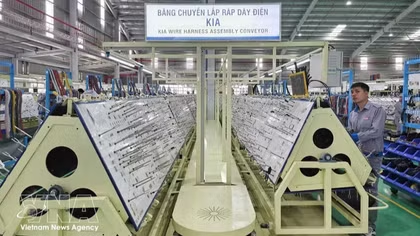
With digital technology transforming almost all sectors of the economy, the skills of the region’s workforce need to keep pace. Education systems will have a key role to play in developing the technical knowledge and soft skills that are required to compete in the global digital economy. Given the rate of technological change, adaptability and lifelong learning will be more important than ever, as well as more effective collaboration between the public and private sectors.

Digital payments are another essential underpinning of the digital economy, but the report finds that they remain underdeveloped in Southeast Asia compared to other parts of the world. In most countries in Southeast Asia, payments are overwhelmingly cash based. The World Bank’s global financial inclusion (findex) data shows that only 19 percent of financial account holders in the region access their accounts via the internet.  Implementing robust regulations and modern digital identification systems can help create the enabling environment for digital finance. At the same time, the digitization of government payments—for pensions, cash transfers, and other social programs—can incentive more change and generate momentum.

The report stresses however that Southeast Asia’s digital development cannot rely solely on virtual foundations. A well-functioning logistics sector is crucial to the growth of the digital economy, especially e-commerce. In the region, a modernized regulatory framework for logistics could increase competition, reduce logistics costs and improve the quality of services. In particular, streamlining customs procedures can make shipping faster, cheaper, more predictable, and give e-commerce a major boost.

Likewise, regional integration, including harmonizing regulations and facilitating transactions between ASEAN countries, can create an integrated digital market benefiting both businesses and consumers.

Finally, to address the risks and vulnerabilities that come with digital transformation, the report suggests prioritizing effective standards and regulations for electronic transactions, cross-border data flows, cybersecurity, data privacy, and consumer protection. Solid measures in these areas are essential to build trust in online platforms and create secure, sustainable digital economies.


PSN

Other News

Private economic sector poised for breakthrough growth

Private economic sector poised for breakthrough growth

More than a year after the Politburo's Resolution No. 68-NQ/TW on private sector development came into effect, expectations now extend beyond increasing the number of enterprises. The goal is to build a stronger business community with greater resilience, larger ambitions and the capacity to compete in global supply chains.

Vietnam remains ASEAN growth leader in 2026 despite global headwinds: WB

Vietnam remains ASEAN growth leader in 2026 despite global headwinds: WB

Vietnam is expected to remain one of ASEAN’s fastest-growing economies in 2026, supported by resilient exports, strong investment inflows and an ambitious reform agenda, despite mounting global uncertainties, according to the World Bank’s latest Vietnam Economic Update released on May 15.

Ministry establishes monitoring framework for carbon market

Ministry establishes monitoring framework for carbon market

Under a new circular, the exchange of greenhouse gas emission quotas and carbon credits is conducted on the domestic carbon credit exchange through the carbon trading system, which is interconnected with the national registration system.

Biofuel ready for nationwide rollout

Biofuel ready for nationwide rollout

For biofuels, particularly E10, to develop successfully, stronger and more coordinated policies are needed, especially pricing mechanisms capable of creating a sufficiently attractive gap between E10 and mineral-based petrol, an expert has said.

Vietnamese farm produce promoted at African investment, trade forum

Vietnamese farm produce promoted at African investment, trade forum

The 12th Africa Forum for Investment & Commerce (AFIC 12) opened in Algiers, the capital of Algeria, on May 9, drawing around 2,000 participants, including officials, economists, businesses, financial and development organizagtions from 43 African countries and international partners, including Vietnam.

Int'l medical, pharmaceutical expo opens in Hanoi

Int'l medical, pharmaceutical expo opens in Hanoi

The exhibition, which runs until May 9 at the Hanoi International Centre for Exhibition, showcases advanced products and technologies across a range of fields, including pharmaceuticals, drug manufacturing machinery and equipment, medical devices, hospital and clinic services and dental equipment.

Mega projects to transform Ho Chi Minh City urban landscape

Mega projects to transform Ho Chi Minh City urban landscape

Leading the charge in this massive building spree is the new central city square in the core of the Thu Thiem new urban area. Spanning more than 20 ha, it’s the crown jewel of the Central Square and new administrative center complex.

Vietnam establishes itself as one of region’s most dynamic manufacturing and supply bases

Vietnam establishes itself as one of region’s most dynamic manufacturing and supply bases

The country’s stable political and economic environment provides a critical foundation for long-term sourcing strategies. At the same time, Vietnam has demonstrated a strong ability to scale up manufacturing, supported by a continuously expanding industrial base capable of meeting both high-volume demand and increasingly complex technical and quality requirements.

Vietnamese pomelos gain broader access to Australian market

Vietnamese pomelos gain broader access to Australian market

The update by Australia’s Department of Agriculture, Fisheries and Forestry to its Biosecurity Import Conditions system (BICON) on April 10, officially setting out import conditions for Vietnamese pomelos, is regarded as a major milestone in market access efforts.

Vietnam's industry spearheads transition to circular economy

Vietnam's industry spearheads transition to circular economy

The circular economy is no longer just a policy choice. It has become an inevitable trend for delivering sustainable and green growth, sharpening competitiveness at home and abroad, and meeting Vietnam’s net-zero emissions target by 2050. It is now a prerequisite to sustain long-term economic expansion, particularly in industrial production and supporting industries.

Nearly 100 tonnes of Vietnamese fruits, vegetables airlifted to UAE

Nearly 100 tonnes of Vietnamese fruits, vegetables airlifted to UAE

Vietnamese fresh produce and processed foods are increasingly recognised for their quality, with items such as cashew nuts, coffee and spices gaining popularity among Middle East consumers. In 2025, Vietnam’s farm produce exports to the UAE exceeded 445 million USD, up nearly 24% year-on-year.