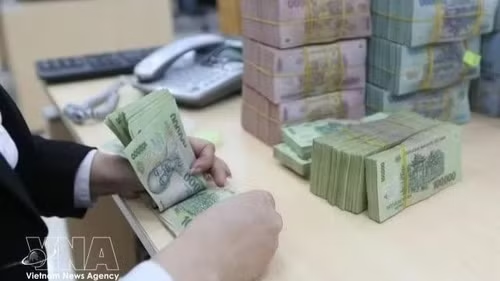
Experts from the World Bank have made four key recommendations to resolve Vietnam’s problem of non-performing loans (NPLs).
The four suggestions are modernisation of the financial sector; promotion of bank regulations and supervision; restructuring and resolution of sub-standard banks and assets; and enhancement of macro safety supervision.
The suggestions were shared at a meeting between Ceyla Pazabassiouglu, senior director of Finance and Markets Global Practice, World Bank Group, and State Bank of Vietnam (SBV)’s representatives in Hanoi earlier this week.
 |
Experts said that NPL management is a complex issue that will involve many agencies and bodies such as the ministries of finance, justice, planning and investment, banks, as well as supervisory, tax and auditing bodies.
If bad debts are not fully resolved, the economy will stagnate and lending will decline. Besides, commercial banks will not operate effectively, which can lead to loss of liquidity and cause chain disruption in the banking system. The need of the hour is cooperation of the public sector linked to bad debt management and resolution.
The World Bank said it has designed a four-year technical cooperation programme to help Vietnam resolve the issue of NPLs. Negotiations is underway with donors for the programme’s capital source.
At the meeting, SBV deputy governor Nguyen Kim Anh said the restructuring of credit institutions and resolution of NPLs have been a priority for the Government and the SBV since the past few years.
The SBV has shared a scheme on restructuring the system of credit institutions and resolving weak credit institutions with the Political Bureau.
It has been submitted to the National Assembly for a resolution on resolving NPLs (it is expected to be approved in June) and a draft law to the National Assembly on revising a number of articles in the Law on Credit Institutions, Anh said.
However, Anh said, there are still many challenges to resolving the bad debt problem, and the central bank needs to learn from other countries’ experience and calls for support and advice from international organisations, including the World Bank, to meet the target of restructuring the banking system and resolving the NPL issue in the 2016-20 period.
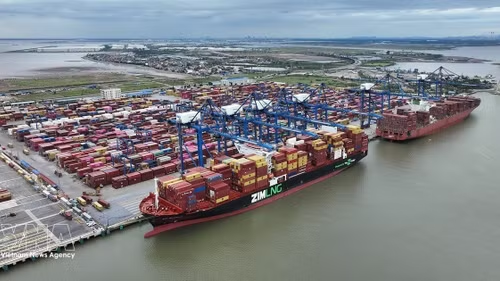
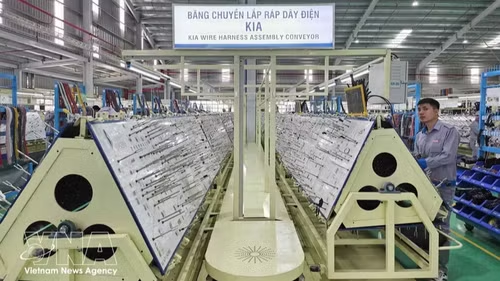
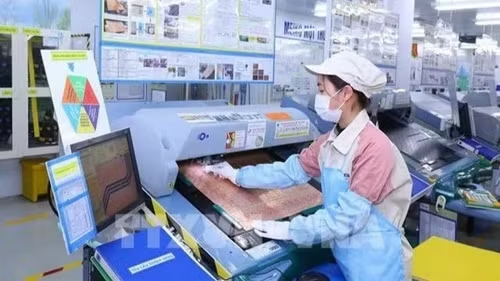
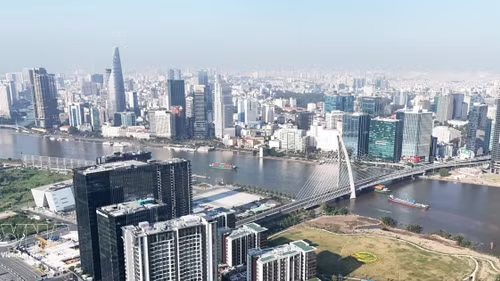
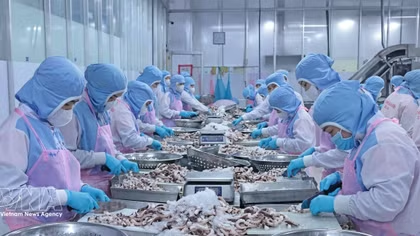
The Vietnam-EFTA Free Trade Agreement brings together two groups of highly complementary economies. EFTA members Switzerland, Norway, Iceland and Liechtenstein have strengths in technology, innovation, finance, clean energy and sustainable development, while Vietnam is one of Asia’s most dynamic economies and is emerging as a major regional manufacturing, trade and investment hub.
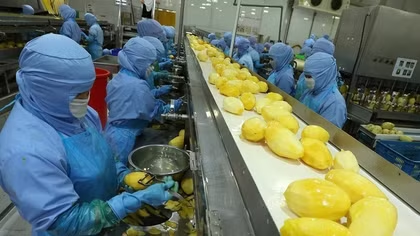
To reach 9.5–10 billion USD, the most important thing is to strictly comply with market requirements, according to an insider.

The phase of building the framework has passed; now is the time for implementation and results – for the two sides to take breakthrough action and elevate economic cooperation to new heights, said General Secretary and President To Lam.

The opening-hour buying and selling rates at major commercial banks also saw decreases.

The two stores opened simultaneously at Petrolimex stations No 74 in Ngoc Hoi and No 41 on Nguyen Quy Duc streets. The opening ceremony was attended by representatives of companies and partners from the energy, retail, technology, sectors.

Success ten years from now should not simply be measured by how many Israeli technologies have been sold in Vietnam. Success would mean seeing technologies that were tested here, adapted with Vietnamese partners, supported locally, scaled commercially, and potentially further developed or manufactured in Vietnam for other Southeast Asian markets.

With strong foundations in infrastructure and human resources, Hai Phong is expected to continue serving as a strategic driver in Vietnam’s journey towards becoming a strong maritime nation.

Ho Chi Minh City will continue to implement drastic measures to achieve double-digit growth, targeting GRDP growth of at least 11.07% in the third quarter of 2026, 9.43% in the first nine months and 12.3% in the fourth quarter, with a view to completing the full-year goal of 10% or more.

Notably, the number of new FDI projects rose only 9.4% while their registered capital surged 96.8%, indicating a significant increase in average project size and investors’ stronger commitment from the outset.

Held both in person and online, the seminar focused on the current status and opportunities for Vietnam’s nuclear power programme, human resources development, global trends in small modular reactors (SMRs), experience in ensuring safety and extending the operational life of nuclear power plants, and ways to mobilise Vietnamese experts abroad to contribute to the programme.

The strong performance followed a series of measures to optimise port capacity and improve the competitiveness of the city’s seaport system, with a focus on maximising the efficiency of the Lach Huyen international gateway port as new berths came into operation.

Vietnam is committed to maintaining dialogue with investors, listening to their recommendations and working to address difficulties on the basis of harmonising interests and sharing risks.

During the session, both sides reaffirmed their determination to advance the negotiations in a spirit of goodwill, with a view to reaching a balanced agreement that aligns with the interests of both Vietnam and Mercosur.
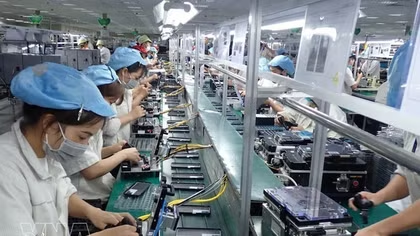
The successful development and production of high-end Pixel smartphones in Vietnam – a more complex process than manufacturing smartwatches and wireless earbuds – is reportedly giving Google confidence in moving its entire Pixel production out of China.

The integrated investment in energy infrastructure will provide a vital infrastructure foundation for effectively harnessing the marine potential, helping realise the goal of making Vietnam a strong maritime nation and achieving sustainable and prosperous development from the sea.

To prepare for the occasion, markets and food shops across Hanoi have increased supplies of fruits, flowers, meat, sticky rice, sweets and vegetarian food for the occasion. Prices of some items have edged up as demand rises, but no shortages have been reported.
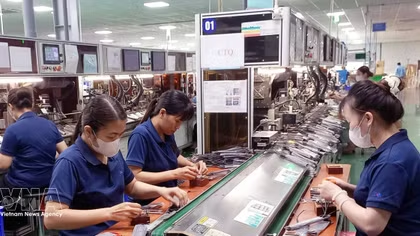
The positive outlook has raised expectations that key export sectors, including electronics, textiles and garments, wood products and agricultural goods, will continue to expand and help sustain double-digit export growth in 2026.
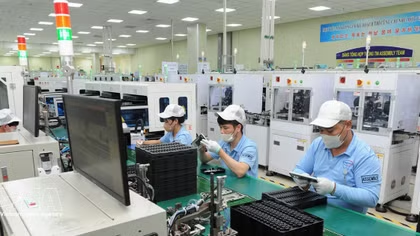
Vietnam’s semiconductor industry offers the country an opportunity to shift from a growth model heavily reliant on low-cost labour and manufacturing toward more technology-intensive, higher value-added sectors, according to Nikkei Asia.
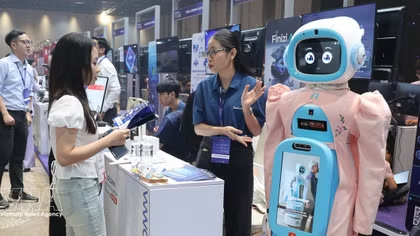
InnoEx 2026 focuses on major shifts reshaping the global economy, including artificial intelligence (AI), data, automation, green transition, international trade and new business models. It also provides a platform connecting businesses, startups, investors and solution providers, facilitating partnerships, investment and access to knowledge and technologies.
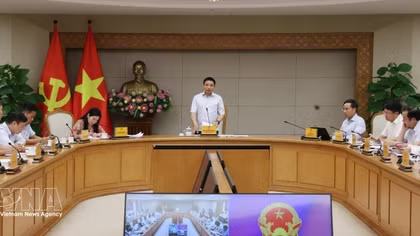
Deputy PM Nguyen Van Thang emphasised that each product at the VIFC must have a clear legal basis, an implementing agency, an operating and supervisory mechanism, and implementation timeline, with priority given to products that can generate actual transactions.