Hanoi (VNA) – The 33rd Diplomatic Conference will focus on thoroughly implementing the Party's foreign policy, renewing thinking and working methods, and improving the effectiveness of diplomacy to meet the country's development requirements in a new era, Politburo member and Minister of Foreign Affairs Le Hoai Trung has said.
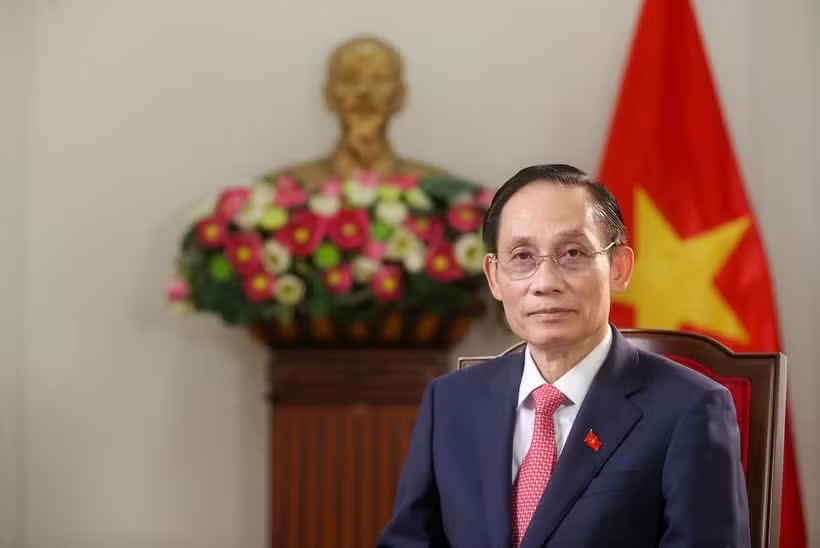
In an interview granted to the press ahead of the 33rd Diplomatic Conference and the 22nd National Conference on External Affairs, slated August 1-8 in Hanoi, Trung said the most important objective of this year's conference is to ensure a common understanding of Party guidelines and the new tasks facing the diplomatic sector, while strengthening coordination between the Ministry of Foreign Affairs and other ministries, sectors and localities under the unified leadership of the Party and the State's management.
He stressed that the diplomatic service will continue to fully perform its pioneering role while effectively carrying out the key and regular tasks entrusted by the Party and the State, thereby contributing to the successful implementation of national development goals in the new era, particularly during the tenure of the 14th National Party Congress and towards the strategic milestones set for 2030 and vision to 2045.
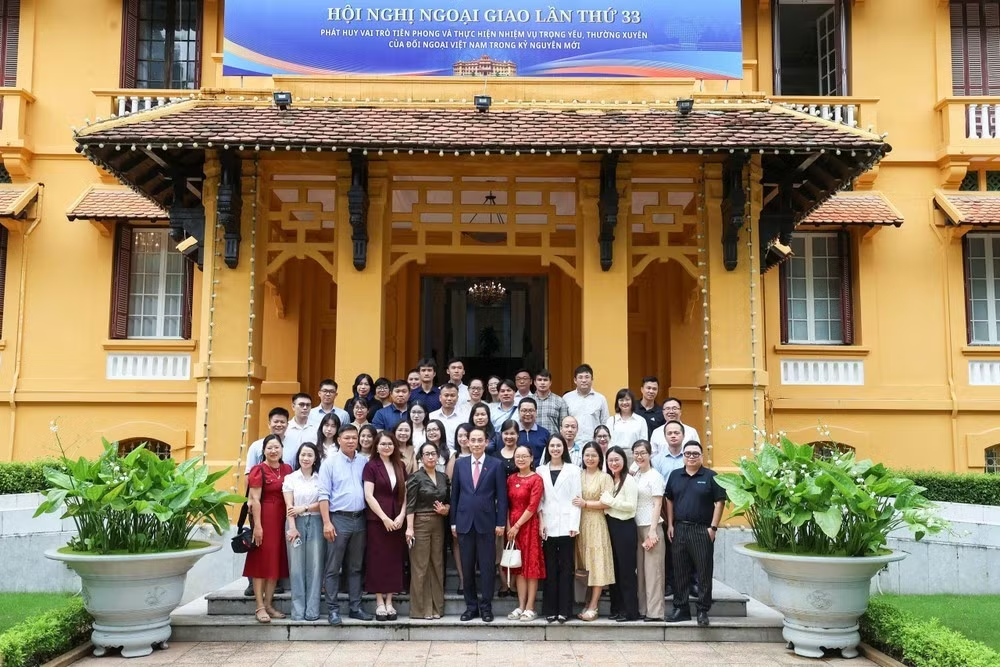
Held regularly since 1957, the Diplomatic Conference serves as the sector's most important forum, bringing together officials from domestic units and overseas missions to review international developments, assess diplomatic affairs and agree on orientations for the next phase.
This year's event carries special significance as it is the first conference convened after the successful 14th National Party Congress and following the completion of leadership restructuring following the elections of the 16th National Assembly and People's Councils at all levels. It is also the first conference held in the new development era identified by the 14th National Party Congress, with the country entering a stage aimed at achieving its strategic development targets through 2030 with a vision to 2045.
In this context, the 33rd Diplomatic Conference is tasked with translating into concrete actions the foreign policy adopted at the 14th National Party Congress and ensure consistency in both awareness and implementation across the diplomatic service and meeting the new requirements and tasks of foreign affairs work based on the achievements and potential of the country after 40 years of doi moi (renewal)
Trung highlighted one of the most important outcomes of the 14th National Party Congress, which for the first time defined foreign affairs and international integration as a key and regular task of the entire Party, people and armed forces. He described the decision as a major development in the Party's diplomatic mindset, building on the consistent approach adopted at the 13th National Party Congress that identified diplomacy as a pioneering force in maintaining a peaceful environment, safeguarding national independence, sovereignty and territorial integrity, mobilising external resources for national development and enhancing Vietnam's international standing and prestige.
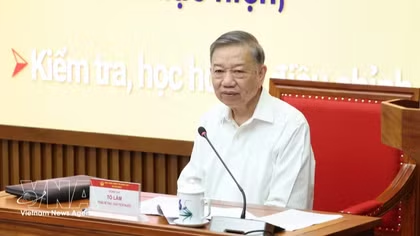
The minister said the conference has been designed around several major priorities. The first is to ensure all diplomatic officials thoroughly understand the Party's new policies on national development, Party building, the political system and foreign affairs. Particular attention will be paid to heads of Vietnam's overseas representative missions and diplomats preparing to assume new assignments abroad. He stressed that understanding the Party's policies is only the first step, adding that, as repeatedly emphasised by Party General Secretary and State President To Lam, the key is to implement them correctly, effectively and comprehensively. High-ranking Party and State leaders, together with leaders of ministries and agencies, will directly brief participants on major policies and strategic orientations.
The second priority is to comprehensively assess international and regional developments across politics, security, strategy, the economy, science and technology. Trung said the diplomatic sector must strengthen strategic research and forecasting so that the country is not caught off guard by emerging developments. As the General Secretary and President have emphasised, the requirement is not only to handle tasks or solve problems, but also to foresee problems and have the ability to create solutions. Therefore, deeper analysis of the international situation will help improve the quality of advice provided to the Party and the State, and at the same time support each diplomat in effectively applying this knowledge in carrying out their duties.
Another key focus will be enhancing the contribution of diplomacy to socio-economic development. While continuing to maintain a peaceful and stable environment, deepen relations with countries and raise Vietnam's international profile, diplomacy is expected to play a more practical role in supporting the country's socio-economic objectives, including the pursuit of double-digit economic growth. Vietnam's overseas diplomatic missions will therefore be required not only to strengthen international connections but also to proactively create favourable conditions for development by mobilising resources in science, technology and knowledge, expanding export markets, promoting outbound investment by Vietnamese businesses and attracting more foreign investment into Vietnam.
Improving implementation will also be a central theme throughout the conference. Trung noted that Secretary General and President Lam and Prime Minister Le Minh Hung have repeatedly stressed that implementation is now the most critical task. Accordingly, the conference will discuss ways to renew the operation of Vietnam's overseas representative missions and the Ministry of Foreign Affairs as well as accelerate digital transformation. Although the ministry has made progress in administrative reform and digital applications, the next stage will require digital transformation to fundamentally change organisational models, working methods and overall operational efficiency across the diplomatic sector.
The conference will also focus on improving personnel quality, strengthening coordination between the Ministry of Foreign Affairs and other ministries, sectors and local authorities. The conference will take place after the establishment of the Central Steering Committee on Foreign Affairs and International Integration, headed by the Party General Secretary and State President. As the committee's standing agency, the Ministry of Foreign Affairs will continue refining coordination mechanisms and policy advice to ensure its effective operation.
A joint session co-chaired by the ministers of national defence, public security and foreign affairs will also be held to strengthen coordination among the three sectors. Specialised sessions will discuss economic diplomacy, Party diplomacy, people-to-people diplomacy, parliamentary diplomacy and local-level diplomacy, highlighting the need to mobilise the combined strength of the entire political system in implementing foreign affairs and international integration.
Based on assessments of the international situation and future priorities, the conference is expected to adopt a concrete action programme for the entire diplomatic sector, covering both units under the ministry and Vietnam's overseas representative system.
Vietnam currently has 99 representative missions abroad, with plans to expand the network to 115 by 2030 and around 130 by 2045 under an approved national development roadmap. Trung said the expansion reflects the Party and State's strategic vision for diplomacy and international integration as well as its determination to enable Vietnam to participate more deeply in global political affairs, the international economy and human civilisation. Each representative mission will be assigned specific targets in each area of work.
The minister acknowledged that many overseas missions continue to face considerable challenges, particularly those operating in conflict zones or areas with difficult security conditions such as Ukraine, Iran and parts of the Middle East. He underscored the need to ensure consistent implementation of national policies while allowing flexibility to respond to local conditions.
Looking ahead, Trung said the diplomatic sector's success will depend on several decisive factors, including a thorough understanding of the Party's policies, a strong sense of responsibility, determination in implementation, effective organisational arrangements, continuous improvement in officials' professional knowledge, greater application of science, technology and digital transformation, and closer coordination with ministries, sectors and localities.
He also underlined the importance of investing in facilities for the Ministry of Foreign Affairs and overseas representative missions while strengthening training and retraining programmes for diplomats. Echoing the Party General Secretary and State President's emphasis on building a learning society and promoting lifelong learning, he said diplomats must continuously update their knowledge and improve their capabilities to meet the increasingly demanding requirements of foreign affairs in the country's new development era. Ultimately, he stressed, the most important requirement is to renew thinking, innovate working methods and improve implementation so that diplomacy can make a greater contribution to Vietnam's long-term development goals./.