A season for unusual culinary discoveries

Spring and the Lunar New Year is a great time for many obvious reasons.
The weather is perfect, or close to perfect, and many traditional festivals are celebrated throughout the country, each with features distinct to the region, whether it is the associated legend, musical tradition or religious ritual.

It also happens to be the best season for visitors to discover many culinary specialties, some of them more uncommon and unusual than others.
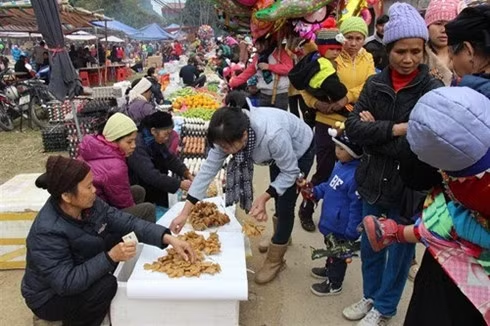
Ho Chi Minh City resident Nguyen Kieu Lam and her two sons recently visited the northern province of Cao Bang. They wanted to see the famous, historic Pac Bo cave and the Ban Gioc Waterfall. A couple of festivals at the King Le and Na Sam temples were also part of their itinerary.

“We enjoyed the beautiful landscapes everywhere, but what stands out for us as most special are the tasty dishes served by the Tay or Nùng ethnic minority vendors at traditional festivals,” Lam said.

She said her two sons could not have enough of a dish called lon quay (roast pig). The pieces were soft and its golden red or reddish brown skin so crispy that they wanted to eat more even after finishing of a large portion.

Lam’s elder son Ho Nguyen Ngoc said it was the first time that he was enjoying such an aromatic and tasty dish, the fragrance of the dipping sauce made with mac mat leaves (a kind of wild wampee tree found in the province) making it very special.

He asked Nong Ich Lai, a Tay man in Hoa An district (about 15km from the downtown Cao Bang city), to please reveal what made the dish so irresistible.

Lai, who has sold lon quay for more than 20 years at festivals in his district and in the city, was kind enough to indulge Ngoc.

Lai said that before Tet arrived, he would go to remote communes in Nguyen Binh district to buy organic pigs of about 20-25kg per pig each and raise them at home.

“I mix the mac mat leaves with dried onions,  garlic, fish sauce, salt, and a pinch of traditionally made spice and put all the dumplings in the pig’s belly and sew it well before pouring a small cup of wild honey on the pig.”

He said roasting technique was rather difficult. The pig had to be turned regularly over a wood charcoal fire for about three hours. If it was not done properly, the pig could get burned, the meat could become dry and the skin would not be crispy.

Apart from lon quay, Lam and her sons also tasted ngai cuu and mo me xu hec cakes made by the Tay and Nung ethnic groups in the province.

Lai’s neighbor Doan Thi Huyen, a famous wampee cake maker in the district, got the recipe from her grandmother.

“I have to wake up very early in the morning to pick up the wampee fruit from my garden to ensure its freshness and then boil it in a special “ashes water” for between two and three hours until it is well-cooked.

“Then the ngai cuu leaves should be carefully washed and then mixed with glutinous rice powder. The cake’s dumpling is a mix of ground fried black sesame and cane sugar,” Huyen.

The cake can be steamed or fried, but steamed is healthier, she said.

Lam said she enjoyed the cake’s combination of fragrant glutinous rice powder and the special flavor of ngai cuu leaves “so much.”

“I could feel it cooling my body and satisfying craving taste,” Lam said.

Local herbalist Ta Ngoc Oanh, 70, said the leaves are particularly good for pregnant women and the elderly.

The leaves, apart from being nutritious, help reduce pain from injury, provide relief from itching, and is good for treating colds and headaches, as also improve blood circulation, Oanh said.

“I’ve used the leaves to treat my patients, and many of them with these ailments have recovered,” he said, reiterating that the ngai cuu cake is very good for human’s health.

Oanh’s wife, Nong Thi Tieu is famous for her mo me xu hec, a traditional cake made by the Tay and Nung people.

This cake is also made from glutinous rice but knead into the shapes of animals such as buffalo, cow, pig, dog, cat, and bird. After kneading and shaping, the cakes are pan fried either in vegetable oil or pork fat. The crispy, chewy and sweet taste makes these cakes very popular at local festivals.

Tieu said her mother taught her to make to the cakes when she was a little girl. “It sells particularly well at festivals. Children enjoy it a lot.”

VNA

Other News

Vietnam secure berth at FIFA U17 World Cup 2026 for first time

Vietnam secure berth at FIFA U17 World Cup 2026 for first time

Vietnam national U17 football team secured a place at the FIFA U17 World Cup 2026 for the first time after defeating United Arab Emirates national U17 football team 3-2 on in the final Group C match of the AFC U17 Asian Cup 2026 in Saudi Arabia on early May 14 (Vietnam time).

Vietnam’s most beautiful railway station twins with French counterpart

Vietnam’s most beautiful railway station twins with French counterpart

A twinning agreement between Da Lat Railway Station in Vietnam and Trouville-Deauville Railway Station in France was signed at the French Embassy in Vietnam on May 7, creating new opportunities for cooperation in station management and operations, as well as cultural and tourism promotion between the two sides.

Hanoi gains two more craft villages in World Crafts Cities network

Hanoi gains two more craft villages in World Crafts Cities network

The recognition of Chuyen My and Son Dong craft villages as members of the World Crafts Cities network represents international acknowledgement of the cultural value, artisanal techniques, creativity and sustainable vitality of Vietnam’s traditional craft villages, he said.

Thang Long - Hanoi Festival 2026 to return in September

Thang Long - Hanoi Festival 2026 to return in September

Co-hosted by the municipal People’s Committee, the Department of Culture and Sports, and domestic and foreign agencies, the whole spectacle is meant to honour the city’s millennia-old heritage while reafffirming its strategy of establishing culture as a development engine.

Spreading Vietnamese cultural identity in digital space

Spreading Vietnamese cultural identity in digital space

In the context of deep international integration, cultural identity serves as both a “shield” against assimilation and a defining marker of a nation’s image. Protecting and promoting uniquely Vietnamese cultural values has therefore become a pressing task, particularly in an increasingly complex digital environment.

ITE HCMC 2026 to promote Vietnam’s tourism on global map

ITE HCMC 2026 to promote Vietnam’s tourism on global map

With its large scale, the ITE HCMC 2026 aims to promote tourism cooperation between Vietnam and priority markets such as Northeast Asia, Western Europe, North America, Southeast Asia, and Oceania while also boosting visitor arrivals from the Indian market

Vietnamese puppetry seeks renewal amid preservation challenges

Vietnamese puppetry seeks renewal amid preservation challenges

Although widely regarded as a cultural “speciality” attracting tourists, Vietnamese puppetry is facing multiple challenges in preservation and development, requiring renewed efforts to both safeguard its identity and adapt to contemporary cultural currents.

Project on digital transformation in cultural sector approved

Project on digital transformation in cultural sector approved

By 2030, the project targets the establishment of shared digital platforms across 100% of cultural sectors. All digitised cultural heritage will be standardised under the national data framework and shared in accordance with regulations, while 80% of public digital heritage assets are expected to receive digital identifiers to clarify ownership and management, encouraging organisations and individuals to do the same and support market development.

Vietnam eyes becoming region’s leading tourism destination

Vietnam eyes becoming region’s leading tourism destination

Vietnam has in recent years undergone a notable transformation in its tourism development strategy, placing a strong emphasis on nature-based and eco-tourism. This shift is not merely aligned with global trends, but represents a necessary step towards safeguarding valuable natural resources, while appealing to a growing segment of environmentally conscious travellers.