AO/dioxin victims in Can Tho, Tien Giang receive support

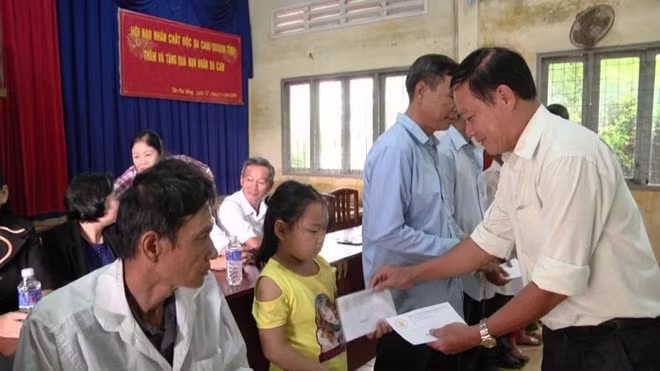
The Association of Agent Orange/dioxin Victims in Can Tho city on August 7 presented gifts to dioxin victims and their families on the occasion of the 57th anniversary of the Day for AO/dioxin Victims (August 10)
AO/dioxin victims and their families in Tien Giang granted with gifts (Source: thtg.vn)

AO/dioxin victims and their families in Tien Giang granted with gifts (Source: thtg.vn)

Specifically, the association granted 200 gifts to dioxin victims, 125 scholarships worth 500,000 VND (21.5 USD) each to students who are children or grandchildren of AO victims, and handed over 10 houses to families with members affected by AO/dioxin.

The association also granted certificates of merit and insignias to 50 outstanding dioxin victims who have made great contributions to the community.

At the granting ceremony, organisations, businesses and individuals donated a total of nearly 750 million VND (32,200 USD) to the Mekong Delta city’s fund for AO victims in 2018.

The association’s President Tran Lien Kieu said that to help ease the pain of dioxin victims and their families, the association will continue making proposals to municipal authorities to promptly give assistance to revolution contributors and dioxin victims, and canvass support from donors for the disadvantaged.

The association will work to increase monthly allowances and better social protection policies for them, she added.

Can Tho city is now home to around 4,500 AO/dioxin victims, including 1,200 victims who cannot take care of themselves, and over 600 children aged under 16.

In the first half of 2018, the association mobilised more than 4 billion VND (172,000 USD) in support for dioxin victims.

On this occasion, the Association of AO/dioxin Victims of southern Tien Giang province also presented 300 gifts worth 400,000 VND (17.2 USD) each to dioxin victims.

According to the association, there are 10,736 people affected by AO/dioxin in Tien Giang. The provincial association set a target of collecting 35 billion VND (1.5 million USD) during 2018-2023 to assist the victims.

The US army sprayed some 80 million litres of toxic chemicals, 61 percent of which was Agent Orange containing 366 kilograms of dioxin, over nearly one quarter of the total area of South Vietnam from 1961 to 1971.

Preliminary statistics showed that 4.8 million Vietnamese people were exposed to Agent Orange/dioxin, and about 3 million people became victims. Tens of thousands of people have died while millions of others have suffered from cancer and other incurable diseases as consequences of  exposure. Many of their offspring have also suffered from birth deformities.
VNA

Other News

Hanoi ready to implement Capital Law 2026, unlocking new development momentum

Hanoi ready to implement Capital Law 2026, unlocking new development momentum

The effectiveness of the Capital Law 2026 will be measured not by the number of legal documents issued but by tangible improvements in governance and public administration, better services for people and businesses, faster administrative procedures, stronger investment attraction and higher economic growth.

Vietnamese students earn honours at ROBOG Asia Cup 2026

Vietnamese students earn honours at ROBOG Asia Cup 2026

Three teams from Chu Van An Secondary School in Vietnam’s Thai Nguyen province have earned First Prize honours and advanced to the quarterfinals at the ROBOG Asia Cup 2026, a regional robotics and artificial intelligence (AI) competition for students held in Hong Kong, China.

Hanoi sets out new investment blueprint with century-long development vision

Hanoi sets out new investment blueprint with century-long development vision

As of early June, Hanoi had attracted 74.6 billion USD in foreign direct investment (FDI) through more than 9,250 valid projects. FDI inflows in the first six months were projected at 3.2 billion USD, surpassing the annual target by 116%, while nearly 16,000 new businesses were established in the first five months, up 34.4% year-on-year.

Vietnam promotes legal cooperation and rule of law at global forum

Vietnam promotes legal cooperation and rule of law at global forum

Vietnam’s development and international integration have gone hand in hand with the improvement of its legal system, the incorporation of international commitments into domestic legislation, and legal reforms aimed at fostering development, openness and global integration. The country regards international law as an essential instrument for building fair, mutually beneficial relations among nations.

Hanoi to hold investment promotion event on June 29

Hanoi to hold investment promotion event on June 29

At the event, Hanoi authorities plan to grant investment policy decisions and investment registration certificates to 20 exemplary projects in the fields of transportation infrastructure, industrial parks, urban development, social housing, environment, science and technology, and foreign investment attraction.

Hanoi's Red River urban area development draws widespread attention

Hanoi's Red River urban area development draws widespread attention

Located south of the Red River and extending from the historic inner city to newly developing areas in the south and the west, the central urban area along Red River’s right bank covers approximately 45,317 hectares and is projected to accommodate around 6.365 million residents by 2045 and 6.455 million by 2065.

Hanoi's Red River urban area development draws widespread attention

Hanoi's Red River urban area development draws widespread attention

Located south of the Red River and extending from the historic inner city to newly developing areas in the south and the west, the central urban area along Red River’s right bank covers approximately 45,317 hectares and is projected to accommodate around 6.365 million residents by 2045 and 6.455 million by 2065.

Regional cooperation strengthened to combat cross-border drug crime

Regional cooperation strengthened to combat cross-border drug crime

Vietnam, China, Laos and Myanmar face common challenges as drug syndicates increasingly exploit the Mekong River, cross-border transport networks, e-commerce platforms, international logistics services, cyberspace and cryptocurrencies to organise drug transactions and smuggling operations.