Australia and UNDP support Vietnam in promoting better governance and public administration

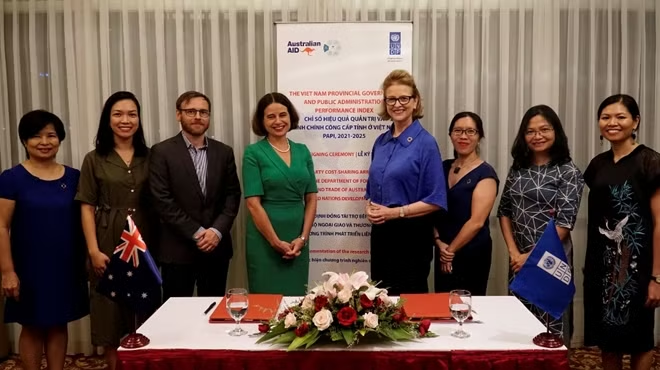
PSNews - Australia’s Department for Foreign Affairs and Trade (DFAT) and the UN Development Programme (UNDP) have signed a Funding Agreement for Australia to make an additional contribution of AUD 9.7 million over four years (2021-2025) to the on-going programme “Viet Nam Provincial Governance and Public Administration Performance Index” (PAPI), implemented through UNDP.

On this occasion, H.E. Ms. Robyn Mudie, Australian Ambassador to Viet Nam, reiterated Australia’s strong support to Viet Nam to promote better governance and public administration at the provincial level, especially in response to COVID-19. “We are very impressed that PAPI has evolved as Viet Nam has changed over the years. PAPI now includes e-government and environment indicators, showing that it is responding to the situation in the country,” Ambassador Mudie said.  
PAPI is a policy monitoring tool that reflects citizen experiences with central to local governments in performing their governance, public administration and public service delivery functions. Since its debut in 2009, PAPI has collected the voices of 131,501 citizens (with 52% being women and 16% being ethnic minorities) who were randomly selected from across the country for face-to-face interviews. Every year since 2011, around 14,000 citizens from different demographic backgrounds have provided their feedback about their local governance performance.

Australia has been the main donor for PAPI since 2018. Thanks to this support, PAPI has continued to make substantial impact at various levels. All 63 provinces across Viet Nam have organized PAPI diagnostic workshops to track how their local government agencies have been doing on governance and public administration. Nearly all provinces have issued resolutions, action plans or directives to directly respond to PAPI findings. 

More importantly, PAPI helps Viet Nam gauge how the country moves towards realizing its commitment to the 2030 Agenda on Sustainable Development, especially in the areas of democratic governance and inclusive institutions.

UNDP Resident Representative in Viet Nam Caitlin Wiesen highlighted that “the significant financial contribution from Australia will help the PAPI programme increase support for better governance and public administration in Viet Nam.” She added that “the funding comes at a critical time for Viet Nam as the country gears up for recovery from the COVID-19 pandemic. UNDP will work with our national partners to support provinces in improving governance and promote more accountable and responsive institutions in Viet Nam”. 

PSNews

Other News

Hanoi ready to implement Capital Law 2026, unlocking new development momentum

Hanoi ready to implement Capital Law 2026, unlocking new development momentum

The effectiveness of the Capital Law 2026 will be measured not by the number of legal documents issued but by tangible improvements in governance and public administration, better services for people and businesses, faster administrative procedures, stronger investment attraction and higher economic growth.

Vietnamese students earn honours at ROBOG Asia Cup 2026

Vietnamese students earn honours at ROBOG Asia Cup 2026

Three teams from Chu Van An Secondary School in Vietnam’s Thai Nguyen province have earned First Prize honours and advanced to the quarterfinals at the ROBOG Asia Cup 2026, a regional robotics and artificial intelligence (AI) competition for students held in Hong Kong, China.

Hanoi sets out new investment blueprint with century-long development vision

Hanoi sets out new investment blueprint with century-long development vision

As of early June, Hanoi had attracted 74.6 billion USD in foreign direct investment (FDI) through more than 9,250 valid projects. FDI inflows in the first six months were projected at 3.2 billion USD, surpassing the annual target by 116%, while nearly 16,000 new businesses were established in the first five months, up 34.4% year-on-year.

Vietnam promotes legal cooperation and rule of law at global forum

Vietnam promotes legal cooperation and rule of law at global forum

Vietnam’s development and international integration have gone hand in hand with the improvement of its legal system, the incorporation of international commitments into domestic legislation, and legal reforms aimed at fostering development, openness and global integration. The country regards international law as an essential instrument for building fair, mutually beneficial relations among nations.

Hanoi to hold investment promotion event on June 29

Hanoi to hold investment promotion event on June 29

At the event, Hanoi authorities plan to grant investment policy decisions and investment registration certificates to 20 exemplary projects in the fields of transportation infrastructure, industrial parks, urban development, social housing, environment, science and technology, and foreign investment attraction.

Hanoi's Red River urban area development draws widespread attention

Hanoi's Red River urban area development draws widespread attention

Located south of the Red River and extending from the historic inner city to newly developing areas in the south and the west, the central urban area along Red River’s right bank covers approximately 45,317 hectares and is projected to accommodate around 6.365 million residents by 2045 and 6.455 million by 2065.

Hanoi's Red River urban area development draws widespread attention

Hanoi's Red River urban area development draws widespread attention

Located south of the Red River and extending from the historic inner city to newly developing areas in the south and the west, the central urban area along Red River’s right bank covers approximately 45,317 hectares and is projected to accommodate around 6.365 million residents by 2045 and 6.455 million by 2065.

Regional cooperation strengthened to combat cross-border drug crime

Regional cooperation strengthened to combat cross-border drug crime

Vietnam, China, Laos and Myanmar face common challenges as drug syndicates increasingly exploit the Mekong River, cross-border transport networks, e-commerce platforms, international logistics services, cyberspace and cryptocurrencies to organise drug transactions and smuggling operations.