Can Gio Mangrove biosphere reserve

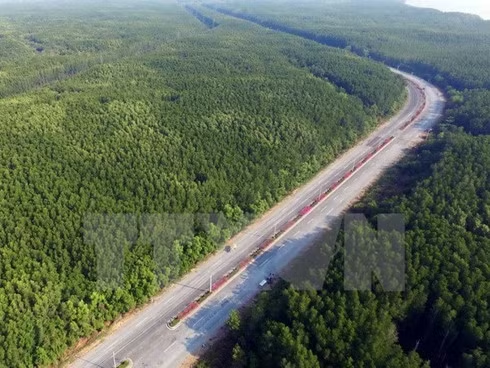
Nearly 60 kilometres away from the centre of Ho Chi Minh City, Can Gio Mangrove has been recognised by UNESCO as a World Biosphere Reserve with primeval forests and abundant floral cover. It was also the sight of a number of glorious battles in the past.

Can Gio Mangrove Biosphere Reserve covers over 70,000 hectares, occupying one-third of Ho Chi Minh City’s total area. It is located in Can Gio district, previously Duyen Hai district. The area is situated in a recently formed estuary complex of tidal flats, where the Vam Co, Sai Gon and Dong Nai rivers discharge into the sea. 

Historically, this land, also known as Sac Forest Guerrilla Base, was a key battleground in the two resistance wars against the French and US aggressors.

It had been devastated by US toxic chemicals that turned the zone into an uninhabited land. 

After the war ended, the uninhabited mangrove forests have gradually been invigorated and its beauty and magnificence have returned thanks to the hard work of local people.
Tourists to the site are offered an insight into Sac Forest soldiers’ military feats in the past.
Senior Lieutenant Colonel Tran Ngoc Soan, Sac Forest Commando, joined in the war in 1965. “At that time, the forest was full of mangroves and avicennia marinas, not just the mangroves as it is now,” he said.
One year later, the US sprayed toxic chemicals that made the trees die and digging tunnel as base difficult. So, Soan and his comrades had to row a boat to the forest. Since 1967, toxic chemicals have ruined the forest, making it nude. They, as a result, had to travel on foot instead. 
Tents and infirmaries have been depicted to make the scene as realistic as possible, moving many of the visiting former soldiers. 
Every time returning the base, Lieutenant Vo Duy Tan of Regiment 10 remembered sharing joys and sorrows with his comrades in the hardest time.
Besides facing enemies, Sac Forest commandoes faced unanticipated dangers from crocodiles and shortages of rice and fresh water.
The Sac Forest Military Zone, also known as Regiment 10, was founded in April 1966. During the next nine years, 860 of more than 1,000 soldiers laid down their lives on the field. 
From 1962 to 1971, Sac Forest had been nearly destroyed by US weed clearing substances in conjunction with vast deforestation. Since 1985, great joint efforts by Ho Chi Minh City’s authorities and people have been made to reinvigorate thousands of hectares of the forest.
The forest is rich in biodiversity values. There are 52 true and associate mangrove species, 200 animal species, hundred fish and over 40 bird species. 
The major habitat types found at Can Gio are plantation mangrove, of which there is about 20,000 ha, and naturally regenerating mangrove, of which there is about 7,000 ha.  
A total of 18 mollusc, 27 crustacean, 45 fish and three amphibian species have been recorded at the site. There are anecdotal reports of local farmers shooting an Estuarine Crocodile Crocodylus porosus at the site in around 1990, although there have been no records since then. Also, Dugong has been reported to occur seasonally in sea-grass beds at the site, although these reports have not been confirmed.
The mangrove forest at Can Gio performs many valuable ecological functions, including coastal stabilisation, and protection against coastal erosion, oil spills and storm surges. The mangrove forest is a source of fuelwood and construction materials.
Being close to Ho Chi Minh City, Can Gio Biosphere Reserve has great potential as a site for tourism, public education, scientific research and training. Already, the site receives a large number of visitors from Ho Chi Minh City. It could also serve as a demonstration site for mangrove afforestation projects elsewhere in Vietnam.
Added to this, it has been seen as the city’s “green lung”, contributing to minimising the impacts of climate change.
VNA

Other News

Vietnam steps up implementation of ethnic affairs strategy through 2030

Vietnam steps up implementation of ethnic affairs strategy through 2030

To accelerate the implementation of the the Ethnic Affairs Strategy by 2030, with a vision toward 2045, the Prime Minister requested ministries, agencies and local authorities to continue thoroughly carrying out the Party and State’s policies on ethnic affairs, enhancing the effectiveness of State management and strengthening oversight of policy implementation.

Security preparations reviewed for APEC 2027 in Phu Quoc

Security preparations reviewed for APEC 2027 in Phu Quoc

The team examined the APEC 2027 Convention Centre, where main conference activities are scheduled; Sun Serenia Hospital, designated to provide healthcare and emergency medical services for delegates; provincial road DT.975, which connects Phu Quoc International Airport to the convention centre; and the area surrounding Phu Quoc International Airport.

Hanoi accelerates seven Red River bridge projects, many exceed 70% completion

Hanoi accelerates seven Red River bridge projects, many exceed 70% completion

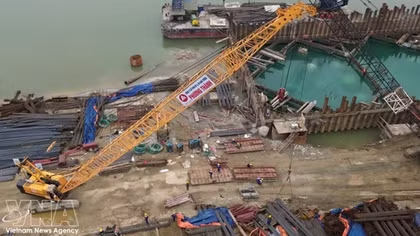
According to the municipal Transport Construction Investment Project Management Board, the city is simultaneously implementing seven projects, namely Tu Lien, Ngoc Hoi, Tran Hung Dao, Thuong Cat, Van Phuc, Hong Ha and Me So bridges. Construction is being carried out on multiple fronts, focusing on bored piles, pile caps, piers and superstructure works.

Dien Bien battlefield legacy powers tourism revival

Dien Bien battlefield legacy powers tourism revival

Seventy-two years after the Dien Bien Phu Victory, its legacy still reverberates. The unity, self-reliance, and resilience forged in that historic triumph remain a powerful internal engine, now propelling Dien Bien toward fast and sustainable development.

Hanoi accelerates shift to green buses, targets 100% by 2030

Hanoi accelerates shift to green buses, targets 100% by 2030

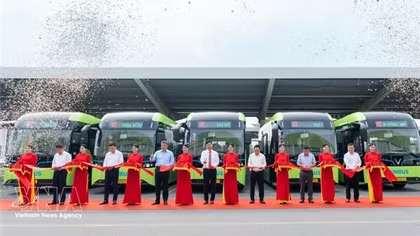
In the 2027–2030 period, the city will accelerate the transition towards the complete phase-out of fossil fuel-powered buses. The share of electric and green energy-fueled buses is projected to reach 79–89% by 2029 and 100% by 2030.

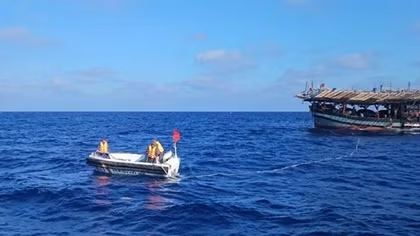
36 fishermen safely rescued after boat breaks down near Truong Sa

36 fishermen safely rescued after boat breaks down near Truong Sa

At 8:00 the same day, KN475 began towing the disabled fishing boat toward Da Tay A island. The towing operation was carried out safely, and by 18:30 both the vessel and its crew had arrived at the island without incident, where repairs and additional support procedures were arranged.

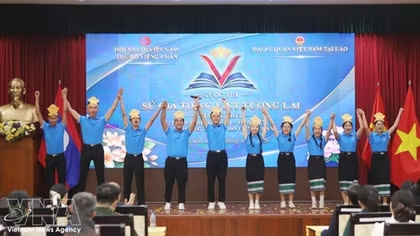
Vietnamese language contest in Laos strengthens youth ties, bilateral friendship

Vietnamese language contest in Laos strengthens youth ties, bilateral friendship

Held in response to the launch of the Vietnamese Language Day among overseas Vietnamese communities, the event aimed to enhance the quality of Vietnamese language teaching and learning in Laos while contributing to the great friendship, special solidarity, comprehensive cooperation and strategic cohesion between the two countries.

Vietnamese language contest in Laos strengthens youth ties, bilateral friendship

Vietnamese language contest in Laos strengthens youth ties, bilateral friendship

Held in response to the launch of the Vietnamese Language Day among overseas Vietnamese communities, the event aimed to enhance the quality of Vietnamese language teaching and learning in Laos while contributing to the great friendship, special solidarity, comprehensive cooperation and strategic cohesion between the two countries.

Hanoi launches 10 electric bus routes from April 1

Hanoi launches 10 electric bus routes from April 1

By the end of April, the number of buses using electricity and other green energy sources in the city is expected to reach 822, including 683 electric buses and 139 compressed natural gas (CNG) buses, representing 42.1% of the total number of vehicles.