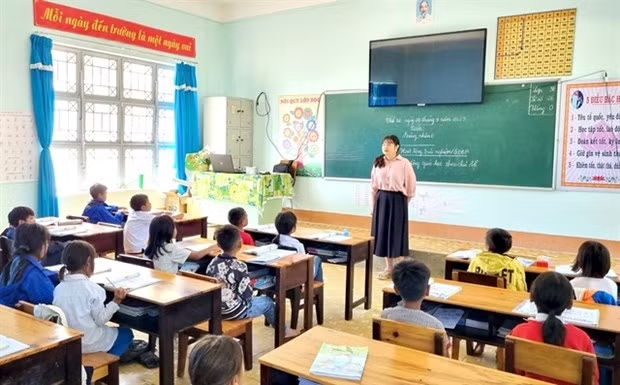
The Central Highlands region is facing a severe shortage of teachers at all educational levels, seriously affecting the universalisation of education for local people, especially ethnic minority people.
Statistics from the Education and Training departments of five provinces in the region show that the region lacks more than 6,500 teachers at all educational levels.
Gia Lai province is the locality having the most serious shortage of teachers, with more than 3,000. The kindergarten level lacks 1,231 teachers, primary school level lacks 817 teachers, secondary school level lacks 660 teachers and high school level lacks 308 teachers.
In the meantime, Dak Lak province is reported to lack 1,700 teachers at all educational levels.
Kon Tum province now lacks 836 teachers, mainly in districts of Ia H’Drai, Dak To and Dak Glei, while Dak Nong province is in a shortage of over 1,000 teachers.
Le Thi Kim Oanh, deputy director of Dak Lak province’s Education and Training Department, said the number of students increasing year after year exacerbated the lack of teachers in the locality.
Nguyen Van Toan, director of Dak Nong province’s Education and Training Department, said the total number of students in the 2023 - 24 school year in the province was nearly 183,000, an increase of more than 7,000 children compared to the previous school year, while there was only over 11,000 teachers in the province.
Pham Thi Trung, director of Kon Tum province’s Education and Training Department, said the number of students had continuously increased over the past ten years in the province. However, the local education sector still had to carry out downsizing the staff number, as regulated.
“It is believed to be one of the main causes of the situation,” she said.
She also said that the province was having difficulty recruiting new teachers, mainly preschool and primary school teachers in some remote districts such as Kon Plong, Tu Mo Rong and Dak Glei.
The main reason was that the 2019 Law on Education raised the requirements for preschool teachers to be college graduates, and for primary teachers to be university graduates, instead of intermediate level as before.
However, the reality was that students who meet the requirements often applied to work in localities with more favourable socio-economic conditions rather than in remote areas, she added.
Even when local schools already recruited teachers, they were still not sure the teachers could work for a long time because of the difficult and complex conditions of the local terrain.
Nguyen Minh Cuong, head of the Education and Training Office in Kon Plong district, Kon Tum province, said the education sector recorded about 150 teachers quitting their jobs in the district and moving to other localities with more favourable conditions to work.
Low income is also worsening the situation.
Y Gia Nhi, of Tu Mo Rong district in Kon Tum province, said she was recruited as a primary teacher in the district with a salary of 3 million VND (122 USD) per month.
Nhi said the salary she earned was not enough to cover daily costs. Therefore, Nhi decided to quit her job after three years. Then she found a job abroad with an income many times higher compared to a primary teacher’s salary to earn a living.
Nguyen Thi Tam, a literature teacher at Tran Quang Dieu Secondary School, Buon Ma Thuot city, Dak Lak province, said the current salary and allowances for teachers were still low, not ensuring a minimum living. So the authorities were requested to increase salary and allowances for teachers in the future.
Ton Thi Ngoc Hanh, deputy chairwoman of the People's Committee of Dak Nong province, also said salary and allowance policies for teachers were still inadequate, leaving schools unable to attract teachers.
To temporarily overcome the shortage of teachers, the Home Affairs Department of Dak Nong province has coordinated with relevant agencies to plan to recruit more than 600 teachers working under short-term contracts.
Huynh Viet Trung, head of the Education and Training Office of Krong Bong district, Dak Lak province, said the locality had merged small schools’ branches in an attempt to fix the shortage of teachers.
Nguyen Tu Do, head of the Education and Training Office in Cu Mgar district in Dak Lak province, said that the office had temporarily arranged for some teachers to work at several schools as a short-term solution for the situation.
Y Nhan, deputy head of the Education and Training Office of Tu Mo Rong district, Kon Tum province, said better remuneration policies for teachers, especially in remote areas, were required to fix the situation.
One of the immediate solutions was to be more flexible in implementing the 2019 Law on Education, she said.
It was suggested to allow the region to recruit teachers with college and intermediate degrees to work at primary school and preschool, however, the teachers had to commit to study at higher levels to meet the requirements in the near future, she said.
Only then could difficult areas attract more teachers to work, she added.
In the long term, Hanh, deputy chairwoman of the People's Committee of Dak Nong province, said the province had proposed the Ministry of Education and Training soon adjust salary and allowance policies for teachers, especially for those working in disadvantaged and remote areas.
Besides, the province also requested the ministry to allocate an additional 1,021 teachers to serve the province’s current demand, as well as prioritise resources to invest in facilities and teaching equipment so the province could better implement the new general education curriculum, she said.
The mechanism needed to be more flexible and suitable to the situation, especially for the Central Highlands provinces, she said.
The regulations on downsizing education staff by 10 per cent during the period of 2021-26 should not be applied to the region, she said.