Ceremonial costume and gift for leaders at APEC 2017: The essence of Vietnam’s traditional crafts

The making of the ceremonial costume and the special gift for leaders at the APEC Vietnam 2017 shows the quintessence of traditional crafts from the host country.

The heads of state attending APEC 2017 were made to wear a long-sleeve shirt, which is made of Vietnamese best quality silk. The shirt, designed by Nguyen Thi Thu Ha and tailored by Do Manh Hung, is hand-weaved and hand-dyed by artisan Nguyen Trong Tu, using his family’s traditional, secret technique.

The unique dying and weaving technique bring a sharp colour to the costume, which are available in two colours, deep blue and ivory white. Traditional Vietnamese silk also ensures a comfort and ventilation for wearers in the tropical heat of central Vietnam.
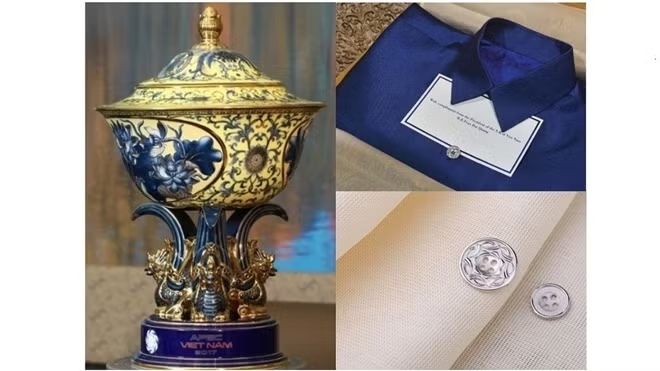
The shirt’s buttons are carved with 21 modified sun rays, representing 21 APEC economies. The sun rays are interlocked into a ring to symbolise the close connection and solidarity of APEC. Inside the ring features stylised images of oars and lac birds, a symbol found on ancient Dong Son bronze drum, aiming to highlight Vietnam’s rich and long-standing culture.

The shirt is wrapped in a box, which is made from bamboo – a popular material of Vietnamese people. To make the box, bamboo is carefully processed and flattened to ensure the reliability and aesthetics of the material.

The original colour of bamboo is kept for the box, creating a natural touch for the design. The name of the leader is engraved onto a piece of bronze, which is attached on the box. On the surface of the box is decorated with a lotus, which is inspired from the pattern found in Thang Long Royal Citadel.

The gift bag is made from a unique type of silk with the APEC logo being embroidered, highlighting the solemnity of the uniform.

Ceremonial costume and gift for leaders at APEC 2017: The essence of Vietnam’s traditional crafts ảnh 2

21 APEC Economic Leaders, dressed in Vietnamese silk shirts, and their spouses took a family photo together on the evening of 10 December, in Da Nang. (Photo: apec2017.vn)

Meanwhile, a jade cup, a product of Minh Long 1 Co., Ltd., was chosen as the official gift by the Government to leaders at APEC 2017. On top of the cup sits a yellow lotus bud, referring to the continuous development of a country.

The dominant decorative pattern used in the cup is lotus – the Vietnamese national flower which represents purity and nobility. The cup is also blended with festoons of flowers and leaves of fern, the earliest botanical species on earth.

The upper part of the cup is adorned with a Vietnamese dragon while the symmetric other side is the logo of APEC.

On the foot of the cup are three sculptures of the mascot of Vietnam’s Ly and Tran dynasties, which is a fusion of the dragon and phoenix. The three sculptures are sheered with 24K gold, standing out in the background colour of cobalt blue.

Through products of the country’s traditional crafts, Vietnam’s culture is spotlighted at APEC 2017 while conveying the Vietnamese President’s sincere blessing towards the international guests.
NDO

Other News

Vietnam secure berth at FIFA U17 World Cup 2026 for first time

Vietnam secure berth at FIFA U17 World Cup 2026 for first time

Vietnam national U17 football team secured a place at the FIFA U17 World Cup 2026 for the first time after defeating United Arab Emirates national U17 football team 3-2 on in the final Group C match of the AFC U17 Asian Cup 2026 in Saudi Arabia on early May 14 (Vietnam time).

Vietnam’s most beautiful railway station twins with French counterpart

Vietnam’s most beautiful railway station twins with French counterpart

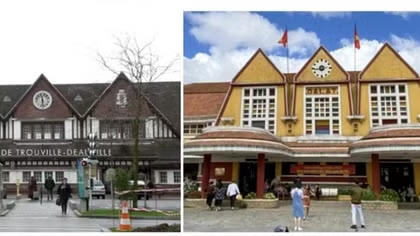
A twinning agreement between Da Lat Railway Station in Vietnam and Trouville-Deauville Railway Station in France was signed at the French Embassy in Vietnam on May 7, creating new opportunities for cooperation in station management and operations, as well as cultural and tourism promotion between the two sides.

Hanoi gains two more craft villages in World Crafts Cities network

Hanoi gains two more craft villages in World Crafts Cities network

The recognition of Chuyen My and Son Dong craft villages as members of the World Crafts Cities network represents international acknowledgement of the cultural value, artisanal techniques, creativity and sustainable vitality of Vietnam’s traditional craft villages, he said.

Thang Long - Hanoi Festival 2026 to return in September

Thang Long - Hanoi Festival 2026 to return in September

Co-hosted by the municipal People’s Committee, the Department of Culture and Sports, and domestic and foreign agencies, the whole spectacle is meant to honour the city’s millennia-old heritage while reafffirming its strategy of establishing culture as a development engine.

Spreading Vietnamese cultural identity in digital space

Spreading Vietnamese cultural identity in digital space

In the context of deep international integration, cultural identity serves as both a “shield” against assimilation and a defining marker of a nation’s image. Protecting and promoting uniquely Vietnamese cultural values has therefore become a pressing task, particularly in an increasingly complex digital environment.

ITE HCMC 2026 to promote Vietnam’s tourism on global map

ITE HCMC 2026 to promote Vietnam’s tourism on global map

With its large scale, the ITE HCMC 2026 aims to promote tourism cooperation between Vietnam and priority markets such as Northeast Asia, Western Europe, North America, Southeast Asia, and Oceania while also boosting visitor arrivals from the Indian market

Vietnamese puppetry seeks renewal amid preservation challenges

Vietnamese puppetry seeks renewal amid preservation challenges

Although widely regarded as a cultural “speciality” attracting tourists, Vietnamese puppetry is facing multiple challenges in preservation and development, requiring renewed efforts to both safeguard its identity and adapt to contemporary cultural currents.

Project on digital transformation in cultural sector approved

Project on digital transformation in cultural sector approved

By 2030, the project targets the establishment of shared digital platforms across 100% of cultural sectors. All digitised cultural heritage will be standardised under the national data framework and shared in accordance with regulations, while 80% of public digital heritage assets are expected to receive digital identifiers to clarify ownership and management, encouraging organisations and individuals to do the same and support market development.

Vietnam eyes becoming region’s leading tourism destination

Vietnam eyes becoming region’s leading tourism destination

Vietnam has in recent years undergone a notable transformation in its tourism development strategy, placing a strong emphasis on nature-based and eco-tourism. This shift is not merely aligned with global trends, but represents a necessary step towards safeguarding valuable natural resources, while appealing to a growing segment of environmentally conscious travellers.