Cost overruns found in major Hanoi projects

The Government Inspectorate (GI) has released findings of egregious wrongdoing in the implementation of a number of BT (Build-Transfer) and BOT (Build-Operate-Transfer) infrastructure and environmental projects in Ha Noi City.
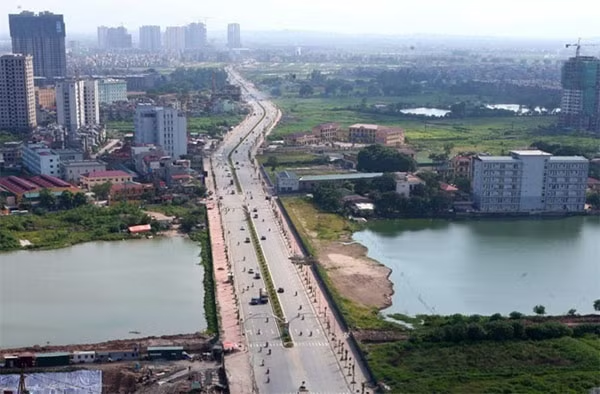
A view of the extension of Le Van Luong Street in the urban district of Thanh Xuan, southwest of Ha Noi. Photo: VNA/VNS

The GI recommended holding Ha Noi authorities accountable for the faults.

The GI said all BT projects were behind schedule and had entailed significant cost overruns. It said contractors were “not sufficiently capable of mobilising capital” and also blamed a “failure to disburse budget in accordance with set schedule.”

Seven BT projects caused massive loss – the construction of the Yen So wastewater treatment plant, the Le Van Luong Road extension, the southern main road of Ha Tay, a street connecting Le Duc Tho and the new urban area Xuan Phuong, a road surrounding the Chu Van An memorial site, and the Ha Noi–Hung Yen interprovincial road.

Regarding the main southern road of Ha Tay, nearly all parties involved – the People’s Committee, Department of Finance, Department of Transport, and the investor – were found to be at fault and violating the BT contract terms.

The GI also reported that the investor has misappropriated large amounts of State budget. The state-owned Civil Engineering Construction Corporation No.5 (CIENCO5) – responsible for the project – was asked to “immediately” pay back VND1.428 trillion ($62.8 million) to the State budget - VND902 billion in interest expenses and VND510 billion for the difference between land use costs and the actual costs of the BT project.

Regarding the Chu Van An memorial site and Ha Noi–Hung Yen Road and Long Bien District intersection, the GI is asking to cut VND100 billion ($4.4 million) from the balance sheets of these projects.

With projects currently behind schedule, GI is proposing that the Ha Noi People’s Committee order competent agencies to review the capabilities of investors and to decide whether they can continue.

Yen So wastewater treatment plant’s construction began without approval by the Ministry of Construction’s or Ha Noi Department of Science and Technology. More importantly, the quality of post-treatment water “did not satisfy the contract’s terms,” the GI report says.

Most of the infrastructure projects are being carried out within the framework of the "trading land for infrastructure" programme. The programme, implemented in various cities and provinces, enables investors to carry out infrastructure projects and get paid with State land.

However, there was no clearly defined protocol to valuate the land, which easily led to corruption and loss. By 2004 the Government decided to put a stop to this mechanism, replacing it with a bidding requirement. However, the Law on Land 2013 continues to provide legal status to the BT (Build-Transfer) model, which is basically the same as the "trading land for infrastructure" mechanism according to many experts.


Duy Tiến

Other News

Hanoi ready to implement Capital Law 2026, unlocking new development momentum

Hanoi ready to implement Capital Law 2026, unlocking new development momentum

The effectiveness of the Capital Law 2026 will be measured not by the number of legal documents issued but by tangible improvements in governance and public administration, better services for people and businesses, faster administrative procedures, stronger investment attraction and higher economic growth.

Vietnamese students earn honours at ROBOG Asia Cup 2026

Vietnamese students earn honours at ROBOG Asia Cup 2026

Three teams from Chu Van An Secondary School in Vietnam’s Thai Nguyen province have earned First Prize honours and advanced to the quarterfinals at the ROBOG Asia Cup 2026, a regional robotics and artificial intelligence (AI) competition for students held in Hong Kong, China.

Hanoi sets out new investment blueprint with century-long development vision

Hanoi sets out new investment blueprint with century-long development vision

As of early June, Hanoi had attracted 74.6 billion USD in foreign direct investment (FDI) through more than 9,250 valid projects. FDI inflows in the first six months were projected at 3.2 billion USD, surpassing the annual target by 116%, while nearly 16,000 new businesses were established in the first five months, up 34.4% year-on-year.

Vietnam promotes legal cooperation and rule of law at global forum

Vietnam promotes legal cooperation and rule of law at global forum

Vietnam’s development and international integration have gone hand in hand with the improvement of its legal system, the incorporation of international commitments into domestic legislation, and legal reforms aimed at fostering development, openness and global integration. The country regards international law as an essential instrument for building fair, mutually beneficial relations among nations.

Hanoi to hold investment promotion event on June 29

Hanoi to hold investment promotion event on June 29

At the event, Hanoi authorities plan to grant investment policy decisions and investment registration certificates to 20 exemplary projects in the fields of transportation infrastructure, industrial parks, urban development, social housing, environment, science and technology, and foreign investment attraction.

Hanoi's Red River urban area development draws widespread attention

Hanoi's Red River urban area development draws widespread attention

Located south of the Red River and extending from the historic inner city to newly developing areas in the south and the west, the central urban area along Red River’s right bank covers approximately 45,317 hectares and is projected to accommodate around 6.365 million residents by 2045 and 6.455 million by 2065.

Hanoi's Red River urban area development draws widespread attention

Hanoi's Red River urban area development draws widespread attention

Located south of the Red River and extending from the historic inner city to newly developing areas in the south and the west, the central urban area along Red River’s right bank covers approximately 45,317 hectares and is projected to accommodate around 6.365 million residents by 2045 and 6.455 million by 2065.

Regional cooperation strengthened to combat cross-border drug crime

Regional cooperation strengthened to combat cross-border drug crime

Vietnam, China, Laos and Myanmar face common challenges as drug syndicates increasingly exploit the Mekong River, cross-border transport networks, e-commerce platforms, international logistics services, cyberspace and cryptocurrencies to organise drug transactions and smuggling operations.