Dien Bien, once a ferocious battlefield, is undergoing a visible overhaul, with gains in economic growth, poverty reduction, infrastructure, and social welfare that lay the groundwork for a new expansion phase.
Battlefield legacy becomes a tourism pillar
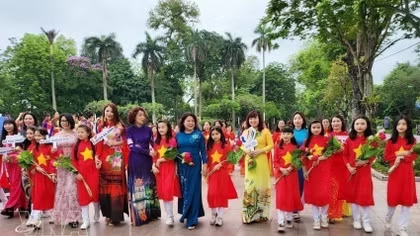
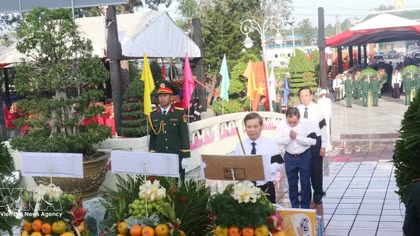
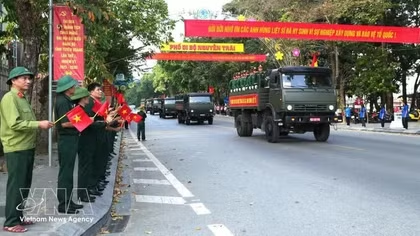
In May, Dien Bien’s streets are draped in flags and flowers, while the landmarks of the Dien Bien Phu campaign, including A1 Hill, De Castries Bunker, the campaign headquarters, and the Victory Museum, pull in crowds of domestic and foreign visitors.
These heritage spaces don’t just recreate a heroic chapter, but serve as “red addresses” to educate younger generations and fuel national pride.
The province has mounted exhibitions of photos, documents, artifacts, and publications on General Vo Nguyen Giap and the Dien Bien Phu Campaign at museums and historic sites. Street performances, film screenings, and mobile information campaigns have added to the buzz, drawing in residents and tourists alike.
From April 25 - May 3, the province welcomed roughly 75,200 visitors, a 25% year-on-year jump, including 14,500 overnight stays, generating about 122 billion VND (4.69 million USD) in revenue.
Following restoration, the Him Lam Resistance Centre, a key site within the special national relic complex, reopened to visitors on April 28.
Dien Bien welcomed more than 1.4 million tourists in 2025, a meaningful contributor to local economic growth. In 2026, it is targeting over 1.6 million visitors, including more than 10,000 foreign arrivals, with total revenue projected at 2.88 trillion VND and an average stay of three days.
Rapid transformation on a heroic land
Locals said the province is changing by the day. Urban roads have been widened and upgraded, schools and healthcare facilities modernised. Trade and services are expanding, lifting living conditions and access.
In rural and remote areas, the transformation is just as visible. Investments in electricity, roads, schools, and health stations are improving livelihoods and supporting production. Boarding schools in border areas, in particular, are being reinforced to raise education quality.
Those changes show up in the data: GRDP grew 7.34% in 2025, industrial production rose more than 10%, and state budget revenue surged nearly 32% year-on-year.
Sustainable poverty reduction efforts have delivered results, with the multidimensional poverty rate falling to around 17.66%, shrinking nearly 4% annually. Tens of thousands of households have received housing, livelihood, and concessional credit support, helping them settle down lives and climb out of poverty.
Socio-economic infrastructure continues to advance. More than 96% of households are connected to the national power grid, and over 92% of rural residents have clean water. Key projects such as Dien Bien Airport and regional transport networks are progressively clearing bottlenecks and opening new investment space.
Leveraging history for sustainable development
The 15th provincial Party Congress’s resolution for 2025–2030 sets a course toward a green, smart, and sustainable model, aiming to turn Dien Bien into a well-developed locality in the region. The province targets annual economic growth of 10–11% and per capita GRDP of 115 million VND by 2030.
To get there, authorities have identified three strategic breakthroughs, including overhauling policies and mechanisms, stepping up administrative reforms, and developing infrastructure as the levers to unlock all possible social resources.
Specifically, “green channel” mechanisms for priority projects slash processing times by 70–90% and smooth the path for investment.
For strategic infrastructure, the Son La–Dien Bien–Tay Trang International Border Gate expressway is expected to tighten regional connectivity and open up new development space.
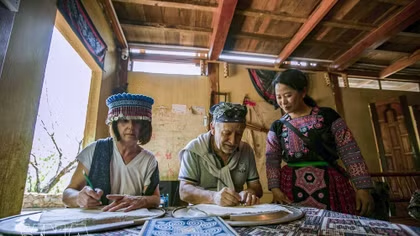
Tourism is expected to serve as an economic pillar, centred on the three engines of historical-spiritual tourism, ethnic cultural identity, and eco-resort tourism. The Dien Bien Phu–Pa Khoang National Tourism Area is flagged as a major project to lift competitiveness and draw visitors.
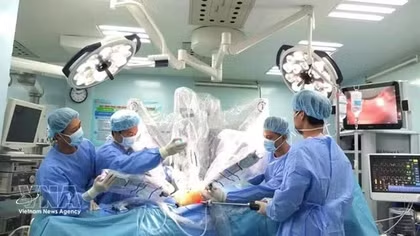
At the same time, the province is targeting breakthroughs in workforce, sci-tech, innovation, and digital transformation. These are seen as long-term, decisive levers to raise productivity and competitiveness, including deploying advanced technologies such as AI in governance and business.
Seventy-two years after the Dien Bien Phu Victory, its legacy still reverberates. The unity, self-reliance, and resilience forged in that historic triumph remain a powerful internal engine, now propelling Dien Bien toward fast and sustainable development.